In 2024, a significant new excavation at Dewars Farm Quarry, situated near Bicester in Oxfordshire, England, yielded a substantial discovery of sauropod dinosaur tracks. This year, a collaborative effort involving paleontologists from the University of Oxford, the University of Birmingham, Liverpool John Moores University, and the Oxford University Museum of Natural History unearthed approximately 200 additional footprints, coalescing into four distinct trackways. Notably, one of these trackways represents the longest sauropod dinosaur trackway documented in Europe.
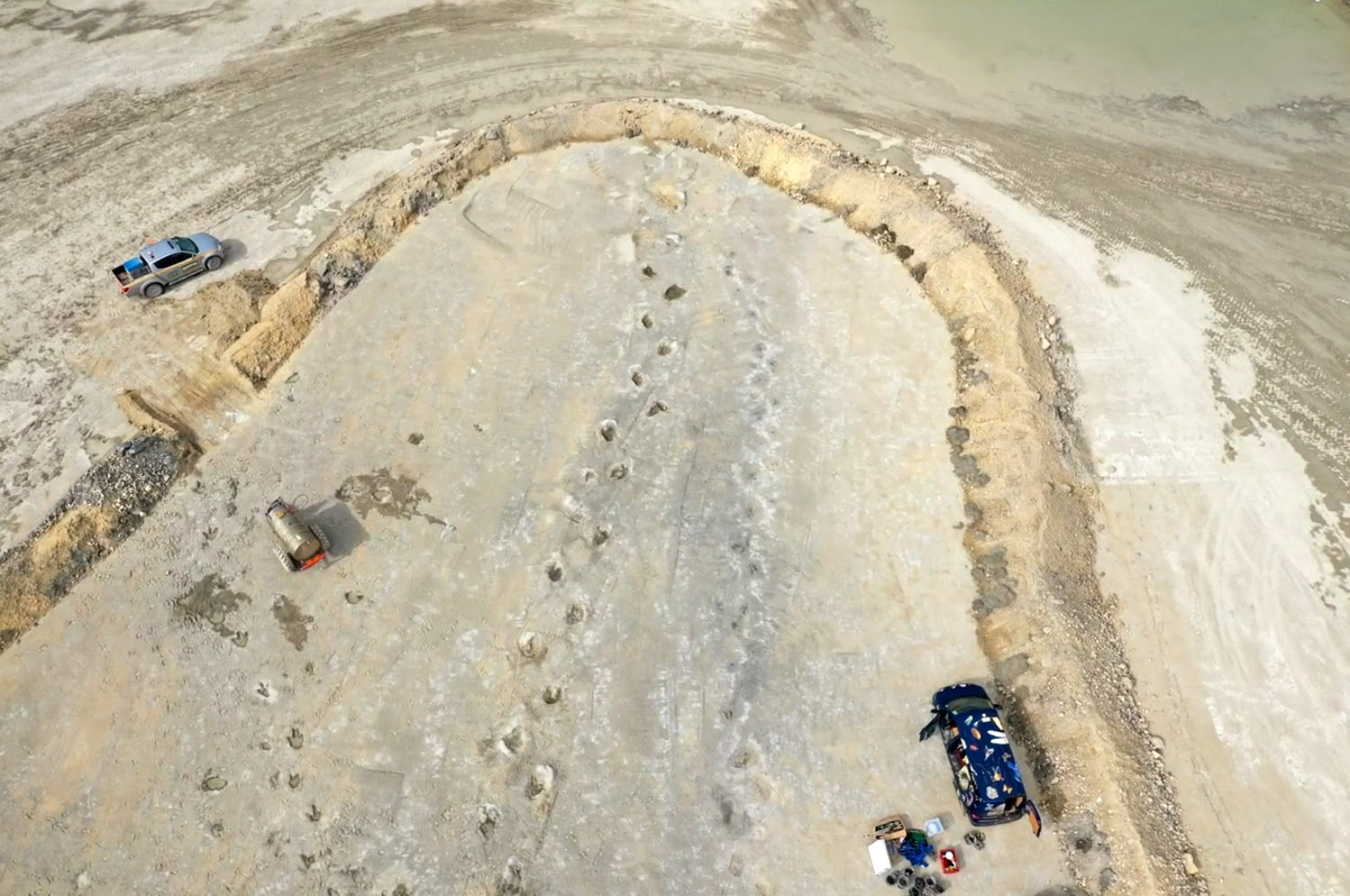
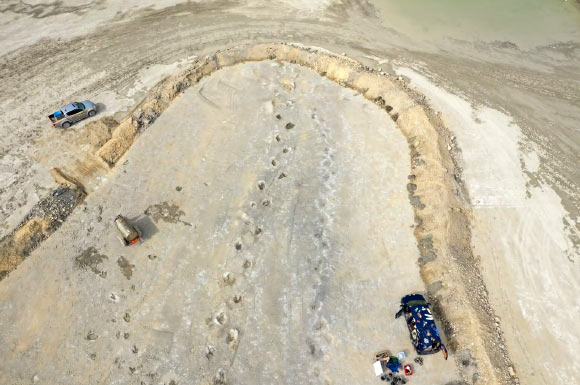
The 166-million-year-old sauropod dinosaur trackways at Dewars Farm Quarry in Oxfordshire, England. Image credit: University of Birmingham.
The quartet of newly identified trackways at Dewars Farm Quarry are attributed to the Middle Jurassic period, dating back roughly 166 million years.
These impressions were made by sauropod dinosaurs: colossal, long-necked herbivores akin to Cetiosaurus.
Among the discoveries is Europe’s most extensive sauropod dinosaur trackway, extending an impressive 220 meters from its initial to its terminal exposed print.
Professor Kirsty Edgar of the University of Birmingham expressed her enthusiasm: “We were delighted to be welcomed back to Dewars Farm quarry earlier this year, to continue excavating and discover more dinosaur tracks.”
“This locale in Oxfordshire stands as the most expansive dinosaur track site in the UK, and arguably now the largest mapped dinosaur track site globally when considering findings from the 1990s on adjacent surfaces.”
Over a period of seven days, the research team encountered considerably drier and more consolidated ground conditions compared to the previous year. Their focus was on a collection of about 80 exceptionally large sauropod prints, some measuring up to 1 meter in length, which traversed the entirety of the site in a near north-south orientation, forming the record-breaking trackway.
In addition to the extensive sauropod trackway, three other shorter trackways were brought to light. One of these appears to be a continuation of prints initially discovered in 2022.
Although not entirely uncovered without interruption, this trackway may ultimately prove to be even longer once all available data is synthesized.
Minor findings at the site also included evidence of marine invertebrates, botanical remains, and a crocodile mandible.
Professor Richard Butler from the University of Birmingham elaborated: “Most of what we know about dinosaurs comes from their skeletons, but footprints and the sediments that they are in can provide valuable additional information about how these organisms lived and what their environment looked like over 166 million years ago.”
“Key new work in this latest excavation included systematic sampling of the sediments that both underlie and fill the footprints, with analysis of these currently underway to find out more about the environment in which they were made and how they were preserved.”
“It is probable that additional portions of the footprint-bearing surface will be exposed in the coming years, and a comprehensive report detailing the site’s significance, novel scientific revelations, and its potential for future conservation is anticipated shortly.”