In a significant archaeological revelation, a remarkable dagger from the Copper Age has been brought to light within Tina Jama Cave, situated in the administrative division of Trieste, within Italy’s Friuli-Venezia Giulia region.

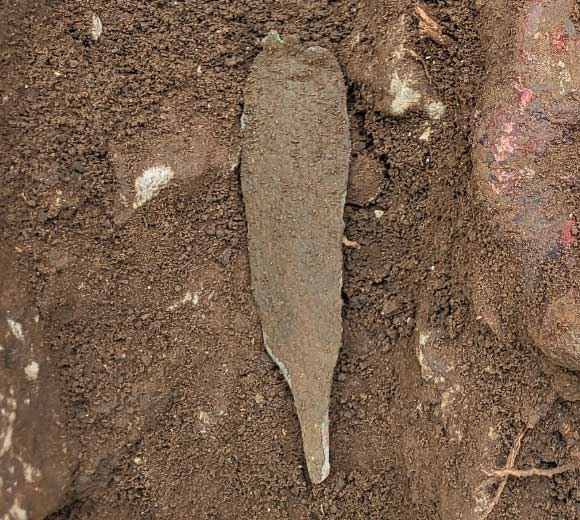
The 4,000-year-old copper dagger found in Tina Jama Cave, Italy. Image credit: Davide Bonaduce.
The ancient copper blade, recovered from Tina Jama Cave, measures slightly less than 10 centimeters (4 inches) in length and exhibits a distinctive leaf-like shape with an integral tang.
This notable artifact was discovered by Professor Federico Bernardini, who led the excavation and is an archaeologist affiliated with Ca’ Foscari University of Venice. He was accompanied by his research associates from both Italy and Slovenia.
“Comparable artifacts are not commonly found within Italy; however, the Tina Jama dagger presents similarities to other discoveries from the well-known Dežman/Deschmann pile settlements situated near Ljubljana in Slovenia,” Professor Bernardini commented.
“The excavation work at Tina Jama has revealed strata corresponding to the Bronze Age and the Late Copper Age, with dating that places them in the latter half of the 3rd millennium BCE,” stated Dr. Elena Leghissa, an archaeologist from the Institute of Archaeology at the Research Centre of the Slovenian Academy of Sciences and Arts.
“These discoveries are vital for comprehending the profound technological, cultural, and societal shifts that occurred across Europe during that formative epoch.”
“Further excavation endeavors will significantly enhance our understanding of the diverse cultural aspects prevalent in the Caput Adriae territory during the 3rd millennium BCE.”
“The unearthing of this copper dagger represents an exceptional occurrence, prompting inquiries into the historical utilization of the cave.”
In addition to the dagger, the archaeological team identified a construction composed of slabs and stone blocks, dating from approximately 2000 to 1500 BCE, positioned at the cave’s entrance.
“While the precise function of this structure remains undetermined, the presence of fragmented human skulls discovered in close proximity suggests a potential funerary purpose,” the researchers noted.
“Alternatively, it is conceivable that this edifice was erected as a means of shielding the cave’s interior from the forceful bora winds.”
“The ceramic fragments recovered at the site, coupled with the identification of a hearth, indicate that prior to the construction of this feature, the cave was a frequent locus for groups whose material culture exhibited strong connections with the Dalmatian region during the second half of the 3rd millennium BCE (associated with the Cetina culture).”
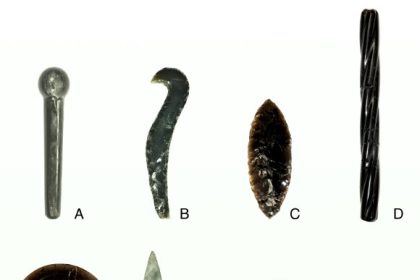
The researchers also documented the recovery of projectile points fashioned from flint, elongated blades meticulously crafted from the same material using pressure techniques, polished stone axes, obsidian artifacts, various stone and ceramic items, and adornments made from shells.
“This collected evidence strongly suggests that the cave has been a site of visitation for many millennia and holds considerable promise for forthcoming excavation initiatives,” they concluded.