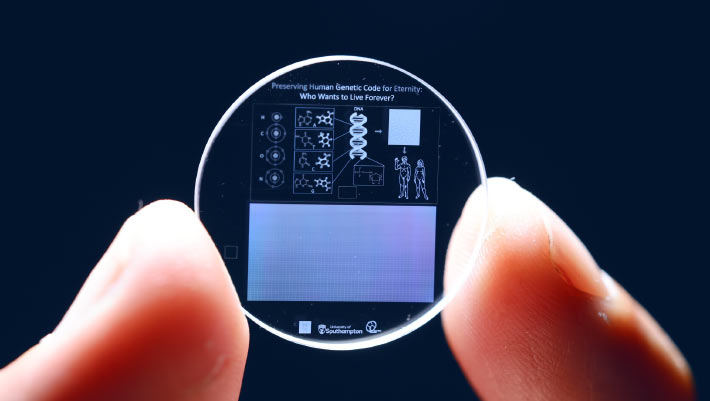
In contrast to conventional data storage mediums susceptible to degradation, 5D memory crystals offer an extraordinary capacity to retain up to 360 terabytes of information indefinitely, with absolute fidelity, for eons, even under extreme thermal conditions, as reported by a scientific consortium at the University of Southampton. This 5D crystalline structure is intrinsically similar to fused quartz, a material renowned on Earth for its exceptional chemical and thermal resilience. It possesses the capability to endure a wide spectrum of environmental rigors, encompassing sub-zero temperatures, intense thermal events, and temperatures soaring to 1,000 degrees Celsius (1,832 degrees Fahrenheit). Further demonstrating its robustness, the crystal can withstand direct mechanical stress of up to 10 tons per square centimeter and remains unaffected by prolonged exposure to cosmic radiation.

The 5D memory crystal. Image credit: University of University of Southampton.
A distinguished research group at the University of Southampton, spearheaded by Professor Peter Kazansky, employs cutting-edge ultrafast lasers to meticulously imprint data within nanostructured voids that are precisely oriented within a silica substrate, achieving feature resolutions as minute as 20 nanometers.
This novel data encoding methodology transcends paradigms like inscribing information on the surface of two-dimensional paper or magnetic tapes. Instead, it leverages two optical dimensions in conjunction with three spatial coordinates to embed data throughout the entirety of the material – hence the designation ‘5D’ associated with its nomenclature.
The extraordinary longevity inherent in these crystals ensures their survival far beyond the lifespan of humans and other terrestrial species. Although the current scientific capabilities do not permit the de novo synthesis of complex living organisms like plants and animals solely from their genetic blueprints, significant advancements have been observed in the field of synthetic biology in recent times.
“We are aware from the foundational work of other researchers that the genetic material of simpler organisms can be artificially constructed and subsequently introduced into an existing cellular framework to engender a viable, living specimen within a laboratory setting,” stated Professor Kazansky.
“The advent of 5D memory crystal technology presents unprecedented opportunities for the scientific community to establish an enduring repository of genomic data. This repository could potentially facilitate the restoration of intricate organisms, such as plants and animals, should future scientific breakthroughs enable such endeavors.”

Memory of Mankind archive in Hallstatt, Austria. Image credit: University of Southampton.
To validate this groundbreaking concept, the researchers meticulously engineered a 5D memory crystal containing the complete human genome.
For the approximately three billion nucleotide bases that comprise the genome, each base was replicated 150 times to guarantee its precise positional integrity.
The resultant crystal has been permanently housed within the Memory of Mankind archive, a specialized time capsule situated within a salt cave located in Hallstatt, Austria.
During the conceptualization and design phase of the crystal, the research team critically considered the potential scenarios for data retrieval by an intelligence, whether biological or artificial, that might emerge in the distant future.
It is indeed conceivable that this data could be uncovered in an epoch so remote that any current frame of reference would be entirely absent.
“The visually encoded key imprinted on the crystal provides the discoverer with essential knowledge regarding the nature of the stored data and its potential applications,” Professor Kazansky elaborated.
Positioned above the densely packed data planes contained within, the key illustrates fundamental universal elements (hydrogen, oxygen, carbon, and nitrogen); the four constituent bases of the DNA molecule (adenine, cytosine, guanine, and thymine) along with their respective molecular structures; their architectural integration within the double helix framework of DNA; and the hierarchical arrangement of genes into chromosomes, which can subsequently be incorporated into a cellular structure.
In a gesture of homage to the iconic Pioneer spacecraft plaques launched by NASA on a trajectory extending beyond the solar system’s boundaries, the team incorporated a visual indicator to signify the species to which the 5D memory crystal pertains.
“While we cannot ascertain if memory crystal technology will ever achieve comparable interstellar distances, it is reasonable to anticipate with a high degree of certainty that each individual disk will significantly surpass the longevity of those pioneering plaques,” Professor Kazansky remarked.
_____
This publication represents an adapted version of a press release originally issued by the University of Southampton.