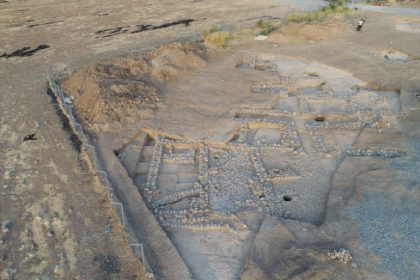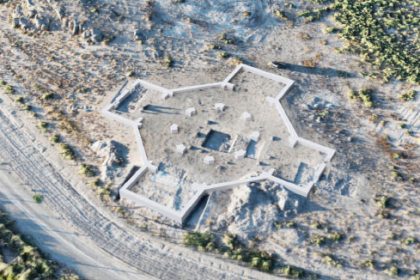
The Tanimbar island chain, a prominent archipelago within Wallacea (a region comprising primarily Indonesian islands separated by deep water channels from the Asian and Australian continental landmasses), is situated along ancient human migratory pathways from Sunda to Sahul (encompassing Australia and New Guinea). Despite its profound geographical importance, this island group has not been subjected to comprehensive archaeological scrutiny. In a significant development, archaeologists from the Australian National University have unearthed the inaugural evidence of Pleistocene human habitation within the Tanimbar Islands, with an estimated antiquity of approximately 42,000 years.

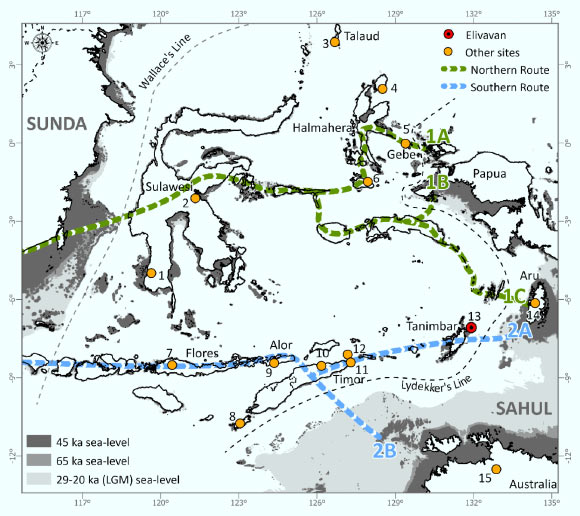
Map of Wallacea, delineating Birdsell’s northern and southern migration routes. The map also highlights the oldest Pleistocene sites on each island. Along the northern route, the following sites are indicated: 1) Leang Karampuang, Leang Tedongnge, and Leang Bulu Sipong 4, 2) Goa Topogaro, 3) Leang Sarru, 4) Daeo 2, 5) Golo, and 6) Kelo 6. On the southern route, the following sites are highlighted: 7) Liang Bua, 8) Lua Meko, 9) Makpan, 10) Laili, 11) Asitau Kuru, Lene Hara, Matja Kuru 2, 12) Here Sorot Entapa, and 13) Elivavan. The last two sites represent connections to Sahul: 14) Leang Lemdubu, currently in the Aru Islands but once connected to the mainland during the Pleistocene, and 15) Madjedbebe, the oldest known site in Sahul. Image credit: Kaharudin et al., doi: 10.1016/j.quascirev.2024.108834.
The Tanimbar Islands are situated at the easternmost extremity of southern Wallacea.
Approximately 250 kilometers to the east of Tanimbar lie the Aru Islands, which constituted a portion of the Sahul mainland during the periods of lower sea levels in the Pleistocene epoch.
Although in close geographical proximity to the Sahul continental shelf, the Tanimbar Islands have remained perpetually isolated by a marine barrier since the earliest documented human presence in Wallacea and preceding eras.
In contrast to their neighboring islands situated near the Sahul shelf, such as Halmahera, Seram, and Gebe to the north, and Timor, Rote, and Kisar to the south, the Tanimbar Islands have garnered comparatively attenuated attention from archaeological research.
“The locus of this discovery — Elivavan on Indonesia’s Tanimbar Islands — imbues it with particular significance,” commented Hendri Kaharudin, a doctoral candidate at the Australian National University.
“Tanimbar is strategically positioned just off the Sahul shelf, an area that encompasses contemporary Australia and New Guinea.”
“The inquiry into how our ancestral populations journeyed there from Southeast Asia represents one of the most compelling enigmas in prehistoric migration, largely due to the extensive distances involved and the sophisticated seafaring capabilities that would have been indispensable.”
“Since the mid-20th century, two primary migration routes have been posited as plausible: a northerly trajectory traversing islands such as Sulawesi, and a southerly course passing in the vicinity of Timor and the Tanimbar Islands.”
“This discovery signifies one of the earliest identified sites along the southern route, rendering it an indispensable component of the broader migration narrative.”
While certain aspects concerning the initial inhabitants of Elivavan remain unelucidated, the inherent perils of the sea crossings strongly suggest that the colonizing populations had developed advanced maritime technologies by approximately 42,000 years ago.
“They would have been compelled to navigate expanses of water exceeding 100 kilometers in length, irrespective of their direction of travel,” stated Kaharudin.
“Alongside minute pottery fragments, we also unearthed evidence in the form of osseous remains, shells, and echinoderms, indicative of the island’s function as a central point for early maritime endeavors.”
“As further investigations are conducted in less extensively explored territories such as the Tanimbar Islands, I anticipate the emergence of additional insights into early human existence and migratory patterns.”
“It is also evident that the colonization of Sahul was not a singular occurrence but rather ‘a progressive undertaking involving sequential incursions of seafaring groups.’”
“Coastal communities likely charted shorelines, effectively utilizing marine resources and establishing robust settlements throughout their voyages.”
“This mode of island-hopping facilitated intermingling of cultures and fostered adaptability, thereby shaping a mosaic of diverse societies across the landmass.”
The published findings can be found in the esteemed journal Quaternary Science Reviews.
_____
Hendri A.F. Kaharudin et al. 2024. Islands on the edge: 42,000-year-old occupation of the Tanimbar islands and its implications for the Sunda-Sahul early human migration discourse. Quaternary Science Reviews 338: 108834; doi: 10.1016/j.quascirev.2024.108834