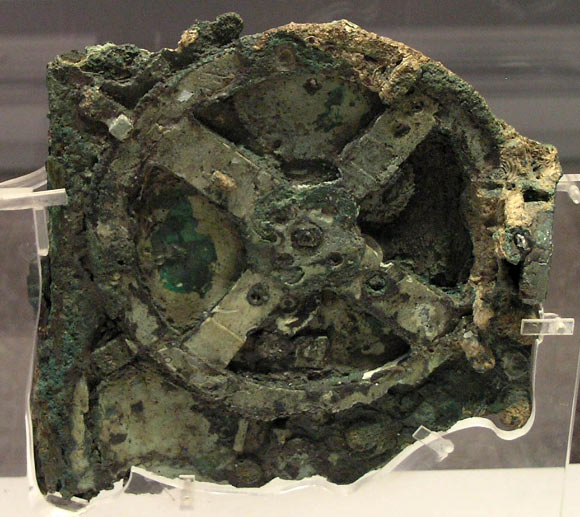
The Antikythera mechanism, a multipart apparatus salvaged from a maritime disaster near the Greek island of Antikythera in 1901, is presumed to be the remnant of a sophisticated ancient mechanical calculator. Extensive scrutiny and analysis have been dedicated to elucidating its precise construction and operational purpose. In a recent investigation, astronomical experts from the University of Glasgow employed statistical modeling methodologies, which were originally developed for the analysis of gravitational waves, to ascertain the placement of apertures situated beneath the calendar dial of the Antikythera mechanism. Their findings introduce compelling evidence suggesting this component was predominantly utilized for delineating the Hellenic lunar calendar.

A fragment of the Antikythera mechanism. Imager credit: National Archaeological Museum, Athens / CC BY-SA 3.0.
The vessel involved in the Antikythera shipwreck dates to the Roman era, specifically the first century BCE (between 85 and 50 BCE).
This wreck is situated off the eastern coast of Antikythera, a Greek island positioned at the nexus of the Aegean and Mediterranean Seas, in proximity to Crete.
It is theorized that the Antikythera ship was laden with plundered treasures originating from the Anatolian coast, destined for Rome, to be showcased in a planned triumphal procession honoring Julius Caesar.
The shipwreck was originally discovered in 1900 by a contingent of Greek sponge divers en route to Tunisia. Seeking refuge from inclement weather near the island, they decided to engage in sponge gathering while awaiting more favorable conditions.
Initial explorations of the site yielded a profusion of artifacts, many of which are now preserved at the National Archaeological Museum in Athens, Greece. These included life-sized marble equine sculptures, an array of decorative items, coinage, glassware, and numerous artistic masterpieces, notably a statue representing Herakles.
The most astonishing revelation was the discovery of the corroded remains of a sophisticated apparatus, identified as the Antikythera mechanism. This device is believed to have served as an early analog computer, instrumental in the planning of significant events, encompassing religious observances, the ancient Olympic Games, and agricultural undertakings.
Often characterized as the inaugural mechanical computer, this bronze artifact was fabricated during the period spanning 150 to 100 BCE.
Its original housing was a wooden case, measuring approximately 31.5x19x10 cm, complete with front and rear access panels, and adorned with astronomical inscriptions across a substantial portion of its exterior.
The surviving fragments of this mechanism incorporate 30 intricately interconnected gears. Technological items of comparable intricacy did not resurface for another millennium.
In 2020, newly acquired X-ray imagery of one of the mechanism’s dials, referred to as the calendar ring, unveiled previously unseen details of uniformly spaced perforations located beneath the dial’s surface.
However, due to the fragmented and incomplete nature of the dial, the precise original count of these perforations remained indeterminate.
An initial assessment conducted by Antikythera researcher Chris Budiselic and his associates indicated a probable range of 347 to 367 perforations.

Top: 82 surviving fragments of the Antikythera Mechanism. Image credit: T. Freeth et al, 2006. Bottom: reconstruction of the Antikythera Mechanism by Allan Bromley and Frank Percival. Image credit: Allan Bromley.
In the course of the recent study, Graham Woan and Joseph Bayley, researchers affiliated with the University of Glasgow, applied two distinct statistical analysis methodologies to extract novel insights regarding the calendar ring.
Their investigations strongly indicate that the ring was significantly more likely to have possessed 354 perforations, aligning with a lunar calendar, rather than 365, which would correspond to the Egyptian calendar.
The analysis further demonstrates that a count of 354 perforations is hundreds of times more probable than a 360-perforation configuration, a possibility previously posited by earlier research.
“Toward the close of last year, a colleague brought to my attention data compiled by the YouTuber Chris Budiselic, who was aiming to construct a replica of the calendar ring and was exploring methods to ascertain its exact perforation count,” stated Professor Woan.
“The challenge struck me as intriguing, and I perceived an opportunity to address it using an alternative approach during the Christmas recess, which prompted me to initiate the application of certain statistical techniques to resolve the question.”
Professor Woan employed a technique known as Bayesian analysis, which leverages probabilistic reasoning to quantify uncertainty based on incomplete datasets. This method was used to calculate the probable number of perforations within the mechanism, utilizing the spatial data of the extant holes and the configuration of the ring’s six surviving fragments.
His findings revealed substantial evidence suggesting that the mechanism’s calendar ring contained either 354 or 355 perforations.
Concurrently, Dr. Bayley also became aware of the problem. He adapted techniques utilized by their research cohort for analyzing signals captured by the LIGO gravitational wave observatories. These detectors, which measure minute distortions in spacetime caused by cataclysmic astronomical occurrences such as black hole mergers, were re-purposed to scrutinize the calendar ring.
The Markov Chain Monte Carlo and nested sampling methodologies, as implemented by Professor Woan and Dr. Bayley, yielded a comprehensive probabilistic spectrum of outcomes. These results again pointed towards the ring most likely housing 354 or 355 perforations arranged in a circular pattern with a radius of 77.1 mm, exhibiting a margin of error of approximately 1/3 mm.
The analysis also highlighted the exceptional precision of the perforation placement, with an average radial deviation of merely 0.028 mm between each aperture.
“Previous investigations had indicated a strong likelihood that the calendar ring was designed to track the lunar calendar; however, the dual methodologies we have implemented in this research significantly bolster the probability of this being the case,” remarked Dr. Bayley.
“This endeavor has instilled in me a renewed appreciation for the Antikythera mechanism and the dedication and meticulousness that Greek artisans invested in its creation—the exactitude in the positioning of the perforations would have necessitated highly precise measurement instruments and an exceptionally steady hand for their creation.”
“There is a rather elegant parallel in the fact that we have adapted techniques employed in our contemporary study of the cosmos to gain a deeper understanding of a mechanism that facilitated human temporal tracking of celestial movements nearly two millennia ago,” Professor Woan commented.
“We aspire for our discoveries concerning the Antikythera mechanism, while perhaps less spectacularly supernatural than those attributed to Indiana Jones, to contribute to a more profound comprehension of its fabrication and utilization by the ancient Greeks.”
A treatise detailing these findings was published in the July 2024 edition of The Horological Journal.
_____
Graham Woan & Joseph Bayley. 2024. An Improved Calendar Ring Hole-Count for the Antikythera Mechanism: A Fresh Analysis. The Horological Journal
This article has been adapted from an original publication by the University of Glasgow.