A recent publication in the journal Astrobiology indicates that known non-biological origins, ranging from meteoritic impacts to surface chemical interactions, are insufficient to account for the organic compounds identified by NASA’s Curiosity rover.
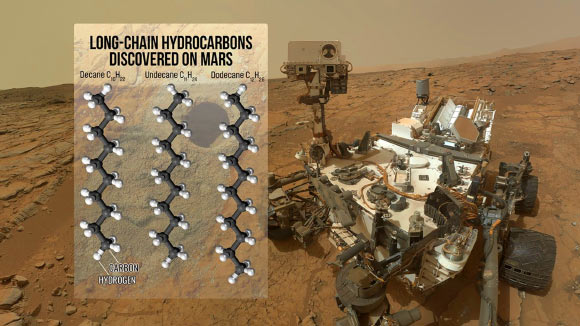
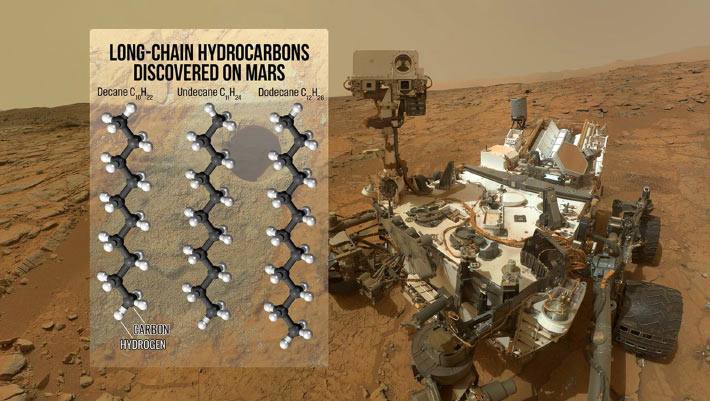
This graphic illustrates long-chain organic molecules such as decane, undecane, and dodecane, alongside NASA’s Curiosity rover. Image credit: NASA / Dan Gallagher.
In an announcement made in 2025, planetary scientists disclosed the presence of long-chain alkanes within the ancient Cumberland mudstone located in Gale crater on Mars, at concentrations approximately between 30 and 50 parts per billion.
The prevailing hypothesis was that these alkanes originated from the thermal decarboxylation of fatty acids during the analytical process employed by Curiosity’s Sample Analysis at Mars (SAM) instrument.
However, in a novel investigation, Dr. Alexander Pavlov, affiliated with NASA’s Goddard Space Flight Center, and his research associates contend that the recorded concentrations represent a minimum estimate. They posit that a significant portion of the original organic material was likely degraded by radiation over spans of tens of millions of years.
It is estimated that the Cumberland mudstone may have initially harbored between 120 and 7,700 parts per million of long-chain alkanes or their fatty-acid precursor compounds before its exposure at the Martian surface.
“To arrive at this conclusion, we integrated laboratory-based radiation experiments, sophisticated mathematical modeling, and data acquired by the Curiosity rover to effectively ‘reverse time’ approximately 80 million years—representing the duration the rock was exposed on the Martian surface,” the research team explained.
“This methodology enabled us to project the quantity of organic material that must have been present prior to its destruction through prolonged exposure to cosmic radiation: a volume substantially exceeding what typical non-biological processes could generate.”
The scientific team also undertook an evaluation to ascertain whether established non-biological mechanisms could adequately explain the unexpectedly elevated inferred abundance of these long-chain alkanes.
The findings of the study suggest that contributions from meteorites and interplanetary dust particles are insufficient by many orders of magnitude, considering the estimated rates of sedimentation and the limited capacity of dust particles to penetrate consolidated rock.
Furthermore, the generation of organic haze within the atmosphere is considered improbable, given that early Mars likely lacked the methane-rich atmospheric conditions requisite for substantial haze deposition.
The authors also scrutinized hydrothermal processes, which are known to produce hydrocarbons under specific circumstances.
Although laboratory investigations demonstrate that long-chain organic molecules can indeed be formed through hydrothermal activity, the mineralogical composition of the Cumberland mudstone indicates that it did not undergo the high temperatures characteristic of such reactions.
These revelations point towards a more speculative possibility: that a portion, or indeed all, of the original organic material could have been the product of a hypothetical ancient Martian biosphere.
“We concur with Carl Sagan’s assertion that extraordinary pronouncements necessitate extraordinary substantiation and acknowledge that any discovery suggesting life on Mars will inevitably face rigorous scrutiny,” the researchers stated.
“Moreover, adhering to the established protocols within the field of astrobiology, we note that definitively confirming extraterrestrial life requires a convergence of multiple evidential streams.”
“Nevertheless, our analytical approach has led us to estimate that, conservatively, the Cumberland mudstone contained between 120 and 7,700 parts per million of long-chain alkanes and/or fatty acids prior to its exposure to ionizing radiation.”
“We contend that such substantial concentrations of long-chain alkanes are incongruent with several known abiotic sources of organic molecules on ancient Mars, specifically the influx of organics via interplanetary dust particles and meteorites, atmospheric deposition and fallout from photochemical haze, and organic synthesis resulting from serpentinization and Fischer-Tropsch reactions on the Red Planet.”
“Conversely, it is not implausible to postulate that an ancient Martian biosphere might have been capable of generating this level of complex organic enrichment within Martian mudstone deposits. Additionally, allochthonous delivery of hydrothermally synthesized organics could have augmented the abundance of alkanes observed in the Cumberland mudstone.”
_____
Alexander A. Pavlov et al. Does the Measured Abundance Suggest a Biological Origin for the Ancient Alkanes Preserved in a Martian Mudstone? Astrobiology, published online February 4, 2026; doi: 10.1177/15311074261417879