At a profound depth of approximately 2,900 kilometers below the Earth’s surface, specifically beneath the African and Pacific regions, two colossal, incandescent rocky formations situated at the mantle’s base have exerted a continuous influence on our planet’s magnetic field for eons, as revealed by recent research spearheaded by Professor Andy Biggin of the University of Liverpool.
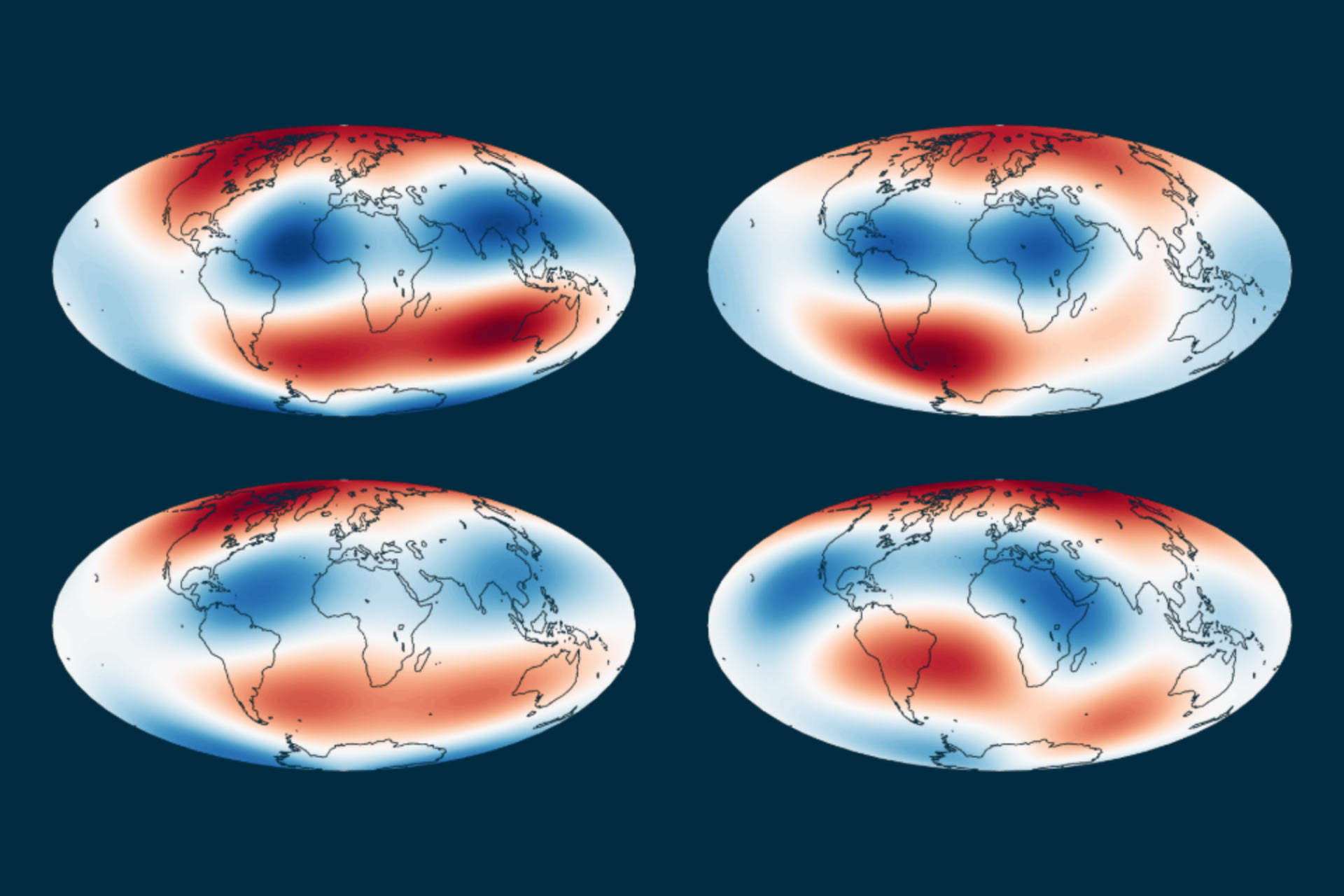
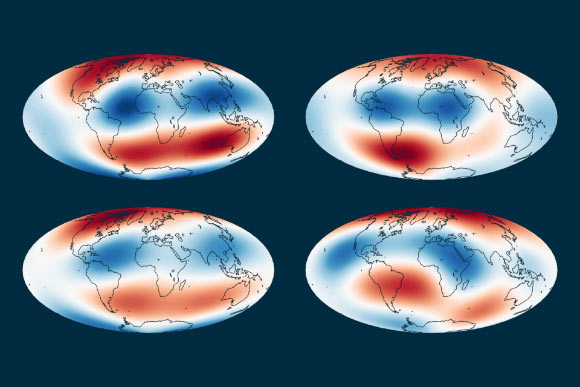
Two immense masses of solid, superheated material residing at the lower boundary of Earth’s mantle exert an influence on the liquid outer core beneath them. Image courtesy of Biggin et al., doi: 10.1038/s41561-025-01910-1.
Reconstructing historical geomagnetic field data and modeling the mechanisms responsible for its generation both present considerable technical hurdles.
To delve into the nature of these deep-seated terrestrial structures, Professor Biggin and his research team integrated paleomagnetic evidence with sophisticated computational models simulating the geodynamo process—the convective motion of molten iron within the outer core that functions as the Earth’s magnetic field generator, analogous to how a wind turbine produces electricity.
These computational simulations facilitated the reconstruction of pivotal observations regarding the magnetic field’s behavior over the past 265 million years.
Even with the assistance of a supercomputer, executing such complex simulations, particularly across vast temporal scales, constitutes a monumental computational endeavor.
The outcomes of the investigation indicated that the upper boundary of the outer core is characterized by a significant lack of thermal uniformity.
Instead, it exhibits pronounced thermal gradients, with specific hot zones being overlain by these continent-sized rocky masses.
Furthermore, the findings demonstrated that certain components of the magnetic field have seemingly maintained a remarkable degree of constancy for hundreds of millions of years, while other aspects have undergone substantial transformations over time.
“These revelations strongly suggest the presence of significant thermal disparities within the rocky mantle just above the core, and that in the areas overlying these hotter regions, the molten iron in the core may become sluggish, ceasing to participate in the vigorous convection observed beneath the cooler zones,” stated Professor Biggin.
“Acquiring such profound insights into the deep Earth over extensive geological periods bolsters the argument for utilizing records of the ancient magnetic field to comprehend both the dynamic evolution of the Earth’s interior and its more enduring characteristics.”
“These findings also carry substantial implications for inquiries pertaining to historical continental arrangements—such as the assembly and fragmentation of Pangea—and could potentially alleviate persistent uncertainties in fields like ancient climate reconstruction, paleobiology, and the genesis of natural resources.”
“These disciplines have traditionally operated under the assumption that Earth’s magnetic field, when averaged over extended durations, behaved akin to a perfect bar magnet precisely aligned with the planet’s axis of rotation.”
“Our research indicates that this may not entirely reflect reality.”
This research project was formally published today in the esteemed journal, Nature Geoscience.
_____
A.J. Biggin et al. Influence of mantle heterogeneity on Earth’s ancient magnetic field. Nat. Geosci, published online February 3, 2026; doi: 10.1038/s41561-025-01910-1