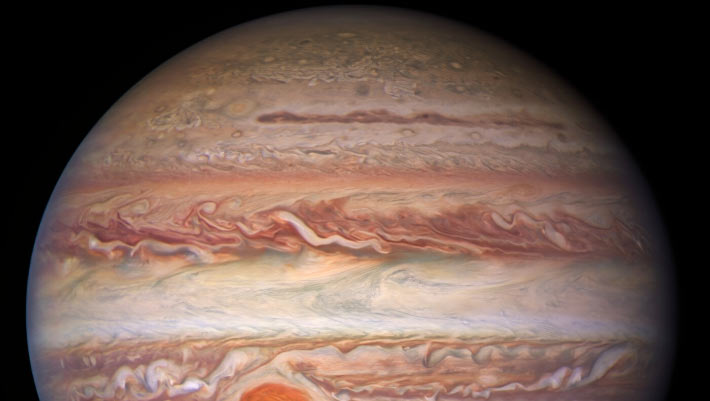
Planetary scientists, by leveraging high-fidelity radio-occultation telemetry from NASA’s Juno spacecraft and integrating the impact of zonal atmospheric currents, have determined Jupiter’s geometric form with a tenfold decrease in ambiguity. These refined measurements indicate that its polar, equatorial, and mean radii are less than those previously established through data acquired by NASA’s Pioneer and Voyager probes.
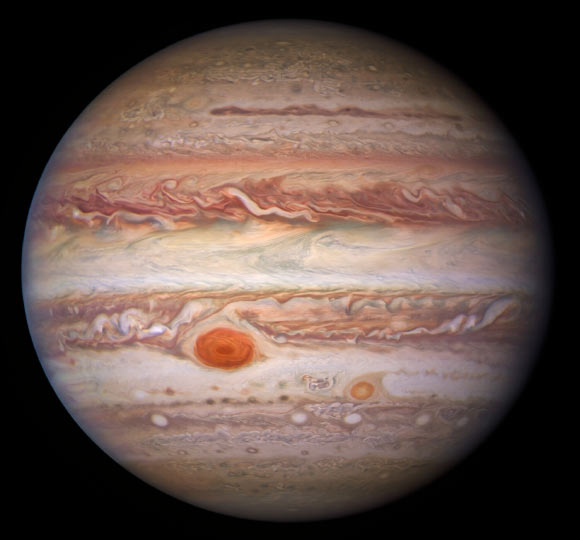
This visible-light image of Jupiter, generated from data collected on January 11, 2017, by Hubble’s Wide Field Camera 3, showcases notable atmospheric features. A substantial brown band, referred to as a ‘brown barge,’ stretches for 72,000 kilometers (approximately 45,000 miles) horizontally. The prominent Great Red Spot is clearly visible in the lower-left quadrant, with a smaller feature, informally named Red Spot Jr. (or Oval BA by Jovian researchers), situated to its lower right. Image credit: NASA / ESA / NOIRLab / NSF / AURA / Wong et al. / de Pater et al. / M. Zamani.
“Jupiter, the most colossal planet within our Solar System, approximates an oblate spheroid, a rotational ellipsoid characterized by slight polar flattening and equatorial bulging due to its rapid rotation period of 9 hours, 55 minutes, and 29 seconds,” stated Dr. Eli Galanti of the Weizmann Institute of Science, alongside his research collaborators.
“This form arises from the equilibrium between the inward pull of gravitational forces directed radially and the outward thrust of centrifugal forces acting perpendicular to the axis of rotation. For Jupiter, this dynamic results in its equatorial radius exceeding its polar radius by roughly 7%.”
“Were a celestial body to possess uniform density, its shape would conform precisely to an ellipsoid. However, Jupiter’s internal density distribution exhibits significant variation, transitioning from densities less than 1 kg/m³ at the cloud tops, approximately situated at the 1-bar pressure level, to densities in the thousands of kg/m³ at profound depths.”
“Consequently, deviations from a perfect ellipsoidal form emerge, amounting to tens of kilometers, which manifest as latitudinal fluctuations in the planet’s gravitational field.”
“Further perturbations to Jupiter’s shape are introduced by the vigorous zonal winds that are observable at the cloud layer.”
“These atmospheric flows modulate the centrifugal forces, generating shape variations on the order of 10 kilometers, primarily concentrated at lower latitudes.”
Historically, Jupiter’s physical dimensions were ascertained using data derived from six radio occultation investigations conducted by NASA’s Pioneer and Voyager missions during the 1970s.
In a recent scholarly work, the research team meticulously scrutinized radio occultation data acquired by the Juno mission during thirteen close passes of Jupiter, crucially incorporating the influence of zonal winds.
“The radio occultation technique serves as a method to penetrate Jupiter’s dense, optically opaque cloud cover, thereby facilitating an understanding of its internal structure,” the authors elucidated.
“During an occultation event, Juno transmits radio signals towards NASA’s Deep Space Network located on Earth.”
“As these radio waves traverse the ionized upper stratum of Jupiter’s atmosphere, known as the ionosphere, atmospheric gases induce refraction and temporal delays in the signals.”
“By quantifying the alteration in signal frequency caused by this bending phenomenon, we are capable of calculating the atmospheric temperature, pressure, and electron density of Jupiter at varying depths.”
The investigators’ findings indicate that Jupiter is approximately 8 kilometers narrower at its equator and exhibits 24 kilometers more polar flattening than previously understood.
“When the effects of zonal winds are factored in, we achieve a tenfold reduction in the uncertainty surrounding our determination of Jupiter’s shape,” the researchers asserted.
“At the 1-bar pressure level, our calculations yield a polar radius of 66,842 km, an equatorial radius of 71,488 km, and a mean radius of 69,886 km. These values represent a reduction of 12 km, 4 km, and 8 km, respectively, compared to earlier estimations.”
These groundbreaking discoveries were announced this week in the prestigious journal Nature Astronomy.
_____
E. Galanti et al. The size and shape of Jupiter. Nat Astron, published online February 2, 2026; doi: 10.1038/s41550-026-02777-x