A novel microbial lineage of the bacterial species Psychrobacter cryohalolentis has been successfully identified from ice dating back 5,000 years, extracted from Romania’s Scarisoara Ice Cave. Intriguingly, this specific isolate, designated SC65A.3, exhibits a notable resilience to ten commonly administered antibiotics, including therapeutic agents typically allocated for formidable infections such as tuberculosis and urinary tract conditions.
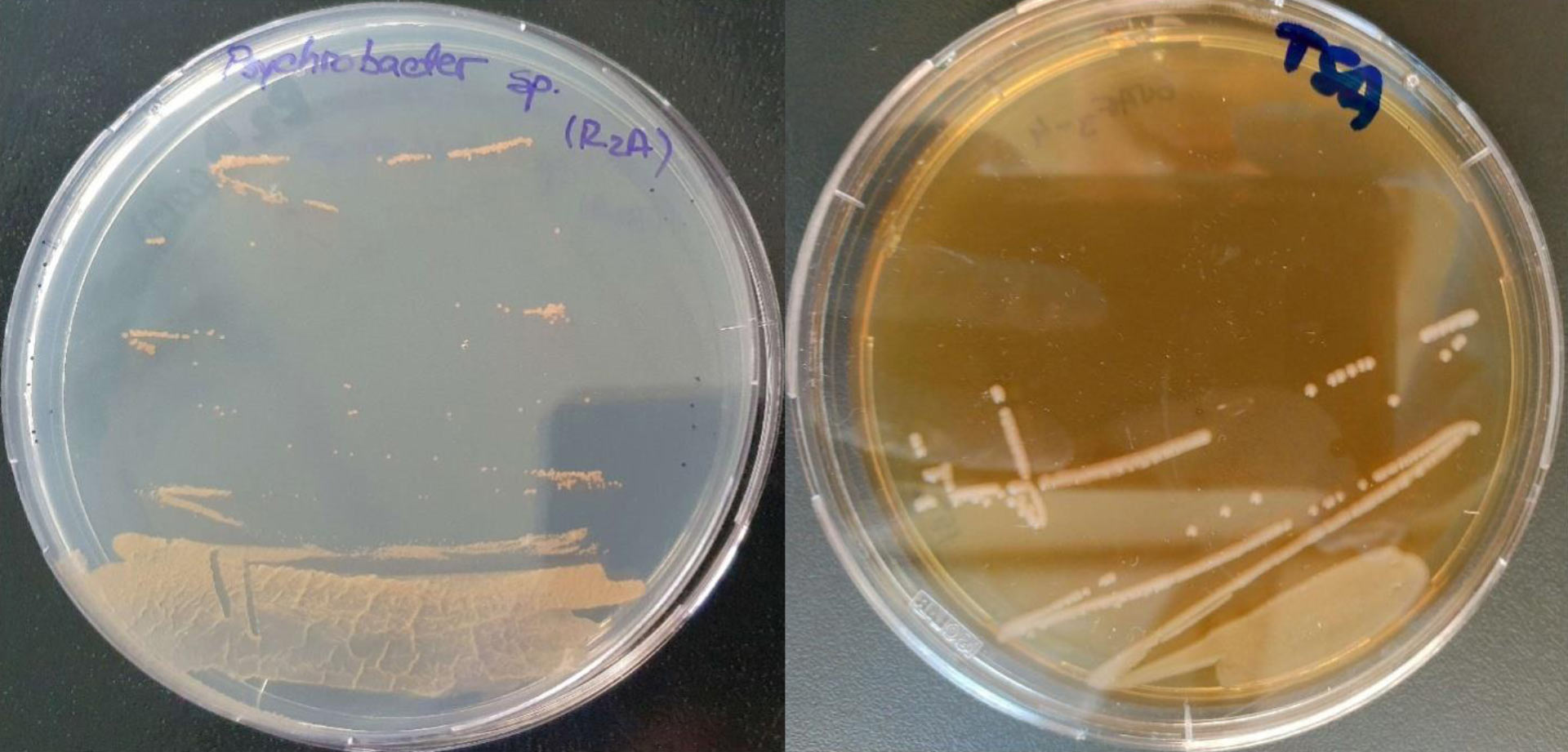
Isolated colonies of Psychrobacter SC65A.3 on R2A medium at 4 degrees Celsius (A) and on TSA medium at 15 degrees Celsius (B). Image credit: Ioana Paun et al., doi: 10.3389/fmicb.2025.1713017.
The Psychrobacter genus encompasses approximately 50 distinct bacterial species that have undergone evolutionary adaptation to frigid and saline environments.
First characterized in 1986, with Psychrobacter immobilis serving as the representative species, this genus has since been found to have a widespread geographical distribution.
Psychrobacter species manifest as cream to orange-hued colonies and flourish in low-temperature conditions, though they possess the capacity to tolerate temperatures up to 35-37 degrees Celsius and a range of salinity levels. Certain species within this genus have the potential to instigate infections in both humans and animals.
These bacteria are obligate aerobes, exhibiting positive catalase and oxidase activity. They metabolize amino and organic acids as their carbon sustenance, demonstrating a limited degree of biochemical adaptability.
According to Dr. Cristina Purcarea, a researcher at the Institute of Biology Bucharest of the Romanian Academy, “Despite its ancient provenance, the Psychrobacter SC65A.3 bacterial strain, recovered from the Scarisoara Ice Cave, exhibits resistance to multiple contemporary antibiotics and harbors over 100 genes associated with resistance.”
She further elaborated, “Paradoxically, it also possesses the ability to suppress the proliferation of several prevalent antibiotic-resistant ‘superbugs’ and displays significant enzymatic functionalities that hold considerable biotechnological promise.”
The isolation of Psychrobacter SC65A.3 was achieved from a 5,000-year-old ice stratum, an integral component of a 25.33-meter ice core procured from the Scarisoara Ice Cave.
Dr. Purcarea emphasized the scientific value of such discoveries, stating, “The examination of microorganisms like Psychrobacter SC65A.3, extracted from millennia-old glacial ice formations within caves, offers profound insights into the natural progression of antibiotic resistance, predating the advent of modern antimicrobial agents.”
The research team undertook a comprehensive genomic sequencing of Psychrobacter SC65A.3. This endeavor aimed to pinpoint the specific genes responsible for the bacterium’s resilience to extreme cold, as well as those underpinning its resistance to antimicrobial medications and its inherent capacity for antimicrobial activity.
Furthermore, the strain was subjected to rigorous testing against a panel of 28 antibiotics, spanning 10 distinct drug classes routinely employed in the treatment of bacterial infections. This included medications already recognized for their diminished efficacy due to specific gene mutations or alterations that compromise their impact.
Dr. Purcarea highlighted the clinical relevance of their findings: “The ten antibiotics to which we observed resistance are extensively utilized in both oral and injectable therapeutic regimens for addressing a spectrum of severe bacterial infections encountered in clinical practice.”
The resistance characteristics of this ancient strain suggest that bacteria indigenous to cold environments may function as reservoirs for resistance genes.
“Should the thawing of ice result in the release of these microorganisms, these genetic elements could potentially disseminate to contemporary bacterial populations, exacerbating the global challenge posed by antibiotic resistance,” cautioned Dr. Purcarea.
Conversely, she noted, “These organisms generate unique enzymes and antimicrobial compounds that could serve as inspiration for the development of novel antibiotics, industrial enzymes, and other cutting-edge biotechnological innovations.”
The outcomes of this investigation have been formally documented and published in the esteemed journal Frontiers in Microbiology.
_____
Victoria Ioana Paun et al. 2026. First genome sequence and functional profiling of Psychrobacter SC65A.3 preserved in 5,000-year-old cave ice: insights into ancient resistome, antimicrobial potential, and enzymatic activities. Front. Microbiol 16; doi: 10.3389/fmicb.2025.1713017