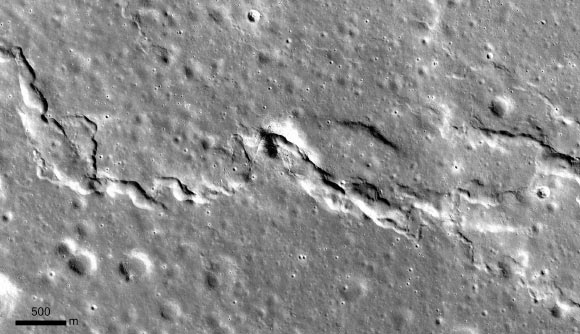
Scientists specializing in planetary research have identified a multitude of small mare ridges (SMRs) distributed across the Moon’s maria, indicating ongoing tectonic processes that could influence future endeavors in space exploration. Furthermore, it has been established that SMRs represent geologically recent formations, with ages ranging between 50 and 310 million years, and are found extensively across the lunar surface.
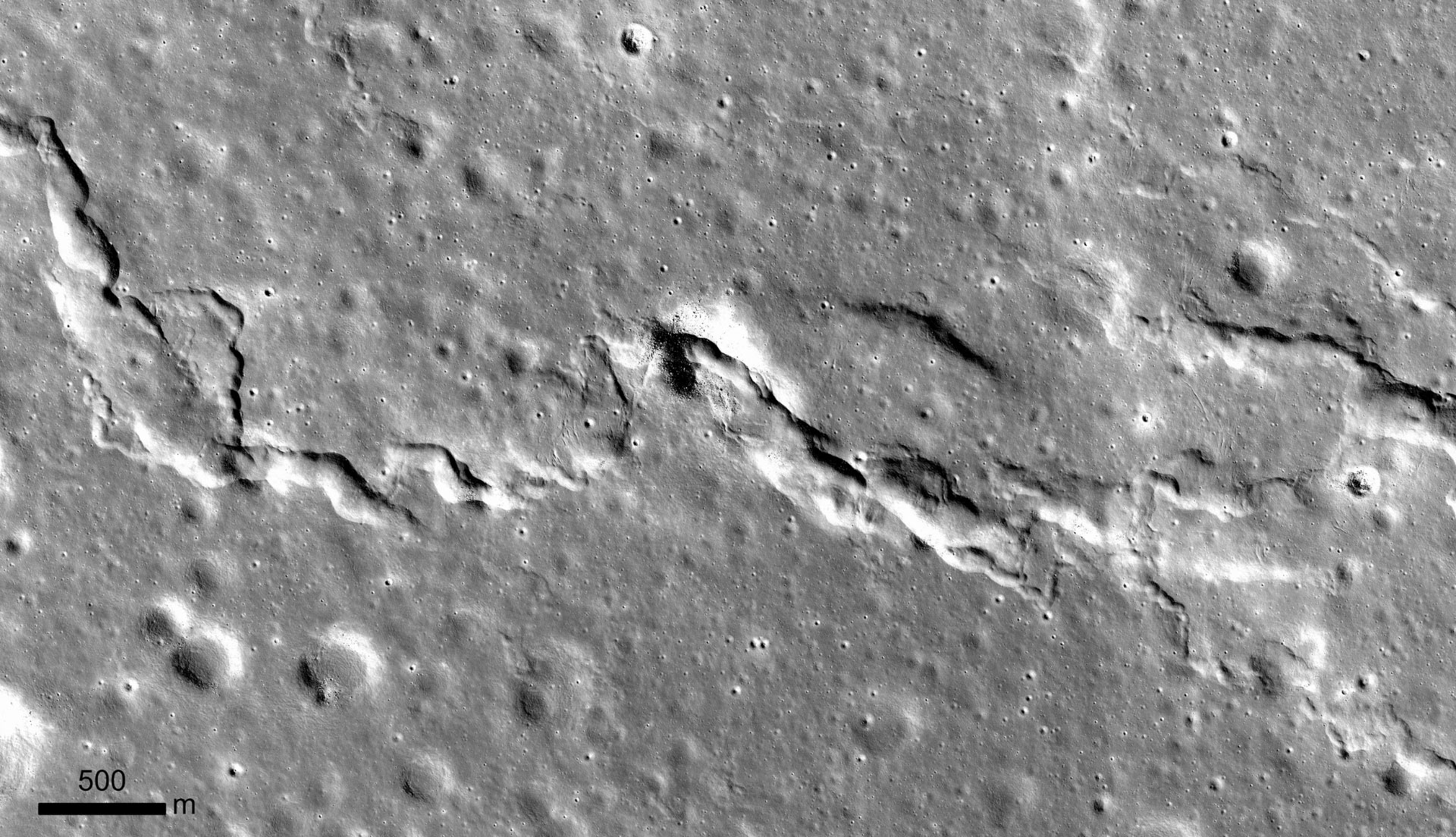
A small mare ridge in Northeast Mare Imbrium taken by the Lunar Reconnaissance Orbiter Camera. Image credit: NASA / GSFC / Arizona State University.
Both Earth and the Moon exhibit tectonic activity; however, the forces driving these processes differ between the two celestial bodies.
The terrestrial crust is segmented into plates that have converged, diverged, and slid past one another, resulting in extensive mountain ranges, profound oceanic trenches, and a circum-Pacific volcanic belt.
In contrast, the lunar crust is not segmented into plates, yet internal stresses within it generate a variety of distinctive geological formations.
Among the most prevalent of these are lobate scarps. These features arise when the crust undergoes compression, causing the resultant forces to elevate and thrust material over adjacent crustal sections along a fault line, thereby creating elevated ridges.
These scarps, observed in the lunar highlands, have only emerged within the last billion years, a period representing approximately 20% of the Moon’s entire geological history.
In the year 2010, research conducted by Tom Watters, an investigator at the Smithsonian Institution, revealed that the Moon is undergoing a gradual contraction.
This shrinkage is responsible for the formation of the lobate scarps found in the lunar highlands.
However, the emergence of lobate scarps does not account for all the recently formed contractional landforms identified on the Moon.
Another category of tectonic landforms that has been recently recognized comprises SMRs.
These geological structures are attributed to the same forces that produce lobate scarps. Nevertheless, whereas lobate scarps are situated in the highlands, SMRs are exclusively located within the maria.
The objective of the new investigation undertaken by Dr. Watters and his associates was to delineate the distribution of SMRs across the lunar maria and to scrutinize their correlation with recent tectonic activity.
“While the widespread presence of lobate scarps across the lunar highlands has been known since the Apollo missions, this marks the initial documentation by scientists of similar features being prevalent throughout the lunar mare,” stated Dr. Cole Nypaver, also affiliated with the Smithsonian Institution.
“This research furnishes us with a globally comprehensive perspective on recent lunar tectonism, which will enhance our comprehension of its interior, its thermal and seismic evolution, and the potential for future lunar seismic events.”
The researchers meticulously compiled the inaugural registry of SMRs found within the near-side lunar maria.
Their findings included the identification of 1,114 novel SMR segments, thereby augmenting the total count of recognized SMRs on the Moon to 2,634.
The analysis also indicated that the average age of an SMR was 124 million years, a figure consistent with the average age of lobate scarps, which stands at 105 million years.
These age estimations suggest that, akin to lobate scarps, SMRs rank among the most recent geological features on the Moon.
Furthermore, the study concludes that SMRs were formed by the same fault types that generate lobate scarps. It was also observed that lobate scarps in the highlands frequently transition into SMRs within the mare, implying a shared origin for these two structural features.
In conjunction with the lobate scarps identified in the lunar highlands, the newly acquired SMR data collectively provide a more holistic depiction of recent contractional tectonic activity on the Moon.
“Our identification of young, diminutive ridges in the maria, coupled with our discovery of their underlying cause, completes the global picture of a dynamically contracting Moon,” remarked Dr. Watters.
The outcomes of this research have been published in the Planetary Science Journal.
_____
C.A. Nypaver et al. 2025. A New Global Perspective on Recent Tectonism in the Lunar Maria. Planet. Sci. J 6, 302; doi: 10.3847/PSJ/ae226a