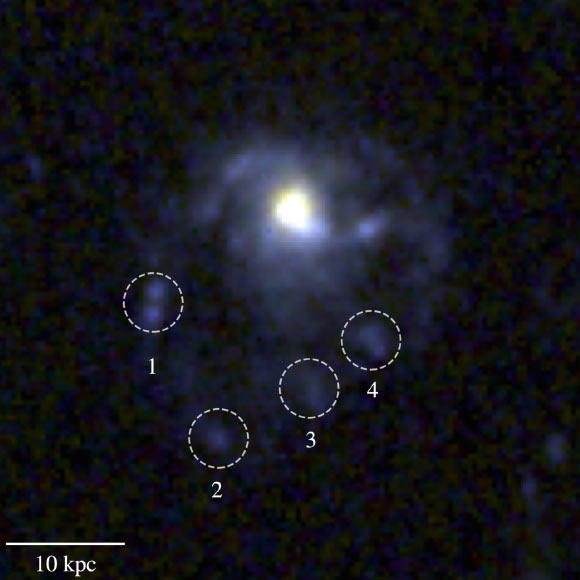
Recent observations conducted with the NASA/ESA/CSA James Webb Space Telescope have identified a galaxy exhibiting extensive gaseous tendrils, or ‘tentacles,’ within a galactic cluster situated at a redshift of 1.156. This signifies that our view of this object corresponds to its state approximately 8.5 billion years in the past.
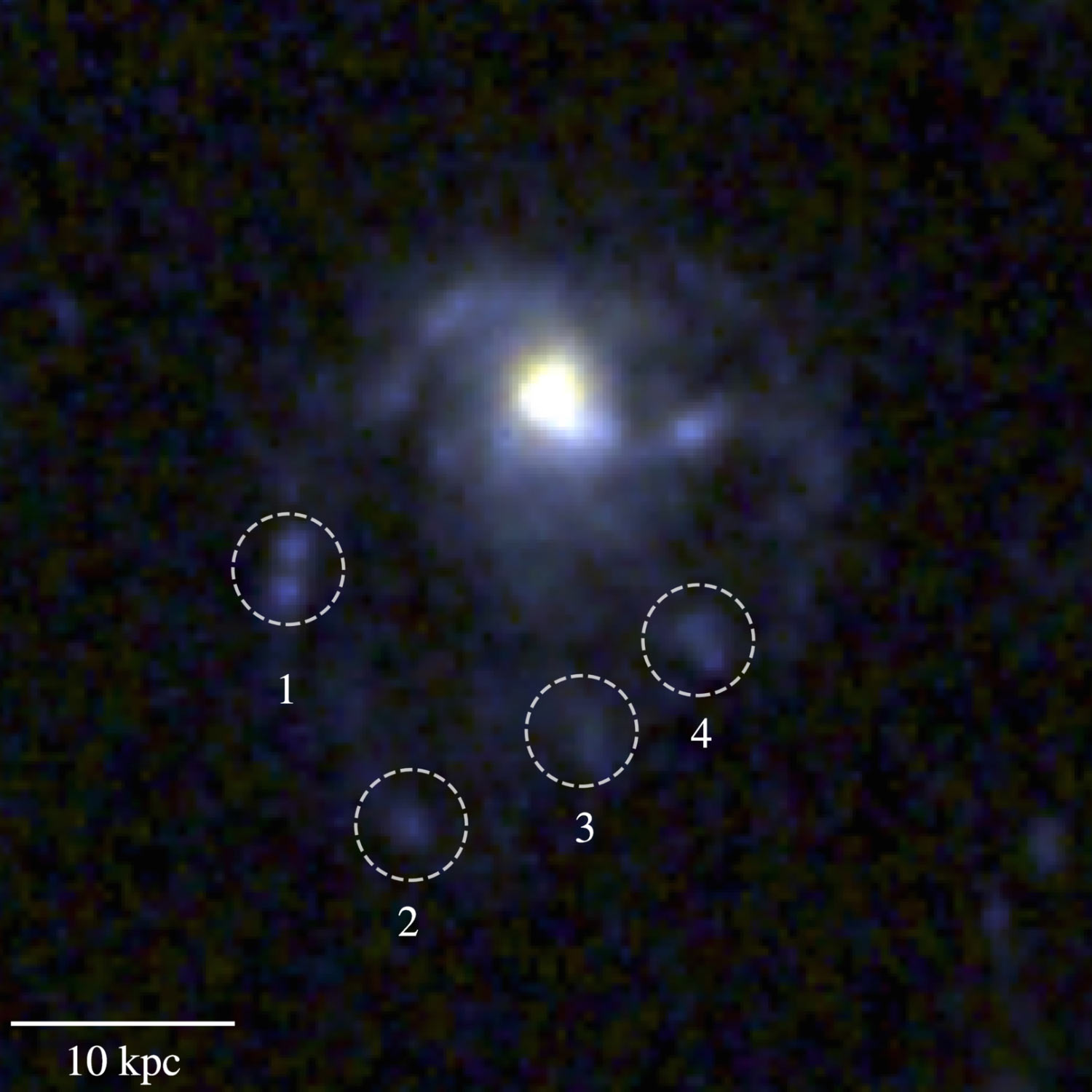
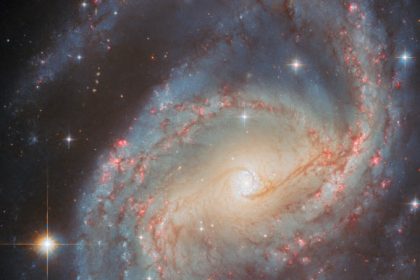
This Webb image shows the jellyfish galaxy COSMOS2020-635829; the dashed circles mark the four extraplanar sources that are identified in the tail of the galaxy. Image credit: Roberts et al., doi: 10.3847/1538-4357/ae3824.
“The appellation ‘jellyfish galaxies’ stems from the elongated, tentacle-like filaments that extend from their main body,” stated Dr. Ian Roberts of the University of Waterloo, along with his esteemed colleagues.
“These celestial objects traverse their surrounding hot, dense galactic clusters at considerable velocities, and the gas residing within these clusters functions analogously to a powerful wind, expelling the galaxy’s intrinsic gas rearward and thereby sculpting these distinctive trails.”
“The scientifically recognized descriptor for this phenomenon is ram-pressure stripping.”
The research team detected the newly identified jellyfish galaxy within extensive deep-space imagery acquired by Webb.
Designated COSMOS2020-635829, this galaxy is located in the COSMOS field, a specific celestial region extensively surveyed by numerous telescopes for the investigation of remote galaxies.
“Our objective was to meticulously examine a substantial volume of observational data from this thoroughly investigated celestial expanse, with the explicit aim of discovering previously unstudied jellyfish galaxies,” Dr. Roberts explained.
“Early in our examination of the Webb datasets, we encountered a remote, uncatalogued jellyfish galaxy that immediately piqued our scientific curiosity.”
COSMOS2020-635829 exhibited a standard-appearing galactic disk, alongside luminous blue condensations within its trailing filaments, which are indicative of nascent stellar populations.
The temporal age of these stars suggests their formation occurred external to the primary galactic structure, within the trails of stripped gas, a phenomenon consistent with galaxies of this classification.
The insights gleaned from the analysis of this particular galaxy have precipitated a re-evaluation of certain established hypotheses concerning cosmic events during that epoch.
Prevailing scientific consensus held that galactic clusters were in a nascent phase of aggregation, and that the process of ram-pressure stripping was relatively infrequent.
Dr. Roberts and his co-authors have put forth three supplementary findings that possess the potential to fundamentally reshape our comprehension of the cosmos.
“The initial implication is that the cluster environments were already sufficiently extreme to induce gas stripping from galaxies, and the second is that galactic clusters may exert a significant influence on galactic characteristics at an earlier stage than previously anticipated,” Dr. Roberts articulated.
“A further consideration is that the combined challenges described herein may have contributed to the formation of the substantial population of quiescent galaxies observed within galactic clusters today.”
“These datasets offer an invaluable and rare glimpse into the transformative processes that shaped galaxies in the early Universe.”
This groundbreaking discovery is detailed in a published treatise appearing in the esteemed journal, the Astrophysical Journal.
_____
Ian D. Roberts et al. 2026. JWST Reveals a Candidate Jellyfish Galaxy at z = 1.156. ApJ 998, 285; doi: 10.3847/1538-4357/ae3824