A cancer diagnosis can precipitate a profound shift in an individual’s life. Such news often elicits feelings of distress, apprehension, or despondency, compelling patients to re-evaluate their perspectives and perceive life through an altered lens.
A recent scholarly investigation suggests that this transformative experience may also engender an unexpected consequence. In the years following a cancer diagnosis, individuals demonstrate a significantly elevated propensity towards criminal convictions, even those with unblemished prior records.
This phenomenon bears a striking resemblance to the narrative arc of the television series Breaking Bad, which chronicles the ethical and legal descent of a seemingly innocuous high school chemistry instructor after receiving a cancer diagnosis.
However, the vast majority of cancer patients exhibiting this behavioral shift do not succumb to the same level of moral compromise as the character Walter White. The findings indicate that their convictions typically pertain to offenses such as petty theft or the possession of illicit substances.
Nonetheless, these transgressions can still precipitate considerable hardship. Considering the potential repercussions for individuals convicted, their families, and the aggrieved parties, it warrants a more thorough examination to ascertain whether cancer is indeed the underlying driver of this pattern and, if so, to elucidate the mechanisms involved.
To achieve this objective, a collective of economists meticulously integrated data from multiple administrative registers within Denmark. This endeavor yielded an extensive repository of information encompassing demographic data, employment statistics, educational attainment, income levels, asset ownership, health status, and criminal histories.
Their analytical focus was directed towards 368,317 individuals who received a cancer diagnosis between the years 1980 and 2018. By correlating health records with criminal justice data, they were able to draw comparisons between the behavior of cancer patients and a control cohort that had not been diagnosed with the disease.
Initially, the research revealed no discernible inclination towards criminal activity among newly diagnosed cancer patients. In fact, crime rates exhibited a decline in the first year post-diagnosis, a trend that is reasonably attributable to the arduous nature of intensive treatments such as radiation therapy or chemotherapy often undertaken by these patients.
“The rationale behind this initial reduction is quite straightforward,” the researchers observed. “The process of undergoing cancer treatment is physically taxing and necessitates prolonged periods of hospital visits or confinement for the patient.”
However, a notable shift emerges approximately two years after the diagnosis: the probability of a criminal conviction for patients escalates beyond their pre-cancer baseline, reaching a statistically significant level.
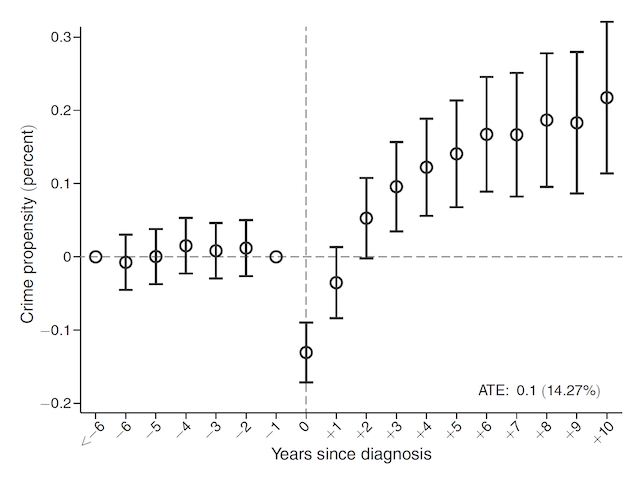
This effect intensifies over a five-year period subsequent to diagnosis, after which it remains elevated at substantial levels for an additional five years.
Collectively, the study determined that individuals diagnosed with cancer are 14 percent more likely to face a criminal conviction.
Beyond merely establishing this statistical association, the research team aimed to investigate the underlying reasons why a cancer diagnosis might predispose individuals to engage in unlawful conduct. They explored several potential pathways, commencing with an examination of economic factors.
All participants in this study benefited from health insurance, a universal provision in Denmark. This suggests that the impetus for engaging in criminal behavior was not driven by the burden of uncompensated medical expenses, as the authors pointed out.
Nevertheless, cancer undeniably imposes a financial strain. The authors reported that patients’ likelihood of remaining employed diminishes by 1.5 percentage points in the year of their diagnosis, and even those who retain employment tend to work fewer hours and experience a reduction in their earnings.
“We have demonstrated that individuals who exhibit the most pronounced correlation between crime and cancer also tend to experience the most significant downturn in their overall income,” the researchers stated.
However, in addition to surges in economic and property-related offenses, the study also identified a considerable increase in non-economic crimes, including acts of violence, hinting at the influence of additional contributing factors.
The researchers also took into account patients’ prognostic outlooks regarding survival, postulating that the contemplation of an imminent demise might attenuate the deterrent effect of long-term penalties, such as incarceration.
They stratified patients into distinct subgroups based on projected five-year survival rates, which were derived from factors including cancer type and patient characteristics like age, gender, and marital status.
The nexus between cancer and criminal behavior was found to be more pronounced among patients whose five-year survival probability experienced a more precipitous decline during the year of their diagnosis.
The implementation of social welfare policies could potentially serve to ameliorate this effect. By leveraging variations arising from the 2007 Danish municipal reforms, the study’s authors discovered that the escalation in crime associated with cancer was more pronounced in locales where social support provisions had been curtailed.
Cancer patients are continually required to adjust to new, often unwelcome, circumstances. Many seek solace and assistance from their support networks or direct their efforts towards enhancing their health, through activities such as physical exercise and exploring treatment alternatives.
Should this correlation prove consistent in other nations, it could signify the existence of an emerging deficit in supportive services.
“Our findings suggest that policies designed to address the financial ramifications of health crises are instrumental in mitigating their subsequent influence on crime rates,” the researchers concluded.