New scientific inquiry spearheaded by paleontologists from Yunnan University reveals that two distinct species of myllokunmingiid fish, inhabitants of present-day China approximately 518 million years ago during the Cambrian epoch, were equipped with a remarkable visual system featuring two prominent lateral ocular structures complemented by two smaller, centrally positioned eyes.
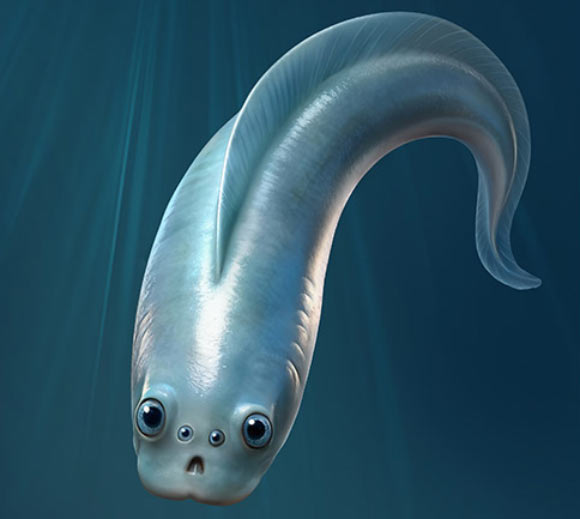
An artist’s reconstruction of a myllokunmingiid with four eyes that helped it see and navigate its ancient world. Image credit: Xiangtong Lei & Sihang Zhang.
The myllokunmingiids represent an ancestral lineage of jawless fish that flourished during the Cambrian period, a transformative era marked by a rapid diversification of animal forms and sensory capabilities, spurred by escalating predatory pressures.
These ancient organisms are recognized as the earliest known members of the vertebrate class.
In a recent scholarly endeavor, Professor Peiyun Cong of Yunnan University, alongside his research associates, meticulously analyzed newly unearthed, exceptionally preserved myllokunmingiid fossil specimens originating from the renowned Chengjiang fossil beds located in southern China.
“The ocular structures within these fossils are preserved with an astonishing degree of fidelity,” Professor Cong stated.
“Our initial examination focused on the conspicuous large eyes to elucidate their structural composition—and to our profound astonishment, we discovered two diminutive, fully functional eyes situated between them. This revelation was exceptionally exhilarating.”
The research indicates that modern vertebrates primarily rely on a binate visual system.
A structure embedded deep within the cranial cavity, known as the pineal gland, plays a role in circadian rhythm regulation by responding to ambient light and synthesizing melatonin.
In certain aquatic and terrestrial vertebrates, including fish, amphibians, and reptiles, this organ retains the capacity to perceive light and is sometimes referred to as a ‘third eye.’
The examination of the two newly identified myllokunmingiids demonstrates that in the nascent stages of vertebrate evolution, the pineal complex was not merely a light-sensitive organ—it constituted a pair of sophisticated, image-forming eyes.
“Our findings suggest that the precursors to the pineal organs were, in fact, image-forming eyes,” Professor Cong elucidated.
“It was only at a later evolutionary juncture that they underwent a reduction in size, lost their visual acuity, and assumed their contemporary function in regulating sleep cycles.”
The scientific team employed advanced microscopy techniques to detect melanosomes—organelles containing pigments responsible for coloration and light absorption in living eyes—within all four ocular structures of the myllokunmingiids.
Subsequent chemical analysis confirmed the presence of melanin, the identical pigment utilized in the visual systems of contemporary vertebrates.
The identification of circular formations consistent with lenses provides compelling evidence that these ocular organs were capable of generating images, transcending mere light detection, thereby offering direct substantiation of advanced visual capabilities in the earliest vertebrates.
“Preserved fossilized eyes are exceedingly uncommon; the delicate nature of ocular tissues typically precludes their survival over hundreds of millions of years,” commented Professor Sarah Gabbott from the University of Leicester.
“However, under specific environmental conditions, they can persist, and when they do, they offer an invaluable glimpse into the perceptual world of extinct fauna.”
“Although it was a speculative endeavor, we harbored a suspicion that the ocular structures in these Chinese fossils might have been preserved—and indeed, they were, complete with light-absorbing retinal pigments and image-forming lenses, thereby illuminating the remarkable visual acuity of our most ancient ancestors.”
During the Cambrian period, marine ecosystems presented significant perils. The emergence of formidable predators coincided with the existence of early vertebrates that were small, lacking exoskeletons, and inherently vulnerable.
“In such a hazardous milieu, possessing four eyes could have afforded these creatures an expanded visual field—crucial for predator evasion,” remarked Dr. Jakob Vinther, a paleontologist affiliated with the University of Bristol.
The research findings also resolve a protracted enigma concerning the evolutionary genesis of the pineal gland and furnish the most ancient documented evidence of camera-type eyes within the fossil record.
“This discovery fundamentally alters our perception of early vertebrate evolution,” Dr. Vinther asserted.
“It appears our ancestral lineage comprised visually adept organisms navigating a perilous world.”
Furthermore, the study challenges the conventional understanding of the vertebrate ‘third eye,’ suggesting a need for revision.
“In actuality, these creatures did not merely possess a third eye—they were endowed with a fourth,” Dr. Vinther concluded.
This groundbreaking discovery is detailed in a scholarly publication released on January 21, 2026, in the esteemed journal Nature.
_____
X. Lei et al. 2026. Four camera-type eyes in the earliest vertebrates from the Cambrian period. Nature 650, 150-155; doi: 10.1038/s41586-025-09966-0