A comprehensive reexamination of 250-million-year-old fossil specimens housed in Australian and United States museum archives has unveiled a striking diversity of trematosaurid temnospondyls within Western Australia. This discovery indicates that early marine amphibians achieved widespread continental distribution shortly following the devastating end-Permian mass extinction event.
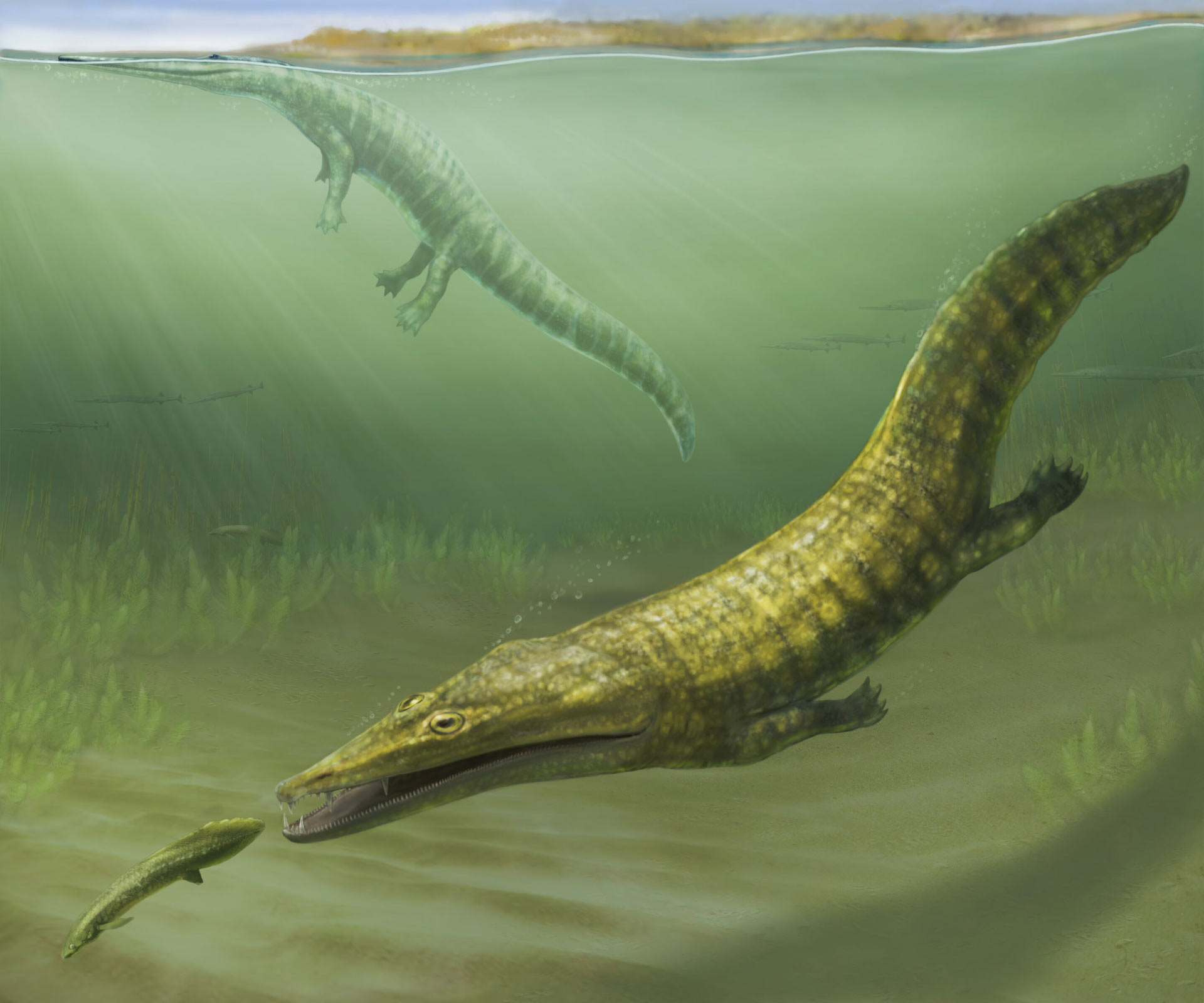
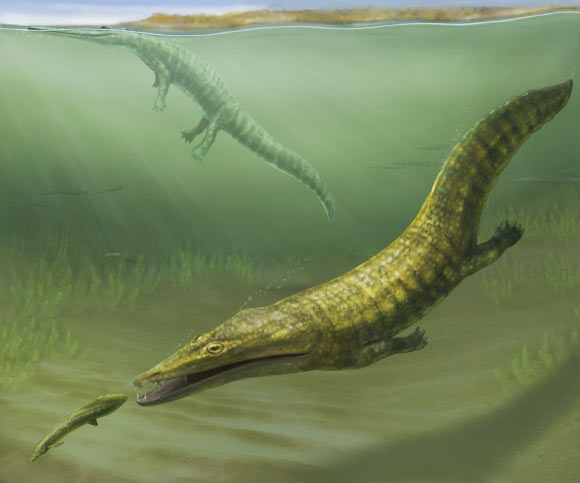
The ancient marine amphibians Erythrobatrachus (foreground) and Aphaneramma (background) swimming along the coast of what is now far norther Western Australia 250 million years ago. Image credit: Pollyanna von Knorring, Swedish Museum of Natural History.
“The cataclysmic global extinction at the end of the Permian period, coupled with extreme worldwide temperature increases, precipitated the genesis of modern marine ecosystems at the dawn of the Age of Dinosaurs, approximately 252 million years ago,” stated Dr. Benjamin Kear of the Swedish Museum of Natural History, alongside his research associates.
“This pivotal evolutionary development witnessed the initial emergence of terrestrial vertebrates adapted to marine environments, encompassing both amphibians and reptiles. These creatures rapidly ascended to prominence as dominant apex predators within aquatic realms.”
“Up to the present, fossil evidence of these pioneering sea-dwelling vertebrates has been predominantly documented from the Northern Hemisphere.”
“In contrast, faunal records from the Southern Hemisphere are characterized by geographic scarcity and incomplete understanding.”
In their recent investigation, the paleontological team undertook an analysis of marine amphibian fossils sourced from the renowned Kimberly region of far northern Western Australia.
“These fossil findings were originally unearthed in Australia during scientific expeditions conducted in the early 1960s and 1970s,” the researchers reported.
“The collected specimens were subsequently distributed among museum collections in both Australia and the United States.”
“The resultant research was ultimately disseminated in 1972, identifying a solitary species of marine amphibian, Erythrobatrachus noonkanbahensis. This taxon was named based on several cranial fragments discovered weathering out of a rock formation at Noonkanbah cattle station, situated east of the remote Kimberly settlement of Derby.”
“Regrettably, the original fossil material of Erythrobatrachus became unlocatable sometime within the intervening five decades.”
“This situation necessitated a meticulous search through international museum archives, culminating in the rediscovery and subsequent reevaluation of these intriguing ancient marine amphibian remains in the year 2024.”
According to the scientific consensus, Erythrobatrachus has been classified as a trematosaurid temnospondyl.
“The trematosaurids were ancient relatives of extant salamanders and frogs, possessing a morphology superficially akin to crocodiles and attaining lengths of up to 2 meters (6.6 feet),” they elaborated.
“Their significance lies in the fact that their fossilized remains are found in sedimentary rock deposits formed in coastal environments, dating from less than a million years after the mass extinction event at the Permian-Triassic boundary.”
“Consequently, they represent the oldest recognizable group of Mesozoic marine tetrapods currently known from the geological record.”
However, a detailed examination surprisingly revealed that the cranial fragments attributed to Erythrobatrachus did not exclusively represent a single species.
Instead, they were found to encompass at least two distinct types of trematosaurids: Erythrobatrachus itself, and an additional species assignable to the well-established genus Aphaneramma.
“Analysis of the Erythrobatrachus skull employing high-resolution three-dimensional imaging techniques suggests that, when intact, it measured approximately 40 cm (16 inches) in length and belonged to a large, broad-headed apex predator,” the authors reported.
“Conversely, Aphaneramma was of comparable size but possessed an elongated, slender snout adapted for capturing small fish.”
“Both of these trematosaurid species were nektonic swimmers, capable of traversing the water column, and are presumed to have hunted different prey within the same ecological niche.”
“Furthermore, while Erythrobatrachus is solely known from Australian fossil localities, remains of Aphaneramma have been documented in deposits of similar age found in Svalbard within the Scandinavian Arctic, the Russian Far East, Pakistan, and Madagascar.”
“The Australian trematosaurid discoveries thus provide compelling evidence that these earliest Mesozoic marine tetrapods not only diversified rapidly into a spectrum of ecological roles but also achieved global dispersal, possibly by traversing the coastal margins of interconnected supercontinents during the initial two million years of the Mesozoic Era.”
The research team’s publication appeared in the current month’s issue of the Journal of Vertebrate Paleontology.
_____
Benjamin P. Kear et al. Revision of the trematosaurid Erythrobatrachus noonkanbahensis confirms a cryptic marine temnospondyl community from the Lower Triassic of Western Australia. Journal of Vertebrate Paleontology, published online February 22, 2026; doi: 10.1080/02724634.2025.2601224