A collaborative effort involving scientists from the United States, Europe, and China has leveraged the Ultraviolet Spectrograph (UVS) aboard NASA’s Juno spacecraft to meticulously delineate detailed structural formations within Ganymede’s auroral displays. These formations bear a striking resemblance to patterns observed in Earth’s aurorae. The implications of these discoveries suggest that the dynamic interplay between magnetic fields and energetic charged particles may constitute a fundamental, pervasive mechanism driving auroral phenomena, offering profound insights for comprehending magnetospheric behavior across our solar system.
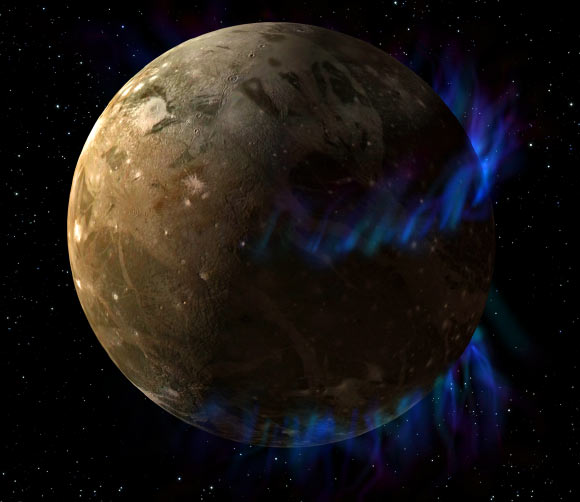
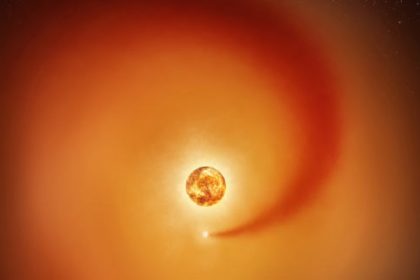
An artist’s concept of aurorae on Jupiter’s moon Ganymede. Image credit: NASA / ESA / G. Bacon, STScI / J. Saur, University of Cologne.
Ganymede distinguishes itself as the sole known moon possessing its own inherent magnetic field, thereby maintaining a localized magnetosphere that is embedded within the larger magnetosphere of Jupiter.
The luminous emissions comprising Ganymede’s aurorae are predominantly generated by oxygen atoms at specific ultraviolet wavelengths (130.4 and 135.6 nm), energized by the impact of precipitating electrons.
In a recent investigation, Philippe Gusbin, a researcher at the University of Liège, along with his esteemed colleagues, undertook an analysis of ultraviolet observations of Ganymede acquired by the Juno spacecraft on June 7, 2021.
Their analysis successfully pinpointed numerous auroral distinct regions, or patches, situated on the moon’s hemisphere facing away from its direction of orbital motion.
These identified patches exhibit characteristic dimensions of approximately 50 kilometers and possess luminance levels reaching around 200 Rayleigh units.
“Auroral phenomena are also detected on Ganymede, and they are understood to be a consequence of energetic electron precipitation into its tenuous oxygen atmosphere,” explained Gusbin.
“Prior to the Juno mission, investigations of Ganymede’s aurorae were constrained by the limited spatial resolution of Earth-based observations, which prevented the discernment of the fine-scale substructures typically observed in planetary auroral displays.”
The structural characteristics and spatial scale of these Ganymedean features bear a marked resemblance to auroral ‘beads’ that have been documented on Earth preceding magnetospheric substorms, as well as those observed on Jupiter during events colloquially termed ‘dawn storms’.
The observed scarcity of comparable patches in the southern hemisphere is tentatively attributed to the specific viewing perspective of the spacecraft. However, potential inherent asymmetries, possibly linked to Ganymede’s spatial positioning within Jupiter’s pervasive plasma disk, cannot be definitively excluded.
“These ‘beads’ have previously been documented in the auroral emissions of Earth and Jupiter, where their occurrence is correlated with magnetospheric substorms and dawn storms—significant dynamic reconfigurations of the magnetosphere that result in the discharge of substantial energy and the generation of intense auroral activity,” stated Dr. Alessandro Moirano, a postdoctoral researcher affiliated with the University of Liège and the National Institute for Astrophysics in Rome.
These groundbreaking findings strongly suggest that analogous physical processes may be operative across a diverse array of magnetospheric environments, notwithstanding considerable disparities in their physical dimensions and ambient conditions.
“The close-proximity observations of Ganymede by Juno were of limited duration, spanning less than 15 minutes, and the spacecraft will not undertake further passes over the moon. Consequently, our current understanding of the prevalence and temporal evolution of these auroral patches remains incomplete,” remarked Dr. Bertrand Bonfond, an astrophysicist based at the University of Liège.
“Fortunately, the European Space Agency’s Jupiter Icy Moons Explorer (JUICE) mission is en route to Jupiter, with an anticipated arrival in 2031, and is slated to conduct dedicated observational campaigns focused on Ganymede.”
“This sophisticated spacecraft is outfitted with an ultraviolet spectrograph possessing capabilities comparable to Juno’s instrument. This will empower us to gather observational data over extended durations, meticulously track the dynamic changes in Ganymede’s aurorae, and, it is hoped, to uncover novel scientific revelations.”
A scholarly article detailing these significant findings has been published in the esteemed journal Astronomy & Astrophysics.
_____
A. Moirano et al. 2026. Juno’s high-spatial-resolution ultraviolet observations of Ganymede’s auroral patches. Constraints on the magnetospheric source region. A&A 706, L16; doi: 10.1051/0004-6361/202558379