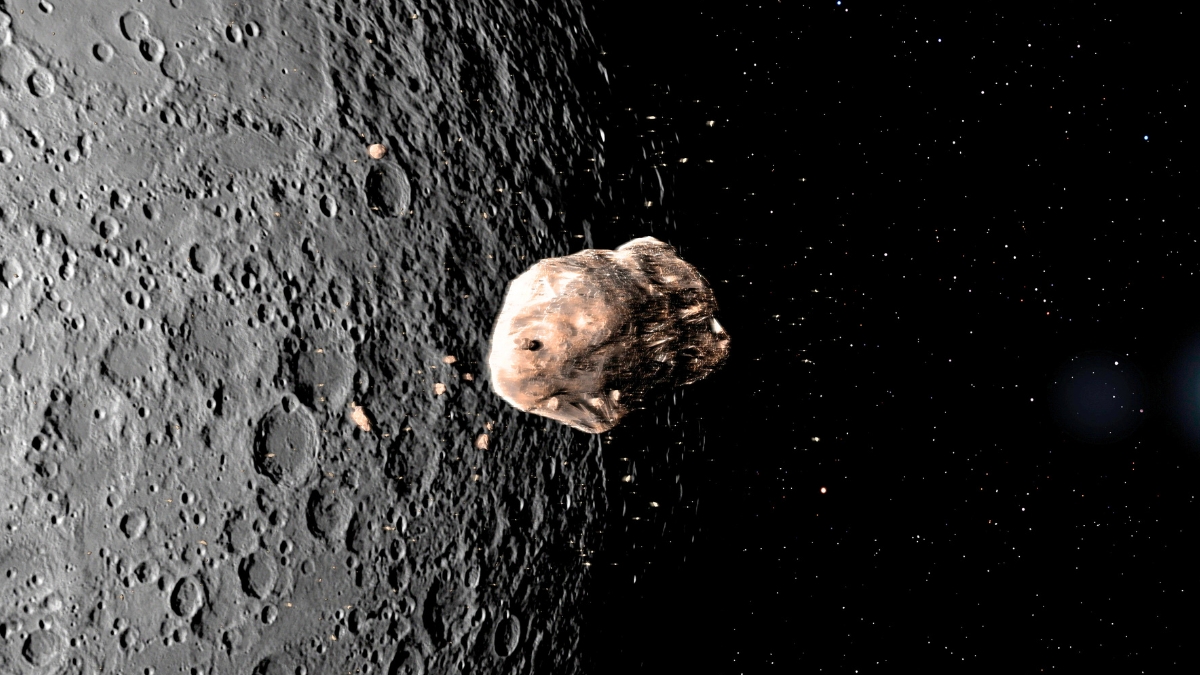
Rest assured, an impending celestial event that might have sparked curiosity is no longer a cause for concern: NASA has definitively dispelled any possibility of an asteroid, designated 2024 YR4, colliding with the Moon in the year 2032.
Previously, the ambiguity surrounding the celestial body’s trajectory introduced a remote prospect of impact, a situation that persisted throughout the preceding year. However, recent, highly precise readings obtained by NASA’s James Webb Space Telescope have conclusively affirmed that the asteroid will indeed bypass the Moon.
Drawing upon the data acquired by JWST on February 18th and 26th, specialists affiliated with NASA’s Center for Near-Earth Object Studies, situated at the Jet Propulsion Laboratory, anticipate that 2024 YR4 will traverse past the lunar expanse at an altitude of 13,200 miles on the 22nd of December, 2032.
Earlier evaluations of 2024 YR4’s orbital trajectory were less refined and had posited a 4.3 percent likelihood of its impact on the Moon during 2032.
The discovery of asteroid 2024 YR4 occurred in the latter part of 2024, attributed to the Asteroid Terrestrial-Impact Last Alert System (ATLAS) operating in Chile. In the early stages of 2025, preliminary observations of the asteroid were sufficiently uncertain to prompt astronomers to acknowledge a minuscule possibility of an Earth impact.
While the scenario involving a terrestrial collision was swiftly discounted, the lingering uncertainty concerning a potential lunar impact persisted for a more extended period.
From the spring of 2025 onwards, the asteroid’s path through the solar system rendered it too faint for observation until it was recently detected last month by JWST’s near-infrared camera.
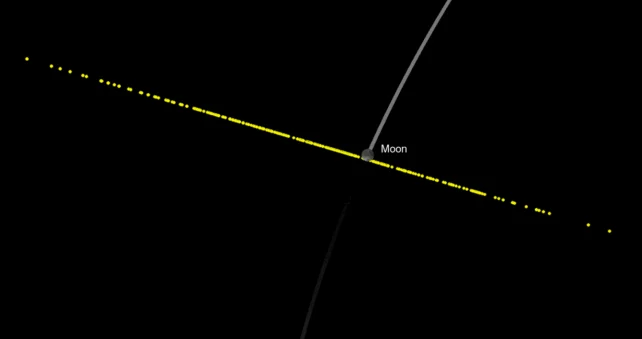
It is not uncommon for initial projections concerning the orbital paths of near-Earth asteroids to exhibit sufficient uncertainty to suggest a conceivable risk of cosmic collision.
Subsequent observational data typically serves to negate such impact possibilities. This was notably the case with an asteroid identified as Apophis, which garnered significant attention upon its discovery in 2004.
Astronomers at that time assigned Apophis a slight probability of impacting Earth in either 2029 or potentially 2036. A subsequent series of observations conducted in 2013 effectively eliminated this risk, and the current situation with 2024 YR4 has reached a comparable resolution.
In the hypothetical event that 2024 YR4 were to strike the Moon, the magnitude of the resulting impact would have been substantial. Experts estimate the asteroid’s diameter to be approximately 200 feet, comparable in size to a 15-story building.
Ed Lu, a former astronaut and the head of the B612 Foundation’s Asteroid Institute, stated last year that an object of such dimensions could excavate a crater on the Moon measuring 1.2 miles in width.
Lu elaborated, “A significant quantity of ejected material would primarily find its way into orbit around the Moon, or settle in its vicinity.”
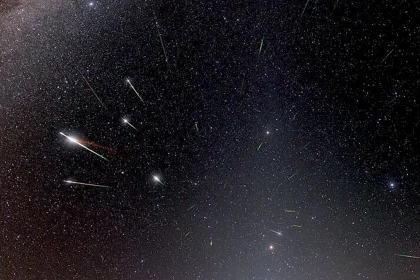
“Should an impact occur, it would be discernible from Earth with the naked eye. The resultant explosion would be considerable, propelling a substantial amount of debris skyward. I would even venture to predict that meteor showers would become visible on Earth.”
Corey S. Powell, co-editor-in-chief of OpenMind Magazine, speculated that this latest development might be met with some disappointment by individuals who had been anticipating a spectacular lunar event.
Powell conveyed in a communication on Bluesky, “My apologies to those anticipating grand celestial pyrotechnics on the Moon.”
This report was initially disseminated by Universe Today. Access the original narrative here.