In the year 2022, NASA achieved a groundbreaking feat by intentionally colliding a spacecraft with an asteroid, aiming to ascertain its capacity to modify the celestial body’s trajectory around a larger companion asteroid.
It was previously established that the Double Asteroid Redirection Test (DART) mission yielded remarkable success, diminishing the orbital period of the asteroid binary, Didymos and Dimorphos, by an impressive 33 minutes.
However, subsequent analyses have unveiled a more significant outcome: the impact also instigated a change in the entire heliocentric trajectory of the Didymos-Dimorphos system.
This developmental milestone represents the inaugural instance of humankind directly influencing the orbit of a natural celestial object around the Sun.
“This investigative effort adds the capability of deflecting a binary asteroid system within its heliocentric orbit to the array of novel technologies demonstrated by the DART mission,” as articulated by a research collective spearheaded by aerospace engineer Rahil Makadia, affiliated with the University of Illinois at Urbana-Champaign.
The imperative behind the DART mission was rooted in the pursuit of planetary safeguarding. The Solar System harbors a multitude of substantial rocky bodies; while currently no imminent threats to Earth are identified, humanity seeks to establish preparedness protocols for such eventualities.
The operational concept for DART was fundamentally uncomplicated. The intended target comprised a celestial pair gravitationally interconnected; the more substantial, designated Didymos, measures approximately 780 meters in diameter (equivalent to 2,560 feet), and the lesser, named Dimorphos, is roughly 160 meters across (or 525 feet). Given Dimorphos’s smaller stature, it was anticipated to be more amenable to orbital modulation.
This particular asteroid system was selected, in part, due to its meticulously characterized orbital period, which facilitated the straightforward quantification of any induced alterations. For the DART mission to achieve its objective, the impact had to sufficiently alter Dimorphos’s course to modify its orbital duration around its primary asteroid counterpart.
The scientific cadre had projected a temporal shift of approximately 7 minutes; consequently, the actual recorded deviation of 33 minutes engendered considerable enthusiasm.
Nevertheless, the asteroid system constitutes but a component of a grander cosmic entity—the entire Solar System. Makadia and his colleagues endeavored to ascertain whether the DART mission had succeeded in modifying not only Dimorphos’s orbital period around Didymos but also the macroscopic trajectory of the paired objects as they circumnavigate the Sun.
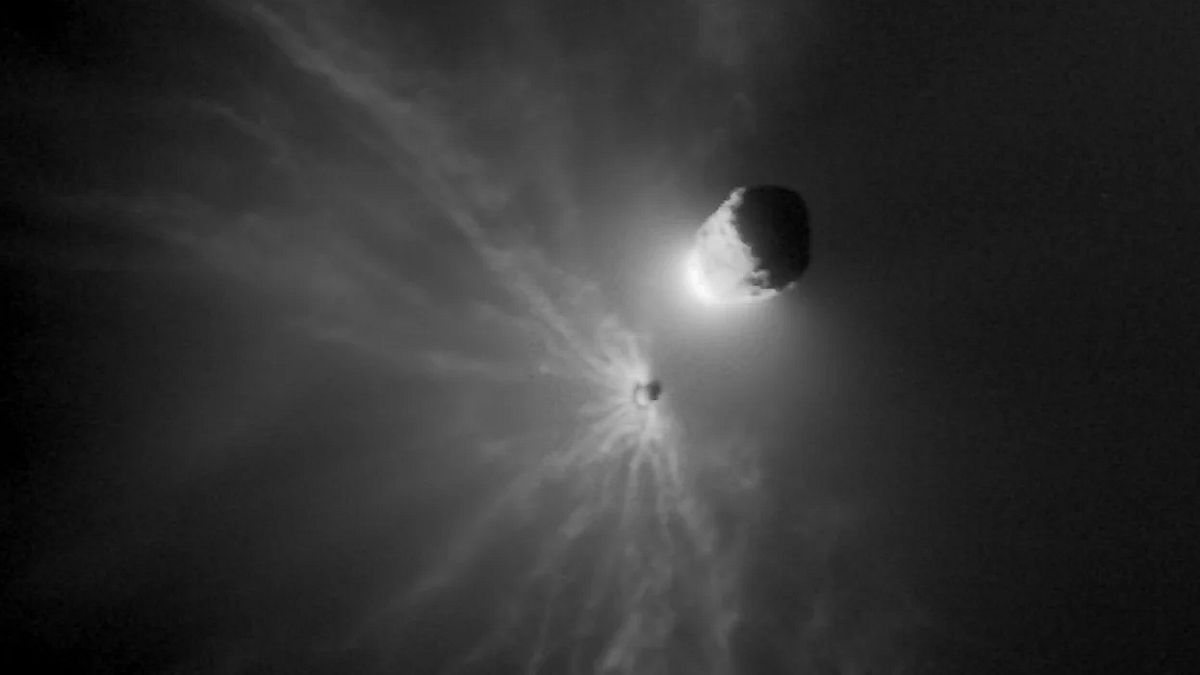
Due to the gravitational affinity between Dimorphos and Didymos, they jointly revolve around a common barycenter. The kinetic impetus imparted to Dimorphos by the DART impact was not confined solely to the smaller asteroid; it also resulted in the ejection of material, generating debris.
#DART Mission#LICIACube – #Luke –
target: #Didymos #Dimorphos
NASA/ASI/j. Roger pic.twitter.com/S8Jqoqv4d7— landru79 Jacint Roger (@landru79) November 3, 2023
This expelled material carried momentum away from the system, a phenomenon scientists had theorized would induce a minor reactive force, potentially causing a subtle alteration in the Didymos-Dimorphos pair’s orbital motion around the Sun.
In the intervening period since the September 2022 impact event, sophisticated instruments have diligently observed the asteroid system. Makadia’s research team undertook an exhaustive analysis of data derived from 22 stellar occultations, 5,955 ground-based positional measurements of the system, three navigation telemetry sets from the DART spacecraft itself, and nine terrestrial distance assessments.
Collectively, this comprehensive dataset corroborated that the impact indeed provided the Didymos-Dimorphos system with a minute propulsion, decelerating its orbital velocity by approximately 11.7 micrometers per second—a speed equivalent to about 42 millimeters per hour (comparable to the width of an Apple Watch).
However, within the vacuum of space, even the most diminutive impetus can, over extended durations, culminate in a substantial positional divergence.
Over periods relevant to planetary defense strategies—encompassing years or decades of proactive monitoring, assuming favorable circumstances—even a minuscule deflection could prove sufficient to guide a potentially hazardous asteroid onto a safe trajectory away from Earth.
Future orbital endeavors will contribute to a more nuanced understanding of the events that transpired during the impact. The European Space Agency’s Hera spacecraft, slated for arrival at the Didymos system later this decade, will conduct an in-depth examination of the impact scar inflicted by DART and meticulously quantify the asteroids’ masses and internal structures.
Nevertheless, the accomplishments to date are nothing short of extraordinary. For the first time in human history, the trajectory of a natural object traversing the Solar System has been intentionally altered.
“By substantiating that asteroid deflection missions, such as DART, possess the capacity to induce modifications in the heliocentric orbit of a celestial body,” the investigators affirm, “this research signifies a significant advancement in our capacity to preempt future asteroid impacts on Earth.”