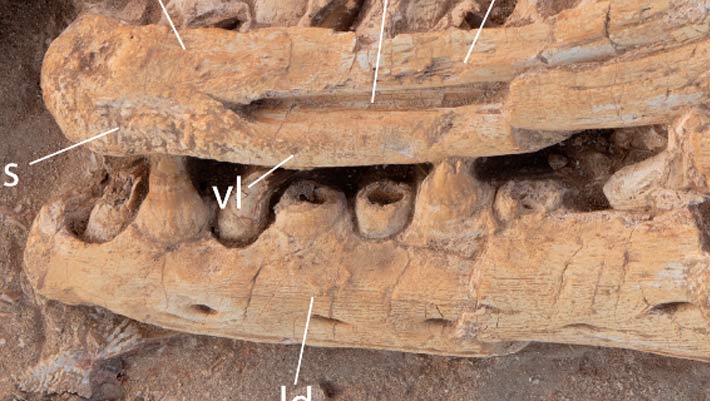
Paleontologists have announced the discovery of a novel, colossal species belonging to the mosasaur genus Pluridens, unearthed from Late Cretaceous phosphate deposits in Morocco. This newly identified species, christened Pluridens imelaki, was part of a lineage of mosasaurs characterized by comparatively slender jaws and is estimated to have attained lengths exceeding 9 meters (approximately 29.5 feet).
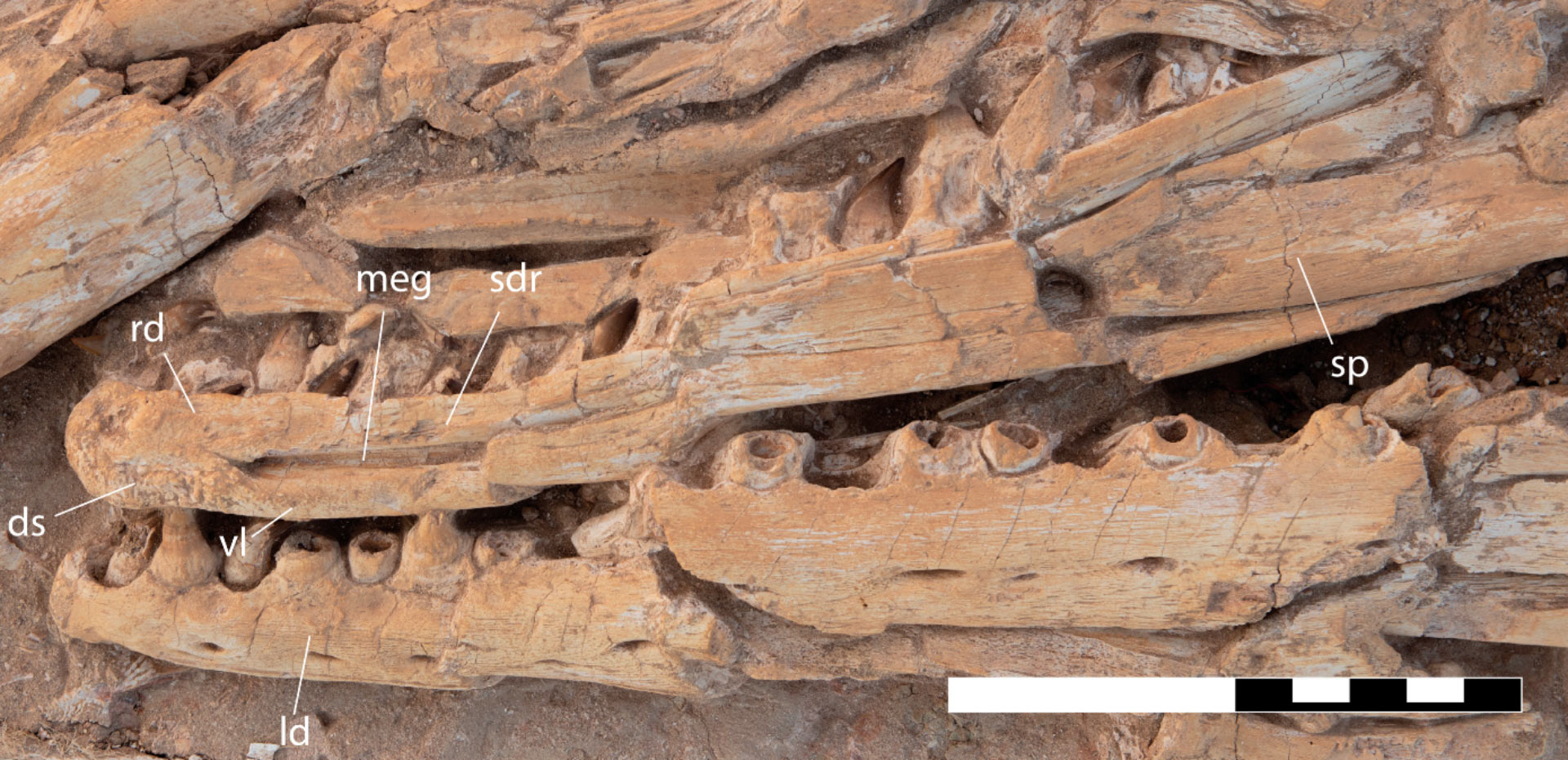
Pluridens imelaki, holotype, close-up of the dentaries. Scale bar – 10 cm. Image credit: Nicholas R. Longrich & Nour-Eddine Jalil, doi: 10.3390/d18030159.
The habitat of Pluridens imelaki was the marine realm during the terminal Maastrichtian age of the Cretaceous period, approximately 66 to 67 million years ago.
This species was classified within the Halisaurinae, a subfamily typically regarded as being of smaller stature compared to many other mosasaur lineages.
Anterior representatives of this group exhibited lengths ranging from approximately 4 to 5 meters (13 to 16.4 feet), as seen in species like Halisaurus, with closely related species such as Pluridens serpentis reaching roughly 7.5 meters (24.6 feet).
With an estimated body length surpassing 9 meters, Pluridens imelaki rivaled in size some of the most formidable predatory mosasaurs documented from the region.
“The Late Cretaceous epoch was marked by a significant diversification of the Mosasauridae, a distinct group of large marine squamates that rose to prominence as the primary marine predators during the final quarter-century of that era,” stated Dr. Nicholas Longrich of the University of Bath and Dr. Nour-Eddine Jalil from the Muséum National d’Histoire Naturelle in Paris, France, and the Muséum d’Histoire Naturelle de Marrakech.
“The most varied known assemblage of mosasaurs, and potentially the most biodiverse marine reptile fauna globally, originates from the Late Maastrichtian phosphatic beds of Morocco.”
“Numerous novel species have been cataloged in recent years, with over 16 distinct species now having been reported.”
“All four principal mosasaurid subfamilies are represented within these phosphate deposits: Mosasaurinae, Plioplatecarpini, Tylosaurinae, and Halisaurinae, in addition to the more basal mosasauroid, Pachyvaranus.”
“While the Mosasaurinae contribute the majority of species diversity, the Halisaurinae are notably prevalent in the Moroccan phosphates and were widespread across Africa throughout the Cretaceous period.”
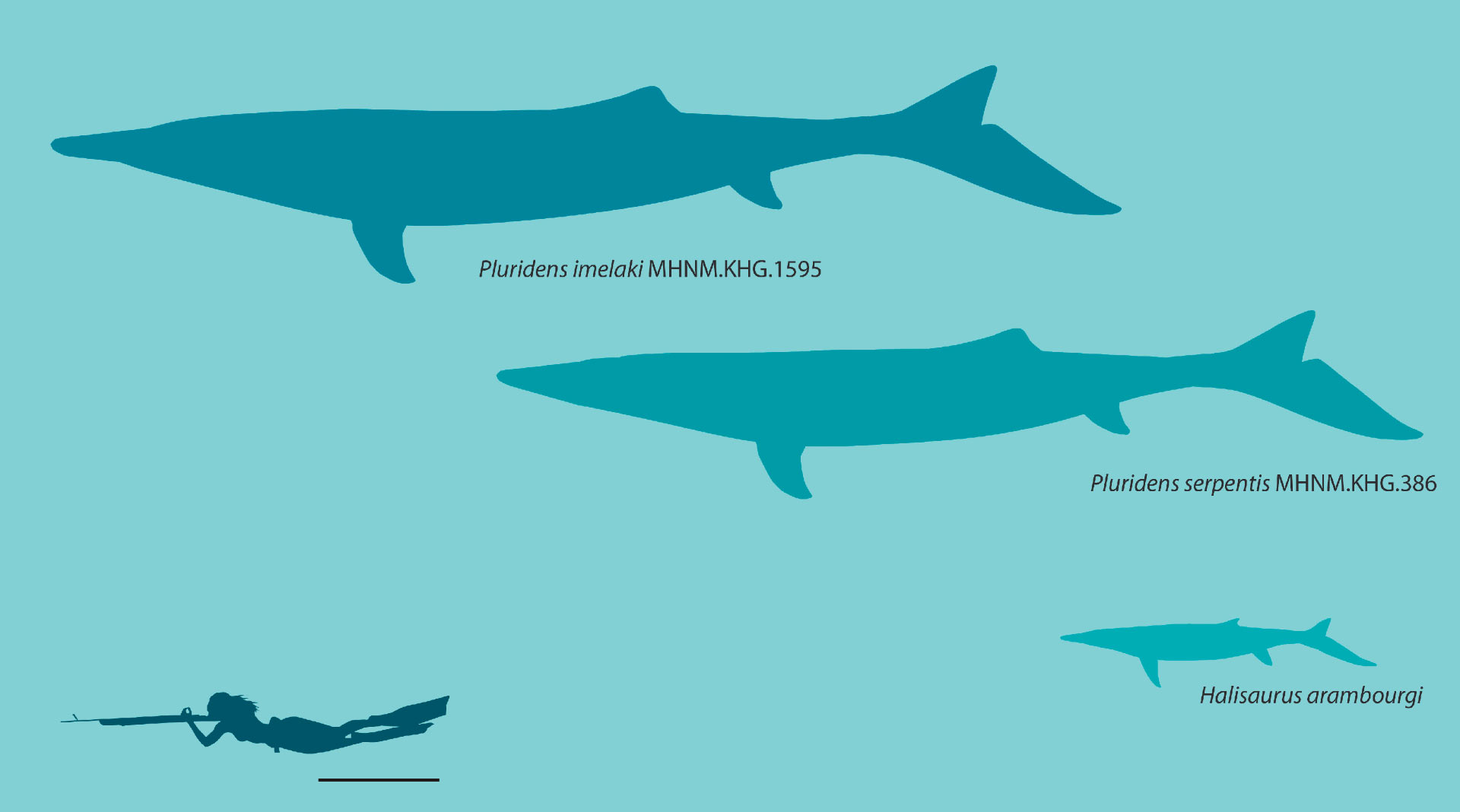
Relative size of Pluridens imelaki, Pluridens serpentis, and Halisaurus arambourgi, all from the latest Maastrichtian-aged phosphates of Morocco. Scale bar – 1 m. Image credit: Nicholas R. Longrich & Nour-Eddine Jalil, doi: 10.3390/d18030159.
The fossilized remains, comprising a skull measuring 1.25 meters (4.1 feet) in length along with associated lower jaws of Pluridens imelaki, were discovered within the phosphate strata designated as Couche III at Sidi Chennane, situated in Morocco’s Khouribga province.
“These phosphate deposits are indicative of a marine upwelling environment that formed in a shallow coastal embayment along the eastern edge of the Atlantic Ocean, extending from the Late Maastrichtian through the Early Eocene epochs,” the paleontologists explained.
“They are part of an extensive sequence of phosphate formations accumulated along the continental margins of the Tethys Sea and the eastern Atlantic during the Late Cretaceous and Early Paleogene periods.”
Comparative analyses with other mosasaur species suggest that Pluridens imelaki likely employed a distinct feeding strategy compared to its closely related counterparts.
Discrepancies in mandibular structure, dental morphology, and orbital dimensions point to the species occupying a unique ecological niche within the marine ecosystem at the close of the Cretaceous.
“The discovery of Pluridens imelaki underscores that the Halisaurinae not only possessed greater species richness than previously understood but also exhibited a wider range of variation in dental characteristics, jaw configurations, and body dimensions than had been anticipated,” the researchers concluded.
“Far from simply being outcompeted by the Mosasaurinae, the Halisaurinae underwent a notable adaptive radiation during the Late Cretaceous and played a significant role as components of the ecosystem in lower latitude environments.”
The formal description of the new species, Pluridens imelaki, was published this week in the scientific journal Diversity, accessible via a published paper.
_____
Nicholas R. Longrich & Nour-Eddine Jalil. 2026. A Giant Halisaurine from the Late Maastrichtian of Morocco. Diversity 18 (3): 159; doi: 10.3390/d18030159