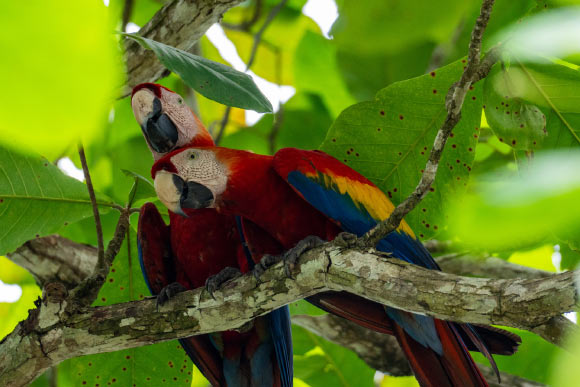
Analysis of ancient genetic material extracted from vibrantly hued feathers unearthed in Peru indicates that a minimum of four distinct Amazonian parrot species—namely the scarlet macaw (Ara macao), the blue-and-yellow macaw (Ara ararauna), the red-and-green macaw (Ara chloropterus), and the mealy amazon (Amazona farinosa)—were transported alive across the Andes mountain range centuries prior to the advent of the Inca Empire. This finding serves as compelling evidence of intricate, long-distance trade networks linking the Amazonian basin, high-altitude Andean passes, and coastal communities.
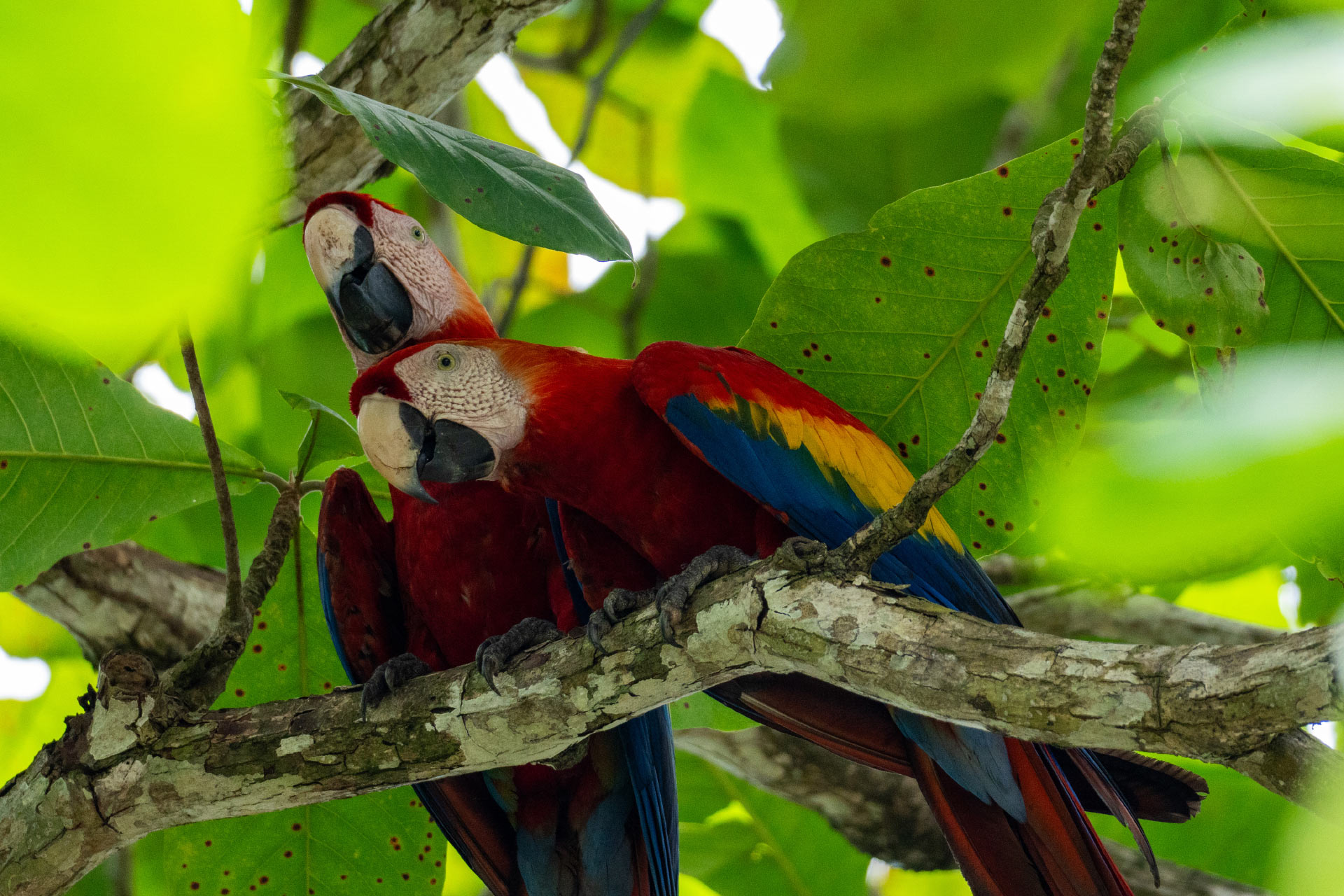
A pair of scarlet macaws (Ara macao) in Costa Rica. Image credit: Julio-César Chávez / CC BY 4.0.
These ancient parrot feathers, discovered at Pachacamac, Peru—a significant religious hub of Andean civilization—originated from regions far removed from the birds’ natural rainforest habitats.
“By integrating ancient DNA sequencing methodologies, isotopic chemistry, and computational landscape modeling techniques, we have successfully elucidated the pathways and locations through which these avian specimens were relocated across the terrain,” stated Dr. George Olah, a distinguished researcher affiliated with the Australian National University and King’s College London.
“Our ancient habitat simulations corroborated that the western slopes of the Andes were equally as inhospitable to these particular species a millennium ago as they are in the present day. These parrots are exclusively inhabitants of rainforest environments, with a natural territorial range of approximately 150 kilometers.”
“The observation that they were found over 500 kilometers away, on the opposite flank of South America’s loftiest mountain range, unequivocally points to human involvement. These birds do not naturally traverse the Andes.”
“The research findings demonstrate that numerous species of Amazonian parrots were captured in their wild environments, conveyed over elevated mountain passes, and sustained alive on the coast for sufficient durations to allow for the regeneration of feathers in their new surroundings.”
Through a comprehensive genomic analysis, the research team identified four distinct Amazonian parrot species within the feather collection: the scarlet macaw, the blue-and-yellow macaw, the red-and-green macaw, and the mealy amazon, all of which are indigenous to rainforest ecosystems situated hundreds of kilometers from the Pacific coastline.
The arduous journey of these birds likely spanned several weeks, if not months, as their human transporters navigated challenging mountain passes and precipitous plateaus.
“We are now capable of substantiating, through both genetic and isotopic evidence, that these parrots were not merely exchanged as feathers but were transported live, traversing formidable terrains, and integrated into coastal ritualistic settings,” Dr. Olah elaborated.
An examination of the chemical markers present within the feathers revealed that the birds’ diets underwent a transformation, incorporating C4 plants such as maize, alongside marine proteins, thereby indicating their survival post-Andean transit.
“Our analytical findings indicate that the parrots were provided with a diet enriched in nitrogen, mirroring that consumed by their captors—a clear indication of prolonged care following their removal from their native rainforest,” Dr. Olah explained.
Furthermore, the landscape modeling identified probable cross-Andean routes and river systems that would have facilitated the birds’ transportation, uncovering sophisticated overland and fluvial exchange networks.
These avian specimens were highly valued for their resplendent plumage, which held profound cultural significance across pre-Hispanic societies and was frequently incorporated into ceremonial practices and the adornment of high-status burials.
“This groundbreaking discovery challenges long-held assumptions that pre-Inca societies operated in isolation or were fragmented,” Dr. Olah asserted.
“Conversely, we are presented with evidence of organized trade, profound ecological understanding, and meticulous logistical planning that created connections between remarkably disparate environments long before the establishment of imperial road systems formalized such links.”
The findings have been disseminated today in the esteemed journal Nature Communications.
_____
G. Olah et al. 2026. Ancient DNA and spatial modeling reveal a pre-Inca trans-Andean parrot trade. Nat Commun 17, 2117; doi: 10.1038/s41467-026-69167-9