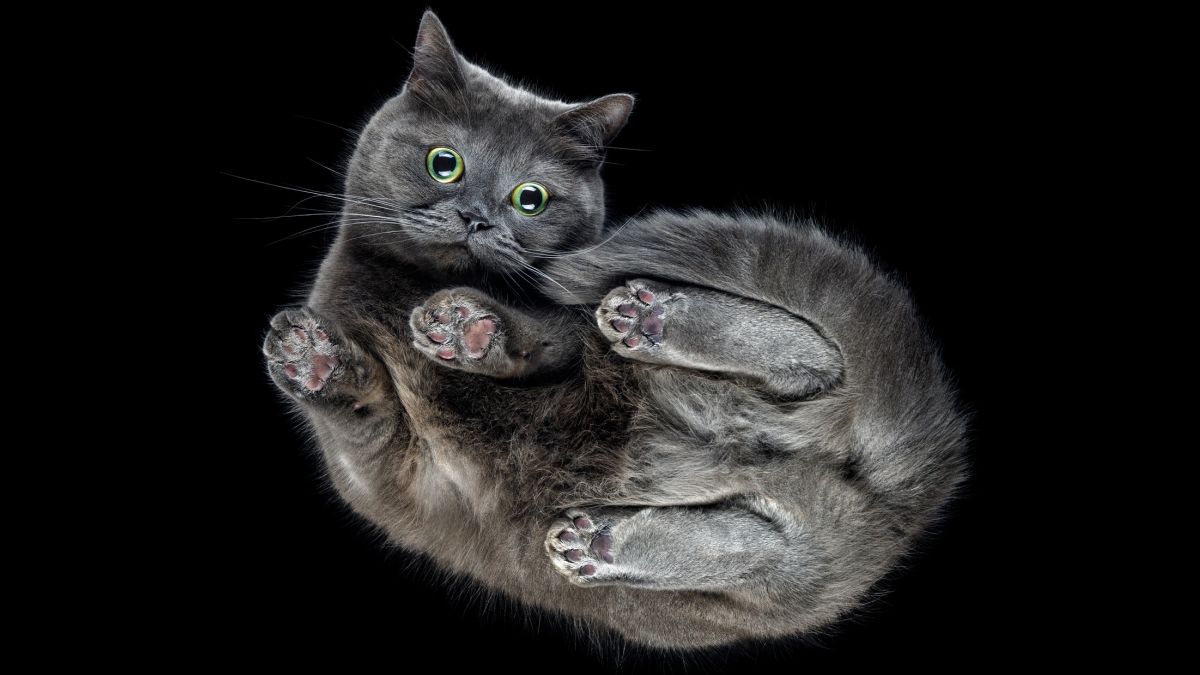
For over a hundred years, scientific inquiry has been dedicated to unraveling the mechanism behind a cat’s remarkable and consistent ability to orient itself upright when falling.
A seminal scientific investigation into this phenomenon was disseminated in 1894. As of 2026, a recently published academic paper indicates that the exploration of its intricacies is far from complete.
A cohort, under the principal investigation of veterinary physiologist Yasuo Higurashi from Yamaguchi University in Japan, postulates that felines’ exceptional landing prowess is, at least to some extent, attributable to variations in spinal column flexibility.
Precise measurements were taken for the torque, rotational angle, rigidity, and the neutral zone—defined as the range of movement requiring minimal force—for each spinal segment.
The anterior portion of the spine, the thoracic region, exhibits a broader scope of motion and disposes to twisting with considerably greater ease than the more rigid lumbar spine located in the posterior section.
The investigators ascertain that “trunk rotation during air-righting in cats occurs sequentially, with the anterior trunk rotating first, followed by the posterior trunk, and that their flexible thoracic spine and rigid lumbar spine in axial torsion are suited for this behavior.”
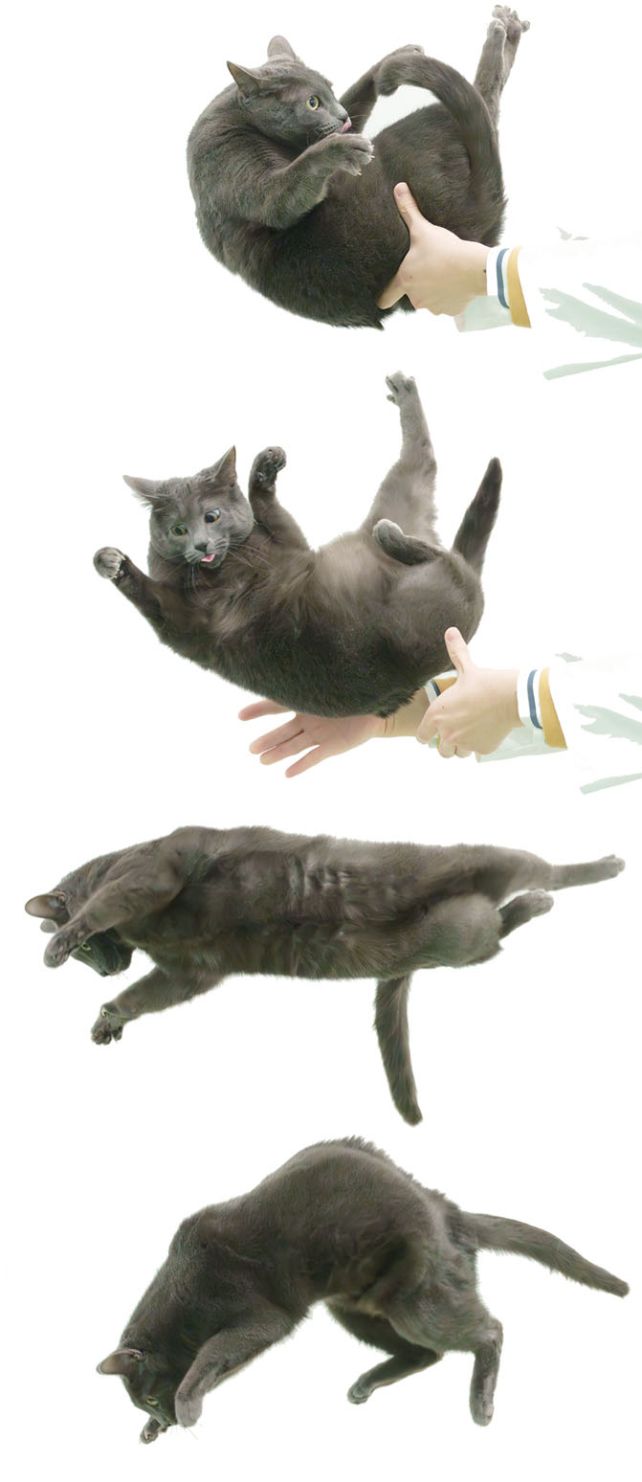
The enigma presented by falling felines gained significant traction when French physiologist Étienne-Jules Marey employed pioneering high-speed cinematography to record a cat’s mid-air contortion. His photographic sequence, appearing in Nature in 1894, depicted a cat initiating its descent without any rotational movement, yet subsequently reorienting itself prior to impact—an observation that seemed to contravene the principle of angular momentum conservation.
This perplexing phenomenon rapidly acquired the designation of the “falling cat problem” within the domain of physics. It was not until 1969 that researchers provided a mathematical demonstration illustrating how a cat can achieve aerial reorientation by differentially twisting its body segments, thereby enabling rotation without violating angular momentum conservation.
Nevertheless, an extensive body of research has predominantly centered on the physical dynamics. The anatomical adaptations facilitating this rotational capability in cats have received comparatively minimal investigation.
A preliminary note is warranted: the study involved the examination of spinal columns from feline cadavers that were voluntarily donated.
Higurashi and his research associates delved into the root cause of this perplexing behavior: the cat’s vertebral column. They meticulously extracted the spinal columns from five deceased felines, including the rib cage and sacrum, while preserving the integrity of the ligaments and intervertebral discs.
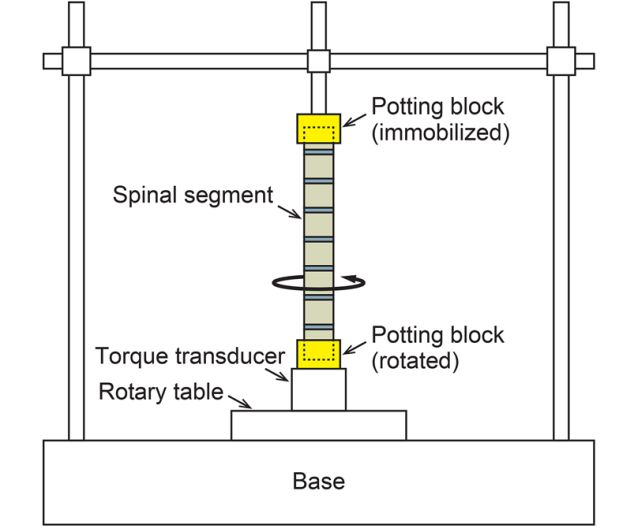
Each extracted vertebral column was bifurcated into two distinct regions: the thoracic vertebrae and the lumbar vertebrae. Subsequently, each of the ten spinal segments underwent rigorous testing within a torsion rig to ascertain its maximal twisting potential.
A pronounced disparity emerged between the thoracic and lumbar segments. The scope of motion for the thoracic vertebrae was approximately three times that of the lumbar vertebrae, and the thoracic sections demonstrated approximately one-third less rigidity compared to their lumbar counterparts.
Furthermore, the thoracic vertebrae exhibited a neutral zone measuring approximately 47 degrees, whereas the lumbar vertebrae displayed no discernible neutral zone.
Despite the limited sample size, the observed differences were consistent across all five specimens, strongly suggesting that thoracic flexibility and lumbar rigidity are characteristic attributes of feline spinal columns in general.
The next phase of the research aimed to determine if these identified properties could be observed during a cat’s aerial descent. Observations were conducted on two live cats, each dropped from a height of approximately 1 meter (3.3 feet) onto a cushioned surface on eight separate occasions, with the entire process meticulously recorded by a high-speed camera.
The findings revealed that the cats did not execute a single, continuous rotational maneuver. Instead, the anterior portion of the body initiated rotation first, followed by the posterior segment. The temporal lag between the rotation of these two sections averaged around 94 milliseconds for one cat and 72 milliseconds for the other.
The investigators propose that falling cats right themselves through a sequential process, rather than as a unified entity. The forward portion of the body leads the repositioning due to the spine’s greater flexibility, and the anterior half of a cat’s mass is roughly equivalent to that of its posterior. Subsequently, the more rigid and substantial hindquarters (colloquially referred to as the “floofy butt”) follow suit.
This differential flexibility may also confer advantages during other dynamic movements, such as galloping and rapid turns, where the capacity to articulate spinal segments independently could enhance agility.
The researchers acknowledge a potential limitation: the necessity of transecting the cats’ rib cages, which might have influenced the biomechanical characteristics of the thoracic spine. However, they also point to the congruence of their findings with a 1998 investigation performed on living, anesthetized cats, which also indicated comparable thoracic spine flexibility.
“Further studies on the material properties of the spine may help clarify how differences in trunk flexibility affect locomotor performance in mammals,” they conclude their report.