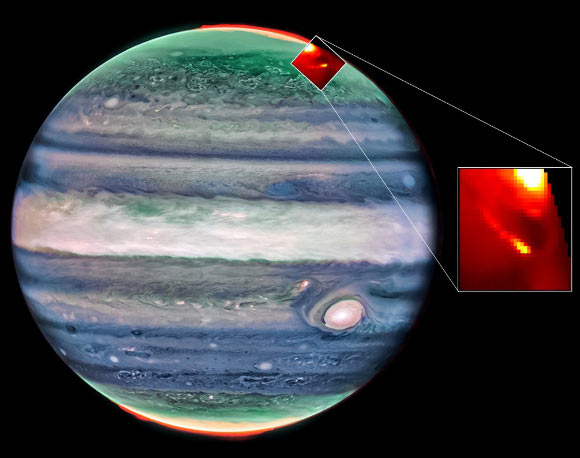
The James Webb Space Telescope, a collaborative endeavor by NASA, ESA, and CSA, executed a comprehensive, clockwise orbital scan around Jupiter’s entire limb, meticulously tracking auroral activity as it rotated into its field of view. This captivating celestial display is a direct consequence of energetic charged particles descending along magnetic field lines, subsequently impacting the planet’s ionosphere and inducing luminescence. During this observational sequence, Webb’s Near-Infrared Spectrograph (NIRSpec) achieved remarkable insights into a particular facet of Jupiter’s aurora, termed auroral footprints. These distinctive luminous patterns arise from the intricate interplay between Jupiter’s Galilean moons and the surrounding space environment of the gas giant. Leveraging the data acquired by NIRSpec, planetary scientists were able to quantify the physical characteristics of the auroral footprints associated with Jupiter’s two innermost Galilean moons, Io and Europa. Specifically, they determined localized temperature and ionospheric density within the near-infrared spectrum. A groundbreaking discovery revealed an unprecedented low-temperature structure centrally positioned over Io’s prominent emission spot, exhibiting exceptionally high densities. This phenomenon is strongly hypothesized to be driven by abrupt fluctuations in the influx of electrons impinging upon the upper atmosphere.
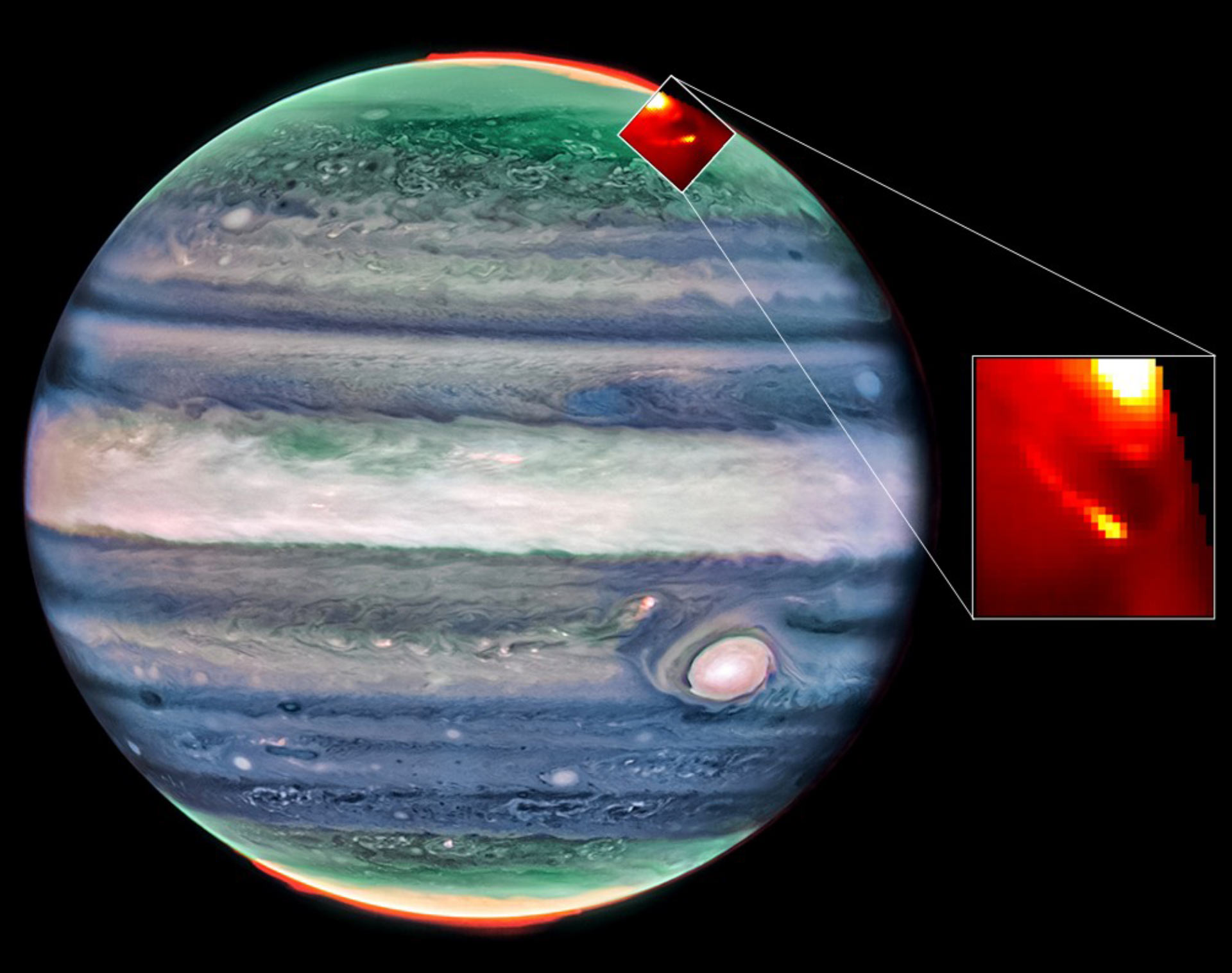
Webb captured the auroral footprints of Io and Europa, providing spectral measurements for the first time, and revealing extreme changes in the physical properties within Io’s auroral footprint that are likely linked to the electrons crashing into the top of Jupiter’s atmosphere. Image credit: NASA / ESA / CSA / Webb / NIRCam / Jupiter ERS Team / Judy Schmidt / Katie L. Knowles, Northumbria University.
“While these emissions have been previously documented at ultraviolet and infrared wavelengths, our understanding was limited to their luminous intensity,” stated lead author Katie Knowles, a doctoral candidate at Northumbria University.
“For the first time, we have successfully characterized the physical attributes of these auroral footprints, specifically the temperature of the upper atmosphere and the ion density, details that have never before been reported.”
In contrast to Earth’s auroras, which are predominantly influenced by solar wind activity, Jupiter’s auroral displays are significantly shaped by its four major Galilean moons—Io, Europa, Ganymede, and Callisto. These moons generate their own localized auroral phenomena on the giant planet, often referred to as ‘mini aurora’.
Jupiter’s formidable magnetic field rotates in tandem with the planet itself, completing a rotation approximately every 10 hours, and it carries charged particles along with its movement.
However, the orbital periods of its moons are considerably longer. Io, being the closest moon, requires approximately 42.5 hours to complete a single revolution around Jupiter.
“The constant interaction between the moons and the surrounding magnetic field and plasma environment results in highly energetic particles being channeled down magnetic field lines. Upon colliding with the planet’s atmosphere, these particles produce the auroral footprints that precisely map the orbital paths of the moons around Jupiter,” explained Knowles.
“Among all the auroras observed within our Solar System, Jupiter’s stands out as the most potent and persistent.”
“The observations facilitated by Webb offer us an unparalleled perspective into the direct influence of Jupiter’s moons on the uppermost layers of the planet’s atmosphere.”
During a 22-hour observation period conducted in September 2023, Webb meticulously scanned Jupiter’s periphery, diligently following and documenting the northern lights as they came into view.
It was within this observational window that the auroral footprints were incidentally captured.
Intriguingly, the footprints generated by Io and Europa did not exhibit the typical characteristics associated with Jupiter’s primary aurora, which is known for its relatively high temperatures and substantial material content.
Instead, a singular snapshot revealed a notably cooler region within Io’s auroral footprint, registering temperatures substantially lower than anticipated and displaying remarkably elevated densities.
Io holds the distinction of being the most volcanically active celestial body within our Solar System. Its volcanoes discharge an estimated 1,000 kilograms of material into space every second, contributing significantly to the dense plasma that envelops Jupiter.
This expelled material undergoes ionization, forming a toroidal cloud of plasma around Jupiter, commonly referred to as the Io plasma torus.
As Io traverses this dynamic environment, it generates powerful electrical currents, which are the source of the most intense luminous points within Jupiter’s auroral displays.
The researchers ascertained that these auroral footprints contain trihydrogen cation densities that are triple those found in Jupiter’s main aurora. Within localized areas, density variations as extreme as 45-fold were detected across very small spatial extents.
“We identified substantial variability in both temperature and density within Io’s auroral footprint, occurring on a timescale of mere minutes,” Knowles reported.
“This observation strongly suggests that the flux of high-energy electrons impinging upon Jupiter’s atmosphere is undergoing exceptionally rapid transformations.”
“The cooler region registered temperatures of merely 538 K (equivalent to 265 degrees Celsius or 509 degrees Fahrenheit), in stark contrast to the 766 K (493 degrees Celsius or 919 degrees Fahrenheit) observed in other regions of Jupiter’s aurora.”
“Furthermore, the cooler region contained material with a density three times greater than that of Jupiter’s primary aurora.”
These revelations hold the potential to extend far beyond Jupiter, prompting new avenues of inquiry into other planetary systems.
Saturn’s moon, Enceladus, also generates an auroral footprint on its host planet, leading scientists to ponder the potential occurrence of analogous phenomena there.
“This research not only unlocks novel methodologies for studying Jupiter and its other Galilean moons but also presents possibilities for investigating other gas giants and their associated moon systems,” Knowles commented.
“We are witnessing Jupiter’s atmosphere responding directly to its moons in real-time, offering profound insights into processes prevalent throughout our Solar System and potentially extending to distant cosmic locales.”
“The fact that we observed this particular phenomenon in only one of our five captured snapshots leaves us with several unanswered questions. How frequently does this occur? Does it activate and deactivate? How do varying conditions influence its manifestation?”
The research publication is featured in the journal Geophysical Research Letters.
_____
Katie L. Knowles et al. 2026. Short-Term Variability of Jupiter’s Satellite Footprints as Spotted by JWST. Geophysical Research Letters 53 (5): e2025GL118553; doi: 10.1029/2025GL118553