
A recent investigation has revealed that maternal and child brain activity becomes aligned during collaborative play, irrespective of the language employed, even when it’s not their primary tongue. This finding underscores that the neural bonding phenomenon remains robust and is not diminished by linguistic translation.
This observed neural alignment, referred to as interbrain synchrony, is characterized as the “concurrent operation of neural circuits across the brains of individuals engaged in social interaction.” It has been documented to occur not exclusively in maternal-child dyads but also among other socially connected individuals.
Synchrony manifests when individuals participate collectively in activities such as collaborative work, learning endeavors, discourse, recreational activities, or even musical performances. This phenomenon may offer an explanation for the widespread appeal of group singing activities. While it is established that synchrony enhances social cohesion and facilitates successful interpersonal exchanges, its influence within the context of bilingualism had not been previously explored.
Research in developmental neuroscience has notably underrepresented bilingual children, despite the cognitive advantages conferred by bilingualism, which include augmented brain health and the cultivation of language proficiencies, social perceptiveness, and cultural understanding – all skills that can be fortified through enhanced synchrony.
Consequently, a research contingent, spearheaded by neuroscientists from a prominent UK university, conceptualized an experimental framework to scrutinize the impact of linguistic diversity on interbrain synchrony within mother-child pairings for whom English is not their native language. The results of this study have been disseminated in the esteemed journal, Frontiers in Cognition.
Fifteen bilingual mother-child pairs were observed within a controlled laboratory environment. Their interactions were assessed across three distinct conditions: engaging in play while conversing in their shared mother tongue; participating in play using English exclusively; and engaging in solitary play behind a visual barrier in silence.
Both mothers and children were outfitted with fNIRS (functional near-infrared spectroscopy) apparatuses designed to monitor neurological activity within the prefrontal cortex and the temporoparietal junction. These specific brain regions are integral to the regulation of social conduct.
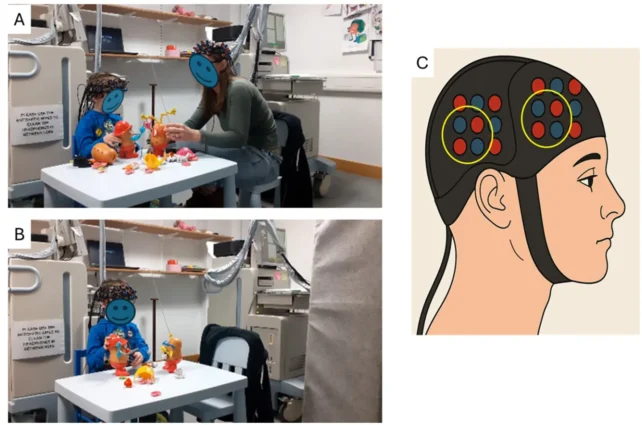
The fNIRS data indicated a statistically significant augmentation in neural synchrony during periods of joint play between mothers and children, irrespective of the communicative language employed, when contrasted with conditions of independent engagement.
This synchrony was particularly pronounced in the prefrontal cortex, a cerebral area instrumental in executive functions such as volitional control and personality expression. Conversely, synchrony was less pronounced in the temporoparietal junction, a region implicated in social cognition, linguistic processing, and self-perception.
These findings additionally propose that divergences in language acquisition trajectories between parents and children do not substantially impinge upon the extent of neural synchrony. It is a common occurrence for bilingual youngsters to acquire two languages concurrently from an early age. In contrast, bilingual adults frequently attain proficiency in their second language at a later life stage, which can sometimes introduce a perceived emotional disconnect.
“Individuals who are proficient in a second language frequently report experiencing a sense of emotional detachment when utilizing their non-native tongue, which may consequently affect their expressions of affection, disciplinary approaches, or empathetic responses within parent-child interactions,” the study’s authors elucidate.
Fortuitously, this perceived linguistic chasm did not appear to impede the establishment of neural synchrony, which is of paramount importance for the quality of the relational bond and the coordinated behavioral patterns between parents and their offspring.
“While bilingualism is sometimes perceived as a formidable undertaking, it can confer considerable life advantages. Our research demonstrates that exposure to multiple languages during formative years can also foster robust communication and learning capabilities,” states Douglas Hartley, a professor of otology at the University of Nottingham and the senior scholarly contributor to the investigation.
The investigative team suggests that subsequent research endeavors should expand their scope to encompass families where parental fluency in their non-native language is less developed, as well as children who acquired their second language at a later developmental stage.
Furthermore, given that established familial relationships tend to foster greater neural synchrony compared to more superficial connections, future investigations ought to explore the intensity of this effect in interactions between children and educators, or between children and unfamiliar individuals.
And since the scope of this study was not confined solely to verbal exchanges, it would be beneficial to delineate the specific contributions of non-verbal communication signals, such as visual contact and gestural cues, from those conveyed through spoken language.
Most significantly, given that an individual’s non-native language does not appear to constitute an impediment to neural synchrony, these findings imply that any language can function as a conduit for expressing affection, with perhaps the sole exception of fictional languages like Klingon.
This body of research has been officially published in Frontiers in Cognition.