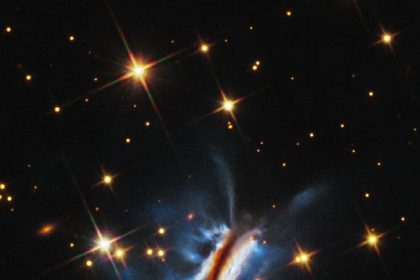
Extended monitoring of WOH G64, which was previously regarded as its galaxy’s most extreme red supergiant, indicates the celestial body has undergone a profound transformation, potentially shedding some of its outer stellar material as it entered a hotter and more uncommon evolutionary phase.

An artist’s reconstruction of the red supergiant WOH G64. Image credit: ESO / L. Calçada.
Stars classified as red supergiants, possessing at least eight times the Sun’s mass, have comparatively brief lifespans, typically ranging from one to ten million years, prior to their eventual explosive demise as supernovae.
Nevertheless, the evolutionary trajectory and ultimate fate of the most luminous red supergiants remain subjects of considerable scientific uncertainty.
Since its initial identification in the 1980s, WOH G64 has been recognized as one of the most luminous, expansive, and coolest red supergiants located within the Large Magellanic Cloud, a satellite galaxy situated approximately 160,000 light-years distant from our own Solar System.
To meticulously examine the evolution of WOH G64, Dr. Gonzalo Muñoz-Sanchez of the National Observatory of Athens, alongside his research associates, undertook a comprehensive review of photometric data spanning over three decades, commencing in 1992. This extensive dataset was augmented with both contemporary and historical electromagnetic spectra.
Their analysis revealed that the star experienced swift alterations in its observable characteristics, notably a reduction in brightness in 2011, followed by a recovery and a subsequent shift towards a more yellow hue, indicating a temperature increase exceeding 1,000 degrees Celsius, observed between 2013 and 2014.
By 2025, WOH G64 exhibited a substantial dimming accompanied by discernible modifications in its atmospheric composition.

This image, captured by the GRAVITY instrument aboard ESO’s Very Large Telescope Interferometer, depicts the red supergiant WOH G64. Image credit: ESO / Ohnaka et al., doi: 10.1051/0004-6361/202451820.
The astronomical team has proposed two principal hypotheses to account for these observed phenomena.
“The first possibility is that WOH G64 is part of a binary star system, wherein the red supergiant evolved into a yellow hypergiant due to an interaction that instigated the expulsion of a portion of its outer envelope,” the researchers stated.
“Alternatively, a pre-existing yellow hypergiant may have undergone a significant outburst of material, which temporarily cloaked it in a red appearance for several decades, ceasing around 2014.”
“These findings prompt an inquiry into whether exceptionally luminous red supergiants, such as WOH G64, owe their existence to being interacting binaries, and consequently, would not attain such extreme states if they were isolated stellar objects,” they elaborated.
“Subsequent stellar interactions will dictate whether this star concludes its existence as a supernova, collapses into a black hole, or merges with its binary companion.”
This scientific investigation has been formally presented in the esteemed journal Nature Astronomy, accessible via the following link: study.
_____
G. Muñoz-Sanchez et al. The dramatic transition of the extreme red supergiant WOH G64 to a yellow hypergiant. Nat Astron, published online February 23, 2026; doi: 10.1038/s41550-026-02789-7