Researchers in Panama have documented a species of katydid that exhibits remarkable mimicry; these insects emerge in a vibrant pink hue, transitioning to a verdant green within days. This color metamorphosis is hypothesized to mirror the natural phenomenon of rainforest leaves that develop reddish or pinkish tones before reaching maturity, a sophisticated adaptive camouflage strategy previously misidentified as an uncommon hereditary trait.
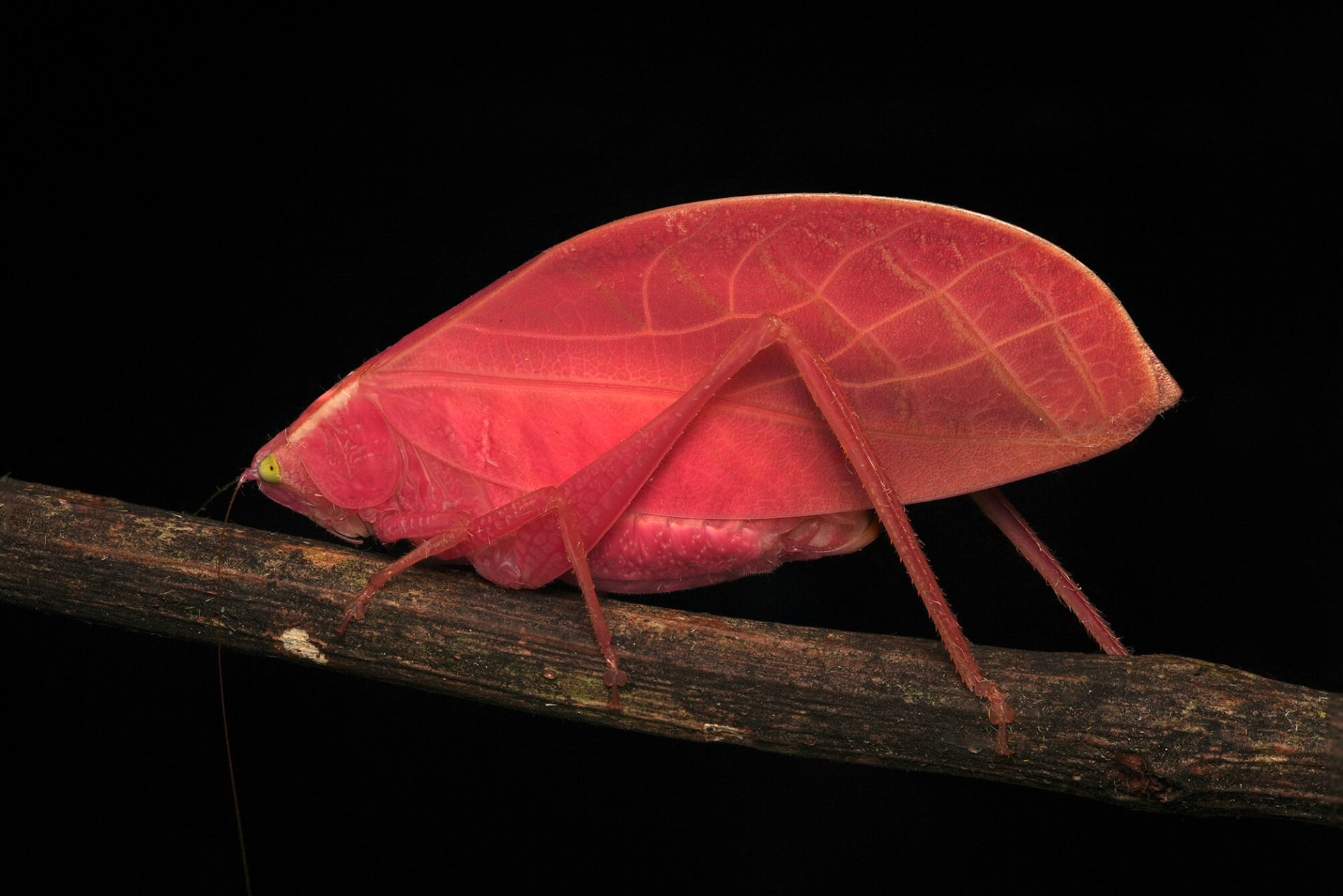
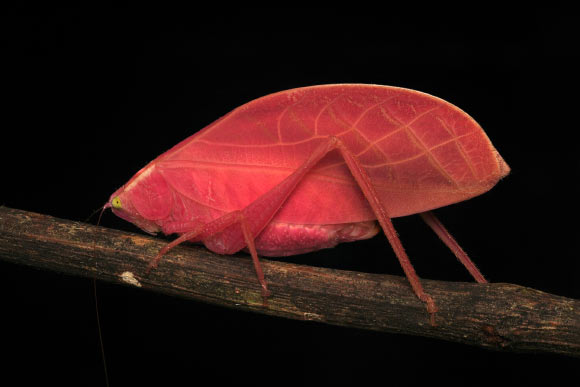
Intense hot pink morph of an adult female Arota festae photographed on March 27, 2025, on Barro Colorado Island, Panama. Image credit: Zeke W. Rowe.
The katydid, scientifically classified as Arota festae, is a moderately sized insect indigenous to Panama, Colombia, and Suriname, also commonly referred to as a bush cricket.
Typically, this species displays a uniform light green coloration, lacking significant sexual dimorphism. Its broad, rounded forewings closely resemble the nascent foliage of vegetation.
On March 27, 2025, entomologist Benito Wainwright from the University of St Andrews, accompanied by his colleagues, observed a strikingly pink female specimen of Arota festae at the Smithsonian Tropical Research Institute’s field station situated on Barro Colorado Island, Panama.
“The discovery of this particular individual was truly unexpected,” stated Dr. Wainwright.
“Given its apparent rarity, we maintained it under natural environmental conditions and witnessed its transformation from a vivid pink to a green shade.”
“Far from being an aberrant genetic anomaly, this color shift may represent a highly refined survival mechanism intricately synchronized with the developmental stages of the rainforest leaves the insect seeks to emulate.”
The scientific team maintained the specimen in controlled captive conditions, replicating ambient temperature and humidity for a duration of 30 days.
Within four days of its enclosure, a noticeable diminution in the intensity of its pink coloration was observed, shifting towards a paler pastel pink.
Subsequently, the researchers meticulously documented the insect’s evolving coloration through daily photographic records captured every 24 hours.
By April 7, 2025, following an additional seven-day observation period, the insect had completely transitioned to a green hue, rendering it indistinguishable from specimens belonging to the more prevalent green morph.
Pink katydids have been documented in scientific literature dating back to 1878; however, these occurrences were generally attributed to rare, disadvantageous mutations.
This instance is believed to represent the inaugural documented case of a katydid successfully completing a full chromatic metamorphosis within a single developmental stage.
“The intricate complexity of tropical forest ecosystems suggests a profound level of evolutionary adaptation in certain fauna, and this finding underscores that precision,” commented Dr. Matt Greenwell, an investigator at the University of Reading.
“One might presume that a brightly colored pink insect in an overwhelmingly green environment would be highly conspicuous to predators, akin to a construction worker in high-visibility attire.”
“The proposition that an insect might progressively alter its color to align with the foliage it imitates highlights the dynamic nature of the rainforest and serves as a remarkable illustration of camouflage in action.”
The research team’s findings were officially published on March 7, 2026, in the esteemed journal Ecology.
_____
J. Benito Wainwright et al. 2026. Pink Cricket Club: Dramatic color change in a Neotropical leaf-masquerading katydid (Arota festae, Griffini, 1896). Ecology 107 (3): e70333; doi: 10.1002/ecy.70333