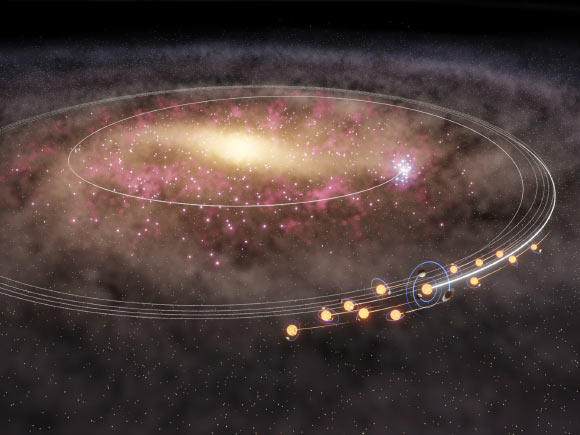
Leveraging an extensive compilation of Sol-like stars meticulously assembled by the European Space Agency’s Gaia mission, astrophysicists have unearthed compelling evidence suggesting our Sun, alongside thousands of its stellar kin, embarked on an outward journey approximately 4 to 6 billion years ago. This revelation offers novel insights into the developmental trajectory of the Milky Way’s prominent central bar.
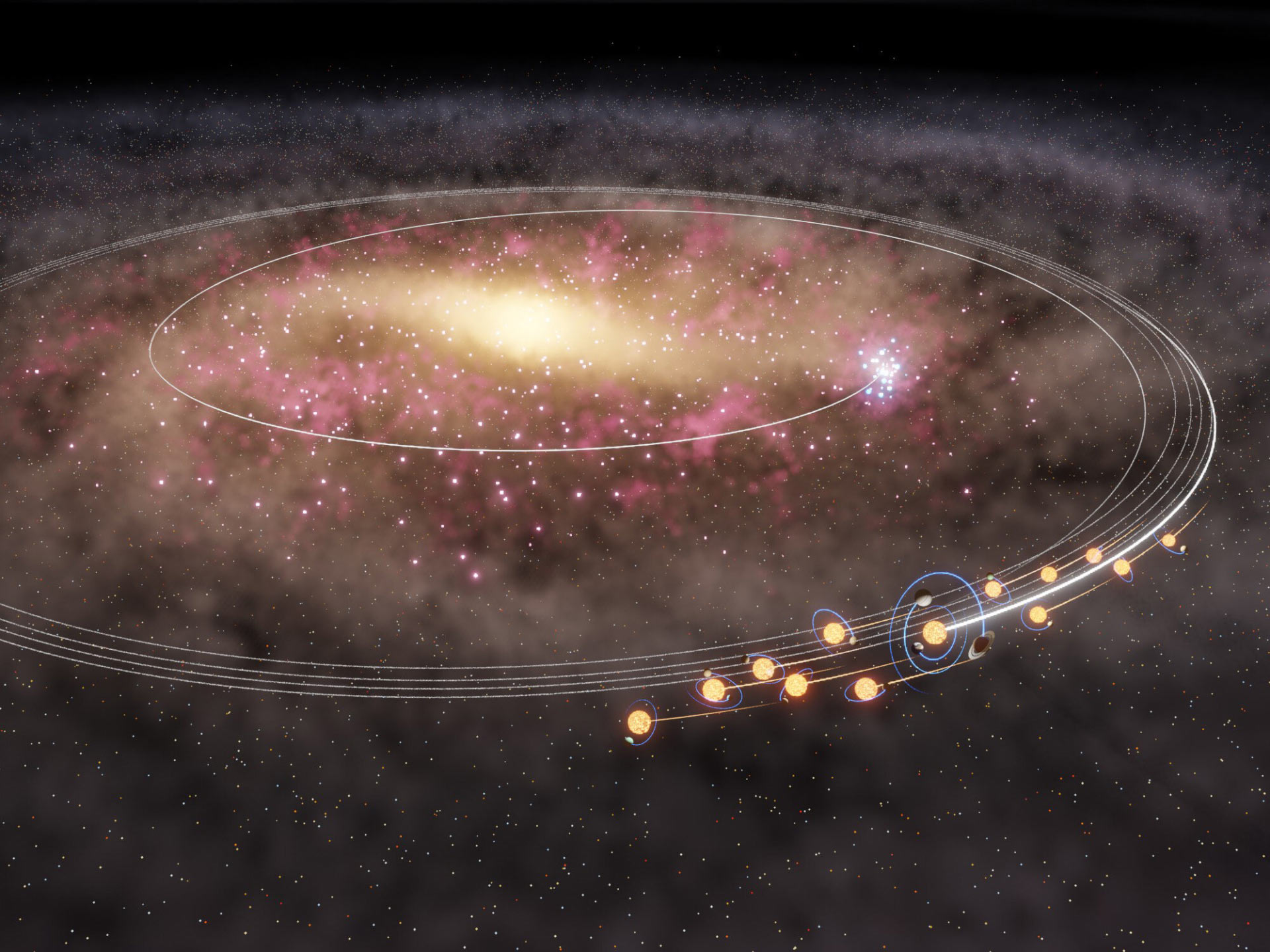
An artistic rendition depicting the migration of the Sun and its stellar counterparts from the Milky Way’s core roughly 4 to 6 billion years ago. Image courtesy of NAOJ.
“While terrestrial archaeology delves into the annals of human history, galactic archaeology endeavors to trace the grand voyages of celestial bodies and galactic structures,” explained Daisuke Taniguchi, an astronomer at Tokyo Metropolitan University, alongside his research collaborators.
“For instance, it is understood that our Sun originated approximately 4.6 billion years ago, residing at a distance from the Milky Way’s center over 10,000 light-years closer than its present location.”
“Although analyses of stellar composition lend credence to this hypothesis, this observation has presented a persistent enigma for the scientific community.”
“Observational data reveals a substantial bar-shaped formation at the heart of our Galaxy, which engenders a corotation barrier. This phenomenon impedes the ability of stars to migrate to distances far from the galactic center.”
Within the scope of their investigation, the researchers sought to construct a comprehensive registry of solar twins – stars exhibiting stellar characteristics remarkably akin to those of our Sun.
“Solar twins are identified as celestial objects whose fundamental stellar parameters, specifically effective temperature, surface gravity, and metallicity, closely approximate those of the Sun,” they elucidated.
“Through the execution of comparative analyses among stars with highly similar stellar attributes – in this instance, solar twins – it is feasible to achieve an exceptionally precise quantification of stellar properties and elemental abundances.”
The scientific team utilized data acquired from the European Space Agency’s Gaia satellite, which represents a monumental repository of observations encompassing two billion stars and other cosmic entities.
They succeeded in compiling a catalog of 6,594 solar twins, a collection that represents an approximately thirty-fold expansion compared to preceding surveys.
From this extensive compilation, they were able to derive the most accurate rendition to date of these stars’ ages, meticulously accounting for biases in the selection of stars that are more readily observable.
Upon examining the distribution of stellar ages, a discernible broad peak was identified among stars aged between 4 and 6 billion years. This age bracket encompasses our Sun and provides evidence for the existence of analogous stars of similar antiquity, situated at comparable distances from our Galaxy’s core.
Consequently, this implies that our Sun’s current placement is not coincidental but rather a result of a far-reaching stellar relocation event.
This groundbreaking discovery not only illuminates the characteristics of our Solar System but also sheds light on the ongoing evolutionary processes of the Milky Way itself.
“The corotation barrier, established by the bar structure at the Galactic nucleus, would typically preclude such a large-scale stellar exodus,” the researchers stated.
“However, the narrative shifts considerably if the bar was still in its formative stages during that epoch.”
“The ages of our solar twins indicate not only the period when this mass exodus occurred but also the temporal span over which the galactic bar took shape.”
“The central regions of our Galaxy present a substantially less accommodating environment for the emergence and proliferation of life compared to its outer reaches.”
“Therefore, our findings underscore a critical factor that contributed to our Solar System, and by extension our planet, finding itself within a galactic zone conducive to the development and evolution of organisms.”
The outcomes of this research were formally published on March 12, 2026, within the esteemed journal Astronomy & Astrophysics.
_____
Daisuke Taniguchi et al. 2026. Solar twins in Gaia DR3 GSP-Spec. I. Building a large catalog of solar twins with ages. A&A 707, A260; doi: 10.1051/0004-6361/202658913