
Palaeontologists have formally identified a novel species of enigmatic cyclidan crustacean, based on three exceptionally preserved specimens unearthed from the Early Triassic Guiyang biota in China.

Cyclidans represent a distinct lineage of arthropods that initially emerged during the Carboniferous period and persisted through to the Late Cretaceous epoch.
Their palaeontological trace is notably scarce, with the majority of discoveries yielding solely the hard exoskeletons, or carapaces, of these ancient creatures, thereby leaving many anatomical characteristics poorly elucidated.
“Cyclida constitutes an order of arthropods within the Guiyang biota,” stated Dr. Xiaoyuan Sun of the China University of Geosciences, alongside his collaborators from China and the United States.
“As a specialized and somewhat mysterious group of crustaceans, they originated in the Mississippian epoch (spanning 359 to 323 million years ago) and ultimately faced extinction during the Late Cretaceous Maastrichtian stage (73 to 66 million years ago).”
“Their classification within Crustacea is founded upon the presence of characteristic features such as antennules, antennae, mandibles, maxillae, and maxillipeds.”
“Nevertheless, our comprehension of cyclidan crustaceans remains considerably constrained due to their infrequent appearance in the fossil record.”
“Typically, only the robust carapaces are recoverable, with their antennules and appendages being exceptionally rare finds.”
The newly identified cyclidan species inhabited the Earth during the Late Dienerian age of the Early Triassic, approximately 251 million years ago.
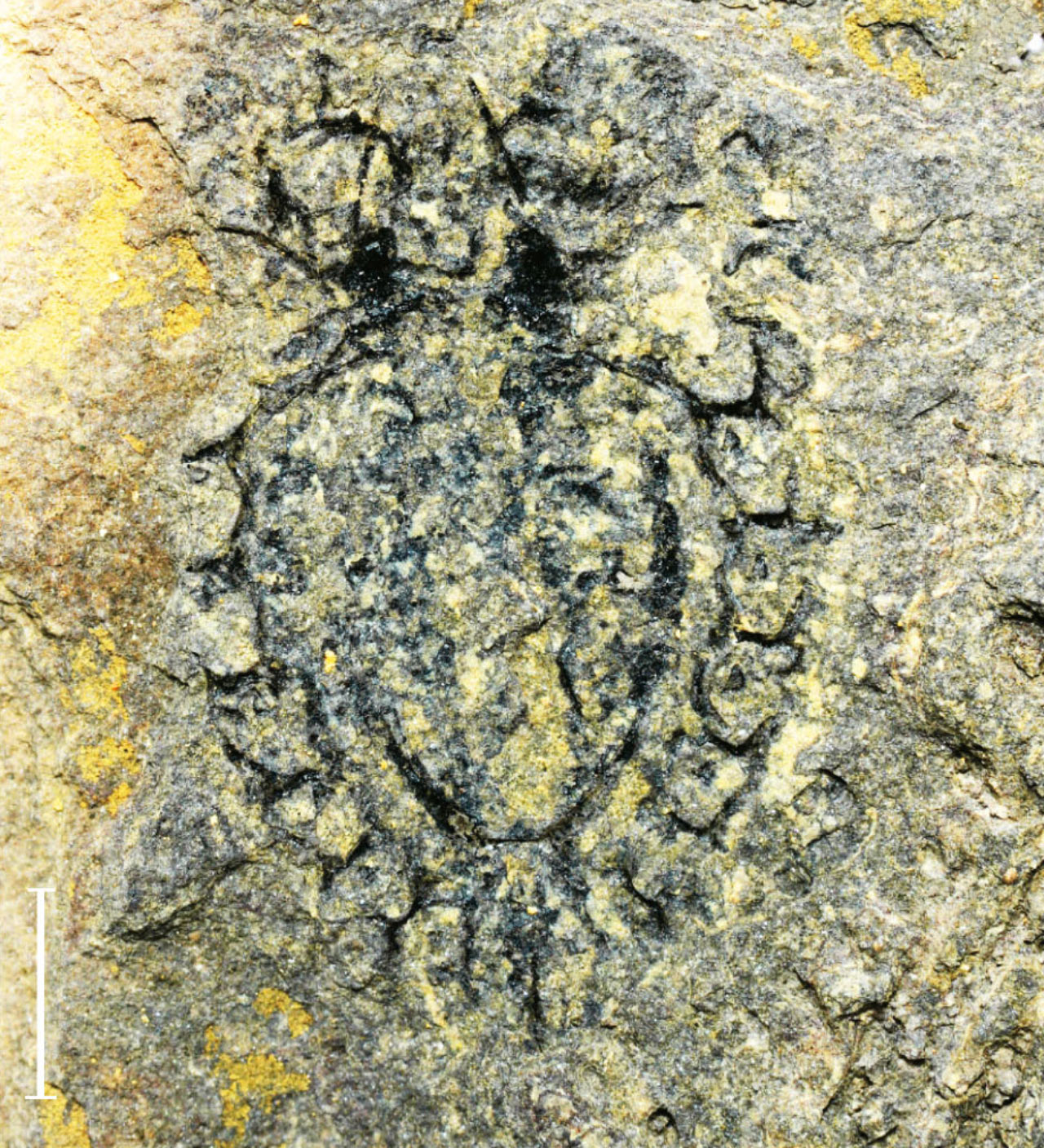
Designated as Yunnanocyclus fortis, its description is based on three specimens recovered from the Daye Formation situated in China’s Guizhou province.
The fossil evidence reveals an ovular carapace featuring a narrow, smooth marginal border, alongside discernible antennules, antennae, and seven pairs of thoracic segments.
Most significantly, the specimens exhibit a pair of robustly developed mandibles—a feature seldom encountered in known cyclidan fossils.
The carapace of the holotype specimen measures approximately 19.8 mm in length and 14.7 mm in width, while its mandibles measure around 1.7 mm in length and 0.8 mm in width.
Through the application of micro-X-ray fluorescence spectrometry, the palaeontologists detected elevated concentrations of calcium and phosphorus within the mandibles and other skeletal elements, indicating their substantial thickness and strong mineralisation.
“Yunnanocyclus fortis possessed markedly ovoid mandibles,” the researchers noted.
This significant discovery extends the previously understood geographical distribution of Early Triassic cyclidans.
Prior to this find, fossil evidence from this geological period had been predominantly documented in Madagascar and certain regions of Europe.
The newly described species constitutes the earliest known cyclidan fossil record from the eastern Tethys region.
“Our identification of this new species from China significantly broadens the known palaeogeographical extent of Early Triassic cyclidans,” the research team commented.
“Early Triassic cyclidans exhibited their most widespread distribution across Madagascar, Europe, and China.”
“By the Late Triassic, their presence was documented exclusively in Europe.”
The recovered fossils provide valuable insights into the evolutionary trajectory of these enigmatic organisms over geological timescales.
By undertaking a detailed analysis of morphological data from Yunnanocyclus fortis and other cyclidan species, the scientists were able to delineate the group’s morphospace, a methodology employed to investigate the diversity of body forms.
The findings suggest that cyclidans underwent their most pronounced diversification early in their evolutionary history, specifically during the Carboniferous period, followed by a gradual reduction in the range of their body plans throughout subsequent geological eras.
This pattern aligns with the evolutionary biology concept known as the ‘early burst’ model, wherein a lineage experiences rapid diversification shortly after its inception, followed by a period of more tempered evolutionary change.
Furthermore, these discoveries contribute to our understanding of ecosystem recovery in the aftermath of the Permian-Triassic mass extinction event, which resulted in the obliteration of over 80% of marine species.
Palaeontological evidence from the Guiyang biota and other Early Triassic fossil sites indicates that complex marine communities may have re-established themselves at an earlier stage than previously hypothesized.
By illuminating novel anatomical details and expanding the geographical record of cyclidans, Yunnanocyclus fortis offers another invaluable perspective on the recuperation and evolutionary development of marine life during one of Earth’s most tumultuous historical periods.
“With the incorporation of a new species and a revised understanding of Triassic paleogeography for Cyclida in terms of age, we observe that Early Triassic cyclidans were the most extensively distributed, with a subsequent gradual contraction of their range,” the authors concluded.
“This phenomenon bears resemblance to the globally dispersed ammonoids and other marine invertebrate species during the Early Triassic, and may be attributable to diminished environmental gradients across different latitudinal zones in the post-Permian-Triassic mass extinction era.”
The unveiling of Yunnanocyclus fortis is detailed in a publication featured in the journal Papers in Palaeontology.
_____
Xiaoyuan Sun et al. 2025. A new Induan (Early Triassic, Dienerian) cyclidan crustacean from the Guiyang biota. Papers in Palaeontology 11 (6): e70052; doi: 10.1002/spp2.70052