The accelerated climatic shifts observed in the contemporary era are predominantly instigated by anthropogenic emissions of greenhouse gases into the atmosphere.
However, novel findings derived from ancient Antarctic ice formations indicate that this has not consistently been the case throughout Earth’s multifaceted climatic history over the preceding three million years.
According to the revelations presented in two recent publications in the journal Nature, at specific inflection points in Earth’s history, oceanic thermal conditions may have exerted a more significant influence on global climate dynamics than atmospheric concentrations of greenhouse gases.
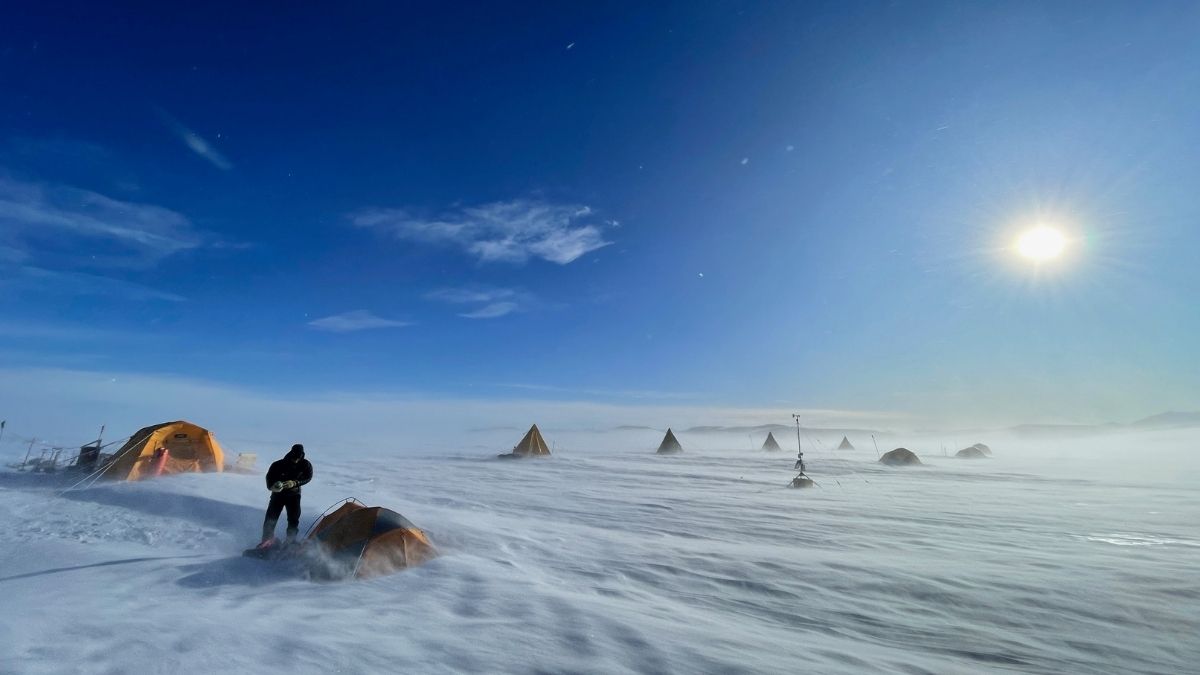
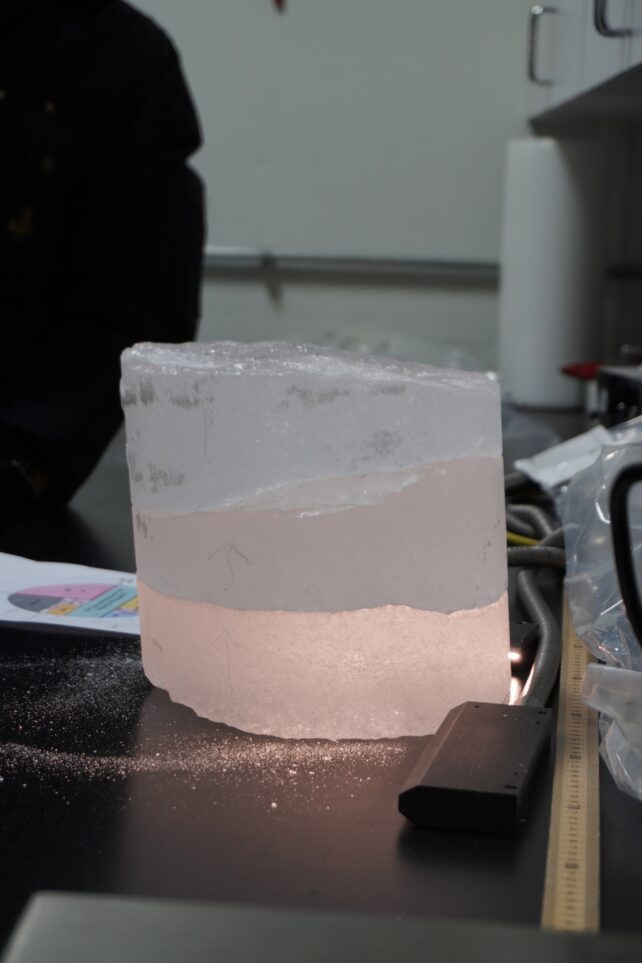
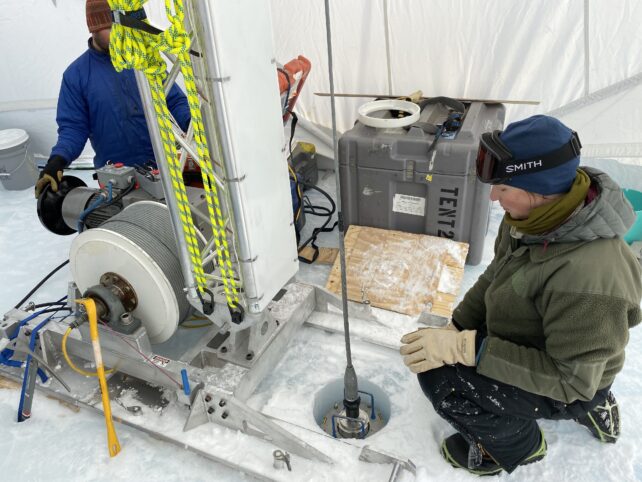
Two distinct research collectives undertook the analysis of ice samples retrieved from the Allan Hills, a distinctive blue ice expanse in Antarctica. The ice cores from Allan Hills represent some of the planet’s most venerable ice strata, with certain specimens dating back as far as six million years.

Regions characterized by blue ice, such as the Allan Hills, constitute a mere fraction, approximately 1 percent of the surface area of Antarctica’s ice sheet. Their designation stems from intense wind patterns that scour away nascent snowfall, leaving ancient glacial ice exposed at the surface.
The geographic location of the Allan Hills has exhibited minimal horizontal or vertical displacement, rendering it an exceptionally advantageous site for the extraction of supremely ancient ice cores.
Ice cores serve as invaluable natural repositories, or ‘archives,’ offering profound insights into Earth’s long-term climatic trajectory.
It is important to note that these records are not invariably complete or chronologically sequential. For instance, the Allan Hills cores contain strata that are not in strict temporal order, a consequence of the depositional processes occurring over millennia.
Nevertheless, each discernible layer of ice encapsulates a climatic snapshot, providing substantial information about the prevailing conditions at the time of its formation, and methodologies exist to unravel these historical narratives.
Specific isotopic signatures within the ice offer indicators of oceanic temperatures. Inclusions such as volcanic ash and other particulate matter can reveal the origins of atmospheric pollutants.
Crucially, and of paramount significance to climatologists, the ice entraps minuscule pockets of ambient air, thereby documenting the atmospheric gas composition across vast geological timescales, extending into millions of years.
Dr. Sarah Shackleton, a paleoclimatologist affiliated with the Woods Hole Oceanographic Institute, spearheaded an international consortium of scientists in a study meticulously examining global ocean temperatures over the past three million years.
The dissolution rates of xenon and krypton, two noble gases that exhibit differential solubility in seawater contingent on temperature varies, provided the researchers with a means to estimate the thermal state of the oceans.
These proxy measurements indicate a substantial cooling trend in the oceans around 2.7 million years ago, a period that closely correlates with the Plio-Pleistocene Transition, a phase during which Earth gradually transitioned from a warmer climatic regime to a cooler one, precipitating the formation of ice sheets across extensive northern hemisphere territories.
The ice core data further suggest that average oceanic temperatures remained relatively consistent throughout the Mid-Pleistocene Transition, another significant alteration in glacial cycles that transpired between 1.2 and 0.8 million years ago.
Concurrently, from these identical ice cores, a research group directed by Dr. Julia Marks-Peterson, a geochemist at Oregon State University, ascertained that atmospheric concentrations of carbon dioxide and methane exhibited “[broadly stable] characteristics” throughout the most recent three million years.
“While paleoclimatic archives derived from Antarctic blue ice regions present inherent complexities, our findings demonstrate that the measurement of atmospheric gases trapped within ice cores can be extended to the late Pliocene epoch. This provides invaluable insights into Earth’s climate system during a period marked by global cooling and receding sea levels,” Marks-Peterson and her team stated.
In an accompanying commentary article, Cambridge climatologist Eric Wolff posits that this observation implies either an “exquisite sensitivity” of ice-sheet growth and persistence to minute fluctuations in carbon dioxide levels, or that past climate transformations may have been engendered by alternative factors.
The investigative work undertaken by Shackleton and her collaborators may furnish additional clues to this scientific enigma. Their research revealed an apparent divergence between fluctuations in sea surface temperatures and average oceanic temperatures.
Comprehending the intricate mechanisms that governed Earth’s climate prior to widespread anthropogenic intervention is imperative for formulating strategies to restore equilibrium to our planet.
However, limitations exist in the interpretation of these ancient ice cores, as Shackleton elaborated in a recent episode of the Science Sessions podcast.
“These historical records are relatively novel, and their interpretation presents greater challenges compared to the continuous ice cores we are accustomed to analyzing,” she remarked.
“Due to the extreme compression of the ice, particularly in the oldest samples, we are likely averaging across glacial and interglacial cycles. Consequently, we are currently unable to study the climatic evolution within specific glacial and interglacial periods.
“The precise nature of what these records represent, in terms of how smooth or how heavily averaged glacial versus interglacial conditions are, remains an unresolved question.”