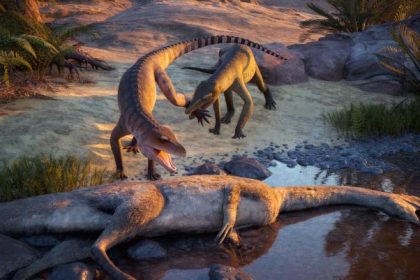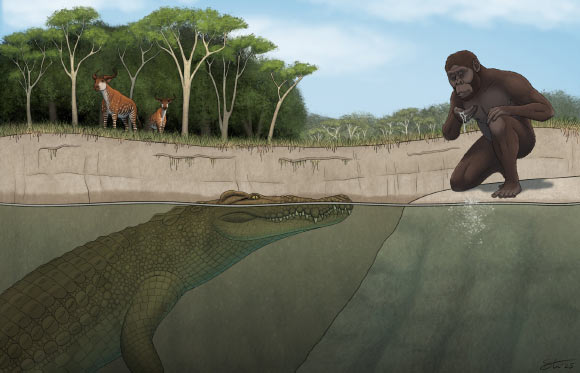
An examination of fossilized remains unearthed in Ethiopia has led to the identification of a previously undocumented species of crocodile. This ancient reptile coexisted with a hominid lineage known as Australopithecus afarensis. Designated Crocodylus lucivenator, this formidable predator likely hunted Australopithecus afarensis near water sources within the wetland and woodland environments of the Pliocene epoch.
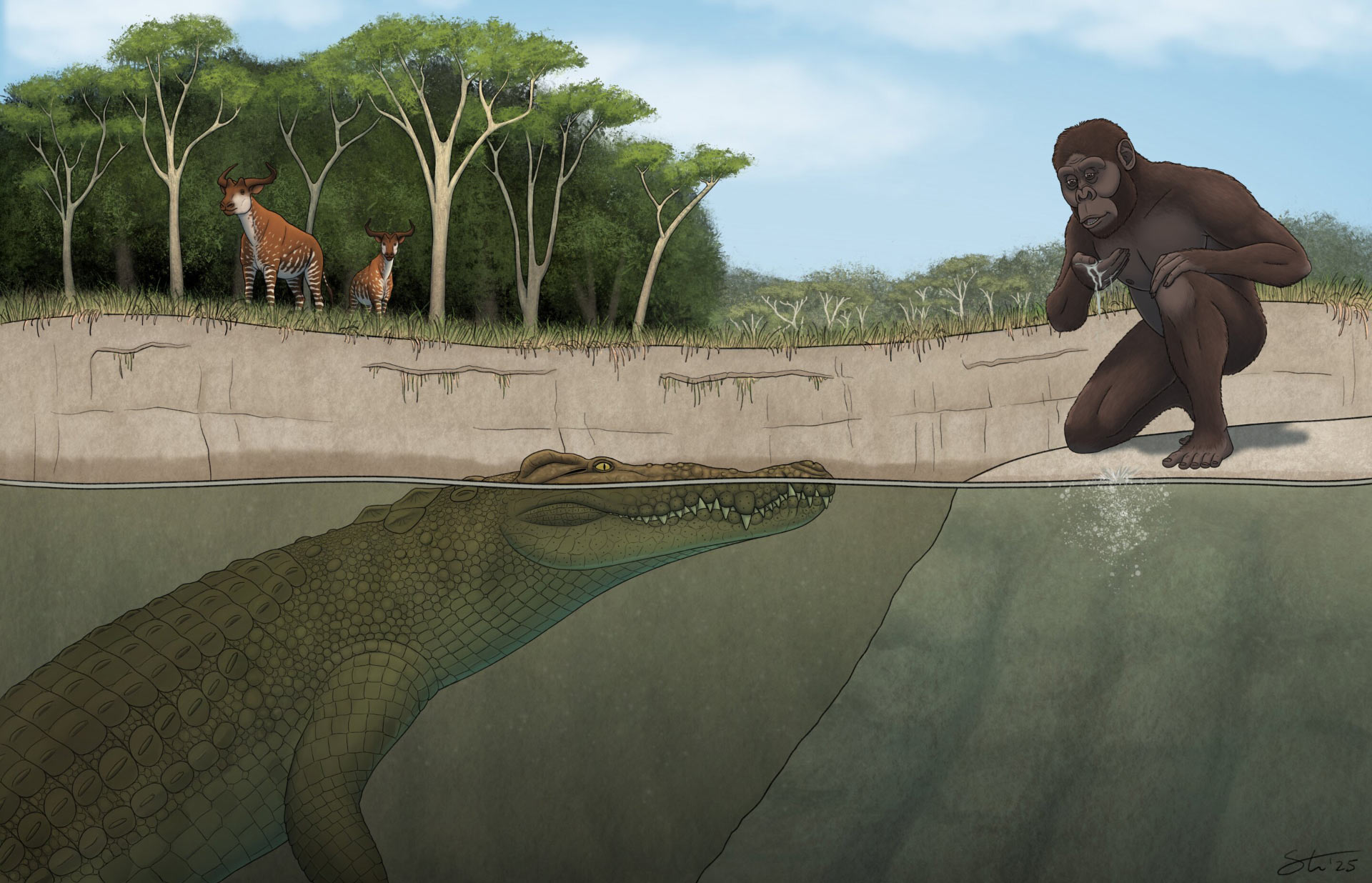
Crocodylus lucivenator overlapped with the famed Lucy and her hominin kin and would have hunted them. Image credit: Tyler Stone, University of Iowa.
The existence of Crocodylus lucivenator dates back to the period between 3.4 million and 3 million years ago. This temporal overlap coincided with the era and geographical location in Ethiopia where the renowned hominid species, Australopithecus afarensis, also lived.
This reptilian species attained lengths ranging from 3.7 to 4.6 meters (approximately 12 to 15 feet) and possessed a body mass estimated between 270 and 590 kilograms (around 600 to 1,300 pounds).
It was an ambush hunter, remaining submerged and concealed in the water, ready to strike at unsuspecting creatures that approached for hydration.
“This creature represented the apex predator within that ecological setting, surpassing even lions and hyenas in its dominance, and posed the most significant peril to our ancient ancestors residing there at that time,” stated Professor Christopher Brochu, a researcher affiliated with the University of Iowa.
“It is highly probable that this crocodile species preyed upon Lucy’s kind.”
“I was utterly astonished by its unique assemblage of distinct characteristics.”
Evidence for Crocodylus lucivenator has been derived from 121 specimens, predominantly comprising skulls, teeth, and mandibular fragments, which were recovered from the Hadar Formation situated in Ethiopia’s Afar region.
One particular fossilized lower jaw exhibits evidence of injuries, interpreted as pathological alterations, potentially stemming from intraspecific conflict with another crocodile specimen.
“This particular individual displayed several partially healed lesions on its jaw, suggesting it had engaged in altercations with one of its conspecifics,” explained Dr. Stephanie Drumheller, a paleontologist at the University of Tennessee.
“The paleontological record shows analogous injuries in extinct taxa as well, indicating that such aggressive, face-biting behavior is a recurring trait across the crocodilian family tree.”
“While we cannot definitively determine the victor of that confrontation, the evidence of healing signifies that, regardless of the outcome, this animal survived the encounter.”
Crocodylus lucivenator displays a mosaic of anatomical features observed in several extinct crocodilian species from East Africa.
It shares specific attributes with two species known from the Pleistocene epoch, while simultaneously retaining more ancestral traits.
Concurrently, the research team identified a distinctive elevated crest running along the dorsal aspect of the snout—a characteristic reminiscent of those found in extant Neotropical crocodiles and in Late Miocene crocodiles from Libya and Kenya.
Fossil materials from the Pliocene site of Kanapoi in Kenya, previously attributed to a different species, also present a comparable cranial crest.
The recent investigation suggests that these fossil specimens, alongside Crocodylus lucivenator, are closely related to several other extinct crocodile lineages from East Africa.
A phylogenetic analysis undertaken by the researchers lends support to the hypothesis that this assemblage of ancient African crocodiles constitutes a distinct evolutionary branch.
The fossil evidence indicates that Crocodylus lucivenator was the sole crocodilian inhabitant of the Hadar Formation during the Pliocene epoch.
This stands in contrast to broadly contemporaneous deposits in the Turkana Basin, where fossil evidence points to the coexistence of up to four distinct crocodile species. The underlying reasons for this ecological disparity remain a subject of investigation.
“Throughout the Pliocene, the Hadar region encompassed a spectrum of environments in addition to its lake and river systems, spanning open and closed woodlands, gallery forests, moist grasslands, and shrublands,” remarked Dr. Christopher Campisano, a paleontologist at Arizona State University.
“Notably, this crocodile was among the limited number of species capable of enduring and persisting throughout these varied conditions.”
The findings of this discovery have been published in a scholarly article in the esteemed Journal of Systematic Palaeontology.
_____
Christopher A. Brochu et al. Lucy’s peril: A Pliocene crocodile from the Hadar Formation, north-eastern Ethiopia. Journal of Systematic Palaeontology, published online March 11, 2026; doi: 10.1080/14772019.2026.2614954