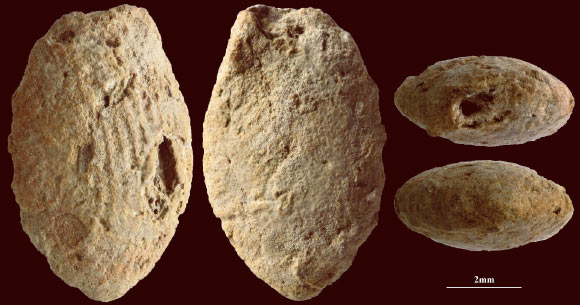
An examination of 142 ornaments, including beads and pendants, unearthed from five Natufian archaeological sites in Israel, dating back to between 15,000 and 11,650 years ago, indicates that the initial application of clay was not for utilitarian purposes like tool creation or food preparation, but rather for expressive functions related to symbolism and personal identity. The remarkable preservation of fingerprints on these artifacts suggests they were often fashioned by children. These findings strongly imply that the foundational elements of artistic expression, cognitive development, and social communication predated the widespread adoption of agriculture.
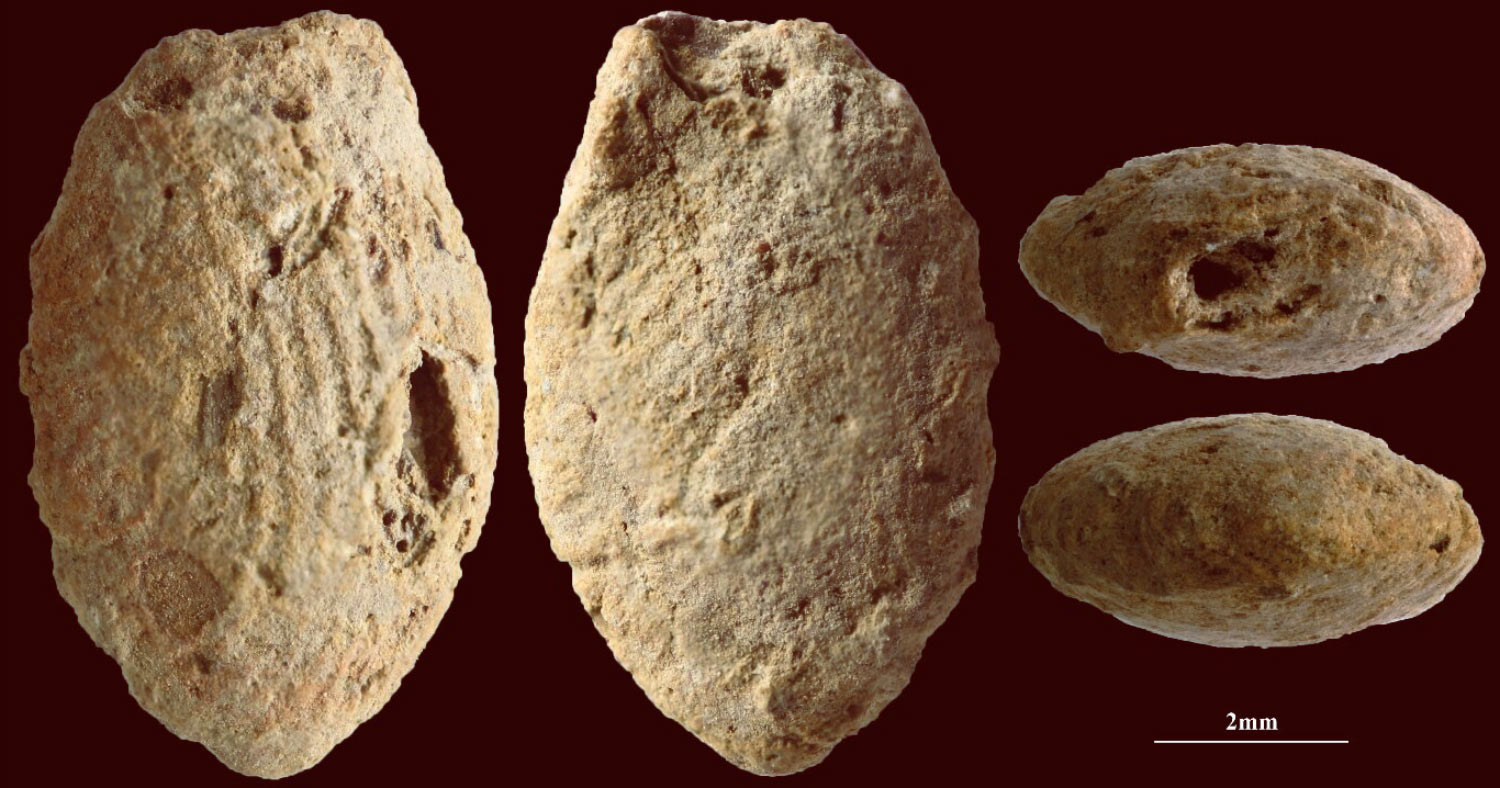
A butterfly clay bead from the Final Natufian period in Eynan-Mallaha, the Upper Jordan Valley, colored red with ochre and marked with the fingerprints of the child (around 10 years old) who modeled it 12,000 years ago. Image credit: Laurent Davin.
“This revelation fundamentally reshapes our comprehension of the interplay between clay, symbolic representation, and the development of sedentary lifestyles,” stated Laurent Davin, an archaeologist affiliated with the Hebrew University of Jerusalem.
The research team meticulously analyzed a collection comprising 142 beads and pendants, originating from five distinct Natufian locations that exhibit evidence of occupation spanning over three millennia.
These artifacts, small enough to be held comfortably in the hand, were expertly molded from unfired clay into a variety of geometric forms, including cylinders, discs, and ellipses.
A significant number of these items were embellished with red ochre, achieved through a technique known as engobe—a thin application of liquid clay, smoothed to create a refined surface.
This represents the earliest documented instance of this specific decorative technique globally.
The substantial quantity and diverse styles of these beads offer an unexpected insight: this was not a sporadic endeavor but rather a deeply ingrained cultural practice.
It has become evident that clay served as a medium for visual communication long before its utilization in the creation of vessels such as bowls or jars.
The investigators identified nineteen distinct classifications of bead types, with many of them exhibiting forms reminiscent of flora vital to Natufian existence, including wild barley, einkorn wheat, lentils, and peas.
These were precisely the plants that the Natufians actively cultivated, processed, and consumed in large quantities—plants that would later form the bedrock of agricultural systems.
Residual traces of plant fibers, preserved on some of the beads, provide invaluable evidence of how they were likely strung and worn. This offers a rare glimpse into organic materials that typically disintegrate and vanish from the archaeological record over time.
Collectively, these adornments suggest that the natural world, particularly its botanical elements, was perceived not merely as sustenance but as a profound source of meaning and cultural significance.
Perhaps the most compelling revelation is not inherent in the shapes of the beads, but rather embedded within their surfaces.
The presence of fifty distinct fingerprints, remarkably preserved, enabled the scientific team to ascertain the identities of their creators.
These imprints correspond to individuals across various age demographics, encompassing children, adolescents, and adults.
This marks the inaugural instance where archaeologists have successfully identified the makers of Paleolithic ornaments through direct physical evidence, and it represents the most extensive collection of such fingerprints ever documented from this prehistoric era.
Certain objects appear to have been intentionally designed for juvenile use, including a miniature clay ring measuring a mere 10 millimeters in diameter.
The findings strongly indicate that the creation of ornaments was a communal, everyday activity, playing a crucial role in the processes of learning, emulation, and the intergenerational transfer of societal values.
For decades, the prevailing archaeological consensus was that the symbolic application of clay in Southwest Asia only emerged with the advent of farming and the subsequent development of the Neolithic way of life.
This current study, coupled with the recent discovery of a clay figurine at Nahal Ein Gev II, unequivocally challenges that long-held assumption.
Instead, the evidence points to an earlier commencement of a significant cultural shift, one that began during the initial phases of sedentarization. During this period, communities still relied on hunting and gathering practices but were concurrently establishing permanent settlements.
Clay ornaments evolved into a tangible means of expressing personal identity, group affiliation, and social connections in a visually discernible and public manner.
“These artifacts unequivocally demonstrate that profound psychosocial and cognitive transformations were already well in progress,” commented Professor Leore Grosman of the Hebrew University of Jerusalem.
“The foundational elements of the Neolithic period are demonstrably more deeply rooted than our previous understanding suggested.”
“By meticulously documenting one of the world’s most ancient traditions of clay adornment, our research recontextualizes the Natufians not solely as precursors to agriculture, but as pioneers of symbolic culture—individuals who employed clay as a medium to articulate their sense of self and their evolving identity.”
The findings of this investigation have been formally published in the esteemed scientific journal, Science Advances.
_____
Laurent Davin et al. 2026. Modeling identities among the first-sedentary communities: Emergence of clay personal ornaments in Epipaleolithic Southwest Asia. Science Advances 12 (12); doi: 10.1126/sciadv.aea2158