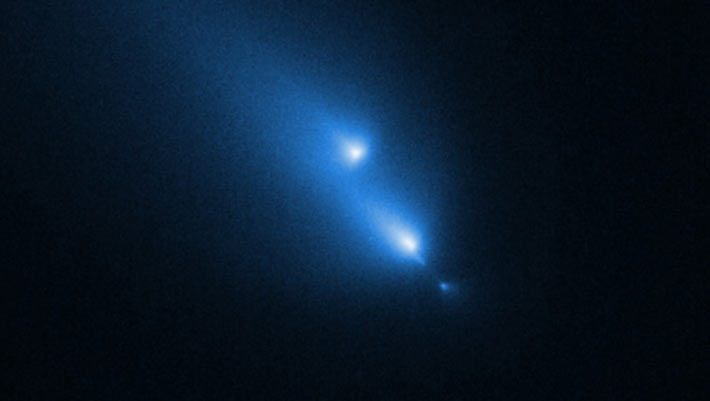
The disintegration of comet C/2025 K1 (ATLAS), meticulously documented by the NASA/ESA Hubble Space Telescope, offers invaluable insights into the dynamic evolution and structural collapse of these icy celestial bodies.
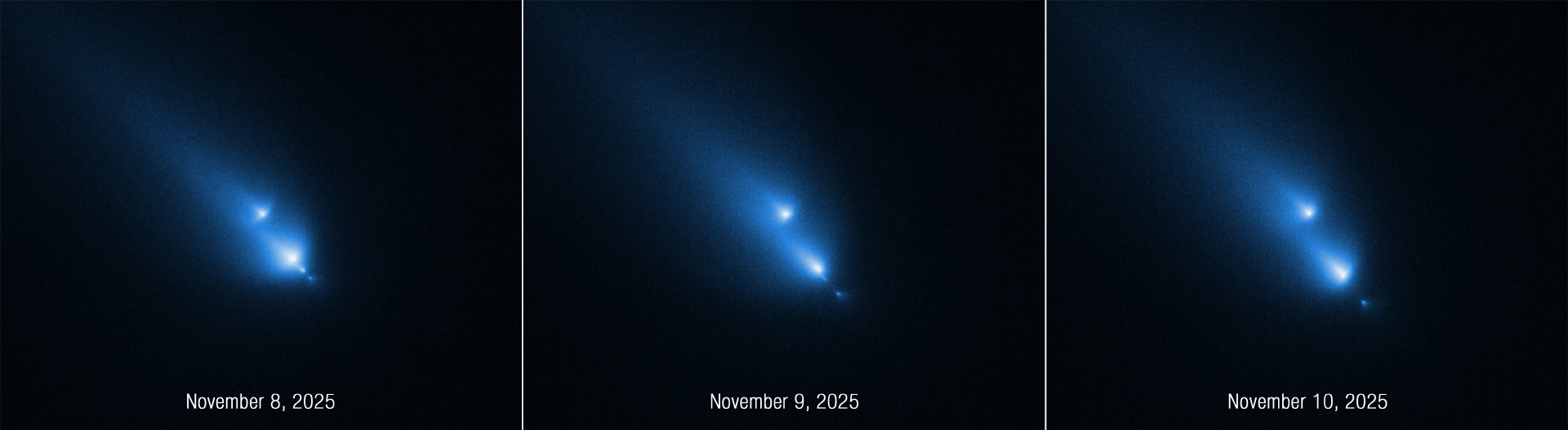
These Hubble observations of the disintegrating comet C/2025 K1 (ATLAS) were acquired over a three-day period, spanning November 8th, 9th, and 10th, 2025. The imagery is credited to NASA / ESA / D. Bodewits from Auburn University and J. DePasquale from the Space Telescope Science Institute.
“Serendipitous discoveries often yield the most significant scientific advancements,” remarked Professor John Noonan from Auburn University, a contributing author to the research.
“Our observation of this particular comet was a fortunate happenstance, as our originally planned target became unavailable due to unforeseen technical limitations that arose after our observation proposal was already approved.”
“Consequently, we were compelled to identify an alternative celestial object. The timing of its observation coincided precisely with its fragmentation, an occurrence representing an exceedingly rare astronomical event.”
Comet C/2025 K1 (ATLAS) achieved its perihelion, the point of closest proximity to the Sun, on October 8, 2025, at a distance of 0.33 AU.
This closest approach to the Sun occurred well within the orbit of Mercury, at approximately one-third the Earth-Sun distance. During perihelion, comets are subjected to their most extreme thermal conditions and immense physical stresses.
Hubble imagery captured between November 8th and 10th, 2025, revealed five distinct fragments, offering an unprecedented high-resolution perspective of a cometary nucleus undergoing catastrophic disruption.
“Never before has the Hubble telescope documented a comet in the process of fragmentation so close in time to the actual event,” stated Professor Noonan.
“Typically, such observations occur weeks or even a month after the fragmentation. In this instance, we were fortunate to capture the phenomenon within mere days of its occurrence.”
“This observation is providing profound insights into the physical processes occurring on the comet’s surface.”
“We may be witnessing the timeframe required for the development of a substantial insulating layer of dust, which can subsequently be expelled by the outgassing of volatile materials.”
Presently, C/2025 K1 (ATLAS) comprises a collection of fragments located approximately 400 million kilometers from Earth.
Situated within the constellation of Pisces, the comet is on a trajectory that will take it out of our Solar System, with little likelihood of returning.
Observations indicate that long-period comets, such as C/2025 K1 (ATLAS), exhibit a greater propensity for fragmentation compared to their short-period counterparts, exemplified by 67P/Churyumov-Gerasimenko which was studied by ESA’s Rosetta mission. However, the underlying reasons for this disparity remain poorly understood.
Scheduled for deployment towards the end of this decade, ESA’s Comet Interceptor mission is poised to become the inaugural mission to investigate a long-period comet.
“The fortuitous observation of C/2025 K1 (ATLAS) by the Hubble Space Telescope will significantly enhance our understanding of the mechanisms driving the fragmentation of certain long-period comets and provide an initial glimpse into their internal structures,” explained Professor Colin Snodgrass from the University of Edinburgh.
“These new findings will serve as a valuable complement to the detailed assessment of a long-period comet that the Comet Interceptor mission will achieve, while also assisting astronomers in the crucial task of selecting the mission’s primary target.”
The research paper detailing these findings was published in the journal Icarus on February 6, 2026.
_____
D. Bodewits et al. Sequential fragmentation of C/2025 K1 (ATLAS) after its near-Sun passage. Icarus, published online February 6, 2026; doi: 10.1016/j.icarus.2026.116996