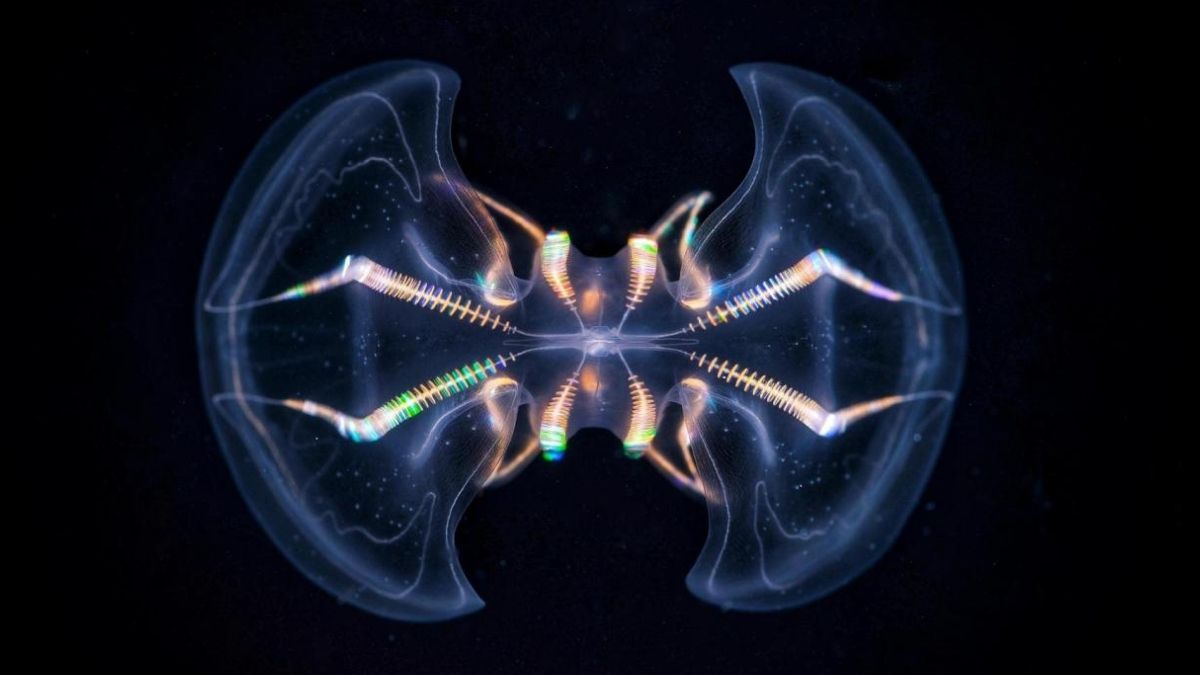
Appearing in Earth’s aquatic environments approximately 550 million years prior, comb jellies are rudimentary, gelatinous organisms famously recognized for their captivating bioluminescent displays.
For an extended period, the scientific community has largely characterized them as exemplars of minimal cognitive function.
However, recent scientific inquiry indicates that their primary sensory apparatus is considerably more intricate and brain-like than previously comprehended.
This revelation carries significant implications for the developmental trajectory of animal nervous systems, particularly given that ctenophores are considered prime candidates for representing the most ancient animal lineage (with sponges also being a prominent contender). Put succinctly, among the extant animal species on our planet, comb jellies appear to hold the distinction of being the most evolutionarily proximate to our last shared ancestor.
The recently identified sophistication of their neural networks suggests that brain-like organizational structures have been an integral component of animal life for a considerable duration.
“Our investigation substantially enhances our grasp of how behavioral coordination has evolved within the animal kingdom,” stated the senior author of the study, Pawel Burkhardt, an evolutionary biologist affiliated with the University of Bergen in Norway.
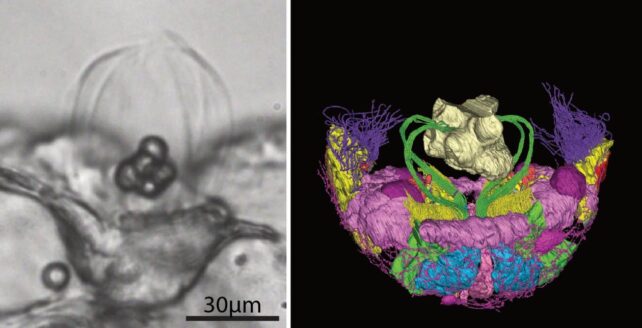
This profound advancement in understanding was achieved through the detailed, high-resolution imaging of the organism’s aboral organ (AO). This sensory apparatus enables the jelly to navigate its oceanic habitat by discerning gravitational forces, shifts in hydrostatic pressure, and the direction of incident light.
These three-dimensional renderings were generated utilizing an advanced imaging methodology known as volume electron microscopy. This technique facilitates the digital reconstitution of organ structures with exceptional fidelity to their in-vivo state—a level of detail often eluded by conventional dissection methods.
The resultant models unveiled a remarkable level of complexity within the comb jelly’s AO, albeit with fundamental distinctions from analogous structures in organisms such as cnidarians (encompassing jellyfish and sea anemones) or even the larval stages of species more closely related to humans, like bristle worms.
The neural network of the jelly, responsible for transmitting signals throughout its body, converges into a concentrated central nexus that envelops the AO. The synaptic connections between these two components establish a clear pathway for the transmission of electrochemical information.
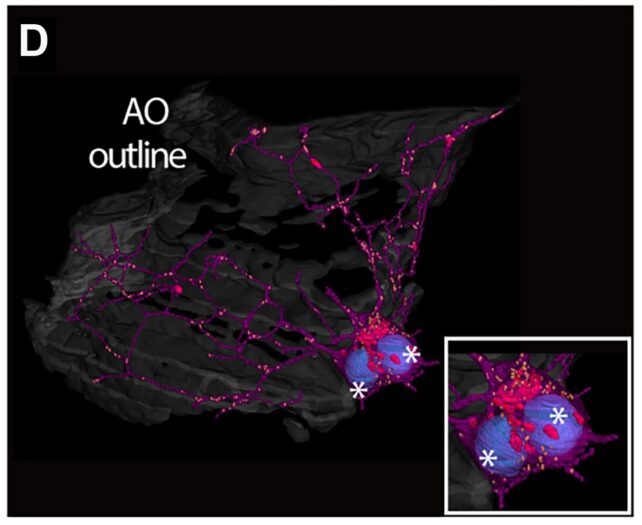
The AO comprised approximately 900 cells in total, representing 17 distinct cell phenotypes. Notably, eleven of these are entirely novel discoveries within the scientific realm.
“I was immediately struck by the striking morphological variations among the aboral organ’s constituent cells,” commented Anna Ferraioli, a molecular biologist at the University of Bergen and the primary author of the study.
The subsequent investigative phases for the research team, as articulated by Ferraioli, will involve delving into the molecular characteristics of the newly identified cell types and elucidating the degree to which the aboral organ influences behavioral patterns.
Furthermore, the researchers observed that a significant proportion of the non-synaptic cells within the AO were replete with vesicles—membrane-bound sacs involved in the transport of chemical substances into and out of cells. It is highly probable that these cellular elements are implicated in a more diffuse, slower mode of chemical communication known as volume transmission.
Volume transmission represents one mechanism through which neurotransmitters like dopamine, serotonin, and histamine can exert their effects within the brain; instead of relying on the rapid and targeted signaling of synapses, these neuromodulatory substances can also disseminate broadly across cellular tissues, influencing their activity.
The genetic and molecular machinery that comb jellies employ to construct this rudimentary central nervous system is unique, exhibiting distinctions from those observed in cnidarians and bristle worm larvae.
“Our findings serve to redefine the ctenophore AO as a discrete, integrated, and potentially multifaceted sensory system that plays a crucial role in behavioral regulation,” the researchers reported in their peer-reviewed publication.
“To put it another way,” added Burkhardt, “it appears that evolution independently developed centralized nervous systems on multiple occasions.”
Collectively, these findings suggest that centralized nervous systems may have emerged in the evolutionary history of animals much earlier than previously assumed, albeit in forms significantly divergent from our own.
The scientific findings were disseminated in the journal Science Advances.