Our planet’s climate is experiencing an unprecedented level of disequilibrium. The period spanning 2015 to 2025 has been unequivocally identified as the warmest eleven-year span on record, a finding substantiated by the World Meteorological Organization’s annual compendium, the State of the Global Climate report.
Remarkably, ocean heat content attained a record zenith in 2025. This phenomenon occurs as the world’s oceans continue to absorb approximately 91 percent of the surplus thermal energy trapped by the escalating concentrations of greenhouse gases accumulating within our atmosphere.
This marks a significant development, as this particular edition of the State of the Global Climate report incorporates Earth’s energy imbalance as a pivotal metric for the first time.
Under normal circumstances, a specific quantity of solar radiant energy arrives at our planet each year. In a theoretically balanced climatic state, the influx of incoming energy would closely approximate the outgoing thermal radiation.
However, substantial volumes of atmospheric greenhouse gases have impeded the escape of this thermal energy back into the void of space. Consequently, this energy is now being disseminated throughout our planet’s systems, with a disproportionate amount being absorbed by our oceans.
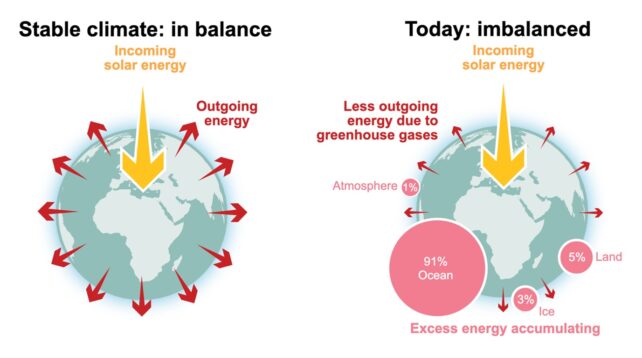
The report indicates that a mere 1 percent of this excess, entrapped thermal energy is retained within the atmosphere itself. An additional five percent accumulates within the terrestrial environment, particularly in urban heat island effects. A further three percent is absorbed by ice formations, contributing to glacial recession.
The overwhelming proportion, 91 percent, of this excess thermal energy is absorbed by our oceans. While this figure is difficult to fully comprehend, the report clarifies it through the lens of stored thermal energy.
In 2025, the cumulative heat content of the oceans surpassed all preceding 66 years of recorded data, exceeding the previous record, established in 2024, by an astonishing 23 zettajoules – a quantity equivalent to 23 sextillion joules.
This represents a colossal escalation, especially when considering that the 14-zetta Joule increment observed between 2020 and 2021 was already deemed alarming at the time.
The scale of this warming is so immense that it is analogous to detonating approximately 12 Hiroshima-sized atomic bombs into the ocean every single second throughout the entirety of 2025.
And this formidable energy increase is confined to the upper 2,000 meters of oceanic depth.
While the oceans’ capacity to absorb thermal energy and carbon dioxide might appear to act as a ‘buffer’ against terrestrial climate change, predictive models suggest that even with a complete cessation of human-induced greenhouse gas emissions, the Southern Ocean alone would continue to release heat and exacerbate global warming for at least another century.
Furthermore, elevated ocean temperatures serve as a catalyst for more severe storm systems, leading to an increased incidence and intensity of extreme and potentially lethal weather phenomena. Examples from 2025 include Hurricane Melissa, Tropical Cyclones Senyar and Ditwah, and severe typhoon events impacting Viet Nam and the Philippines.

This situation poses a grave threat to marine ecosystems and to the human communities that depend on oceanic resources. Recent intense and unprecedented marine heatwaves illustrate the detrimental impact of this so-called ‘buffer’ mechanism.
Moreover, marine heatwaves can paradoxically lead to further greenhouse gas release as decomposing marine life releases captured carbon during their decay.
Beyond solar energy, the WMO report highlights that the oceans have also absorbed 29 percent of the carbon dioxide emissions generated by human activities over the last decade. The dissolution of carbon dioxide in seawater results in increased water acidity.
Numerous species of plankton, the foundational microorganisms of global marine food webs, are experiencing severe degradation due to the ocean’s escalating acidity.
More acidic seawater impedes the ability of calcifying organisms, such as plankton and coral, to construct and maintain their protective shells, skeletons, and other calcium carbonate structures. In sufficiently acidic conditions, these structures can even begin to dissolve.
Greenhouse gas emissions stemming from human endeavors, primarily the combustion of fossil fuels for nearly all facets of modern life and agricultural practices, have precipitated rapid and extensive environmental transformations within a mere few decades.
“When history repeats itself eleven times, it is no longer a coincidence. It is a call to act,” remarked UN Secretary-General António Guterres.
“In this age of conflict, climate-induced stress also reveals another stark reality: our dependence on fossil fuels is undermining both climatic stability and global security,” he further asserted. “Today’s report should be accompanied by a cautionary advisory: climate disruption is accelerating, and delaying action is perilous.”
The presented findings are derived from an extensive compilation of data and contributions from national meteorological and hydrological services worldwide, WMO Regional Climate Centers, partner United Nations agencies, and a multitude of scientific experts.