Current human numbers and consumption patterns significantly exceed Earth’s sustainable limits, a recent investigation reveals.
Analyzing over two centuries of demographic data, a research collective spearheaded by Corey Bradshaw of Flinders University in Australia has concluded that humanity is currently operating beyond the planet’s long-term support capabilities.
Ecological science defines a species’ capacity to be sustained by its environment as its “carrying capacity.” This metric estimates the maximum population size an ecosystem can support indefinitely, considering available resources and their regeneration rates.
Our species, Homo sapiens, demonstrates a remarkable ability to stretch these ecological boundaries, largely by developing technological workarounds to circumvent natural resource replenishment constraints, notably through the exploitation of fossil fuels.
Intriguingly, the concept of “carrying capacity” originated in the late 19th century maritime sector, coinciding with the shift from wind-powered vessels to coal-fired steamships. It was initially applied to calculate the optimal cargo load for these new ships, ensuring sufficient space and weight remained for essential coal, water, and the operational crew.
This pivot to fossil fuels across shipping and other industries was a primary catalyst for the exponential population expansion observed in the 20th century. Amidst current geopolitical events impacting global fuel supplies and the populations reliant upon them, this historical context is particularly relevant. The global populace currently numbers approximately 8.3 billion individuals.
“Contemporary economic systems, built upon perpetual expansion, appear to disregard the finite regenerative capacities associated with sustained population growth, as fossil fuels artificially bridge the deficit,” the research group states.
Bradshaw and his colleagues have formulated an empirically grounded estimation of human carrying capacity. They employed ecological growth models to chart fluctuations in population size and growth rates globally and regionally over the past two hundred years.
Their analysis distinguishes between the absolute maximum carrying capacity – the theoretical upper limit irrespective of ensuing hardship like starvation, disease, and conflict – and the optimal carrying capacity, which denotes a population size that is both sustainable and upholds a minimal quality of life.
“Earth’s ability to replenish resources cannot keep pace with our current consumption trajectory. It is incapable of supporting even present-day demands without substantial modifications. Our findings indicate that we are placing an unsustainable burden on the planet,” Bradshaw observes.
Prior to the 1950s, the study identified an accelerating rate of human population growth. However, this trend began to decelerate in the early 1960s, even as the overall population continued to rise.
“This transition signaled the commencement of what we term ‘a negative demographic phase’,” explains Bradshaw. “This implies that an increase in population no longer correlates with accelerated growth. Our analysis of this phase suggests that the global population is likely to reach a peak between 11.7 and 12.4 billion by the late 2060s or 2070s, assuming current trends persist.”
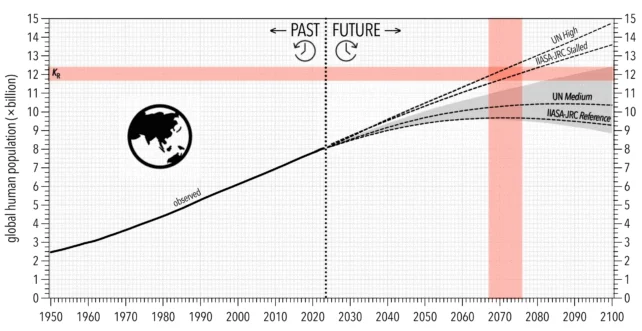
The upper boundary for Earth’s estimated carrying capacity is approximately 12 billion individuals. However, this is considerably higher than the optimal figure for sustainable living at present consumption levels, which Bradshaw’s team estimates at 2.5 billion.
This research represents a pioneering effort to examine the interdependencies between per capita population change rates and long-term average population sizes.
The findings indicate a shift in human societal dynamics, moving from a pattern where larger populations spurred higher growth rates, to one where the growth curve began to flatten. In essence, as population numbers increased, the pace of expansion diminished.
Despite these moderated growth rates, humanity’s current numbers already substantially exceed the sustainable carrying capacity as projected by Bradshaw and colleagues’ models.
The significant disparity between their calculated optimum of 2.5 billion and the current population of 8.3 billion may shed light on the pervasive issues of overconsumption plaguing our species.
For instance, recent reports from the UN have highlighted a global state of water scarcity. Animal populations are experiencing precipitous declines, unable to compete for resources or adapt to our escalating consumption demands.
Furthermore, our reliance on fossil fuels to temporarily enhance Earth’s carrying capacity – for purposes such as producing the fertilizers that sustain our agriculture and powering our complex lifestyles – is clearly proving detrimental. The combustion of fossil fuels also directly contributes to anthropogenic climate change, which is destabilizing ecosystems and natural resources worldwide.
Notably, the study posits that fluctuations in global average temperature, ecological footprint, and total emissions are more accurately explained by an expanding population than by increasing per-capita consumption.
“The planet’s vital support systems are already under considerable strain. Without swift transformations in our energy, land, and food utilization practices, billions will face escalating instability,” Bradshaw asserts. “Our research demonstrates that these limitations are not abstract concerns but are actively materializing.”
While the study presents a stark outlook on human existence on Earth, the researchers suggest that remedial action is still possible.
“Earth cannot sustain future human populations, or even the current numbers, without a profound re-evaluation of socio-cultural practices concerning the use of land, water, energy, biodiversity, and other resources,” the study’s authors conclude.
“Smaller populations with reduced consumption levels yield superior outcomes for both humanity and the planet,” Bradshaw comments. “While the window for decisive action is narrowing, substantial positive change remains attainable through collaborative international efforts.”
As with all global-scale analytical models, inherent limitations exist. The sheer complexity of Earth’s continuously interacting variables makes it impossible for scientists to meticulously account for every factor influencing population dynamics, growth rates, and carrying capacity. Consequently, these figures should be interpreted as estimates valid only within the scope of the data upon which they are founded.
The concept of carrying capacity also introduces complex ethical considerations. The unequal distribution of opportunities and resource consumption among global populations raises difficult questions, and discussions surrounding population management often intersect with sensitive issues of racism and ableism.
“The unfortunate reality is that human ingenuity has bypassed the inevitable corrective feedback mechanisms inherent to carrying capacity, without establishing equitable and ecologically sound alternatives,” the researchers summarize.