Paleontologists have unearthed the most complete ichthyosaur fossil discovered to date on the island of Cuba, retrieved from the depths of a limestone cavern in the western part of the country.

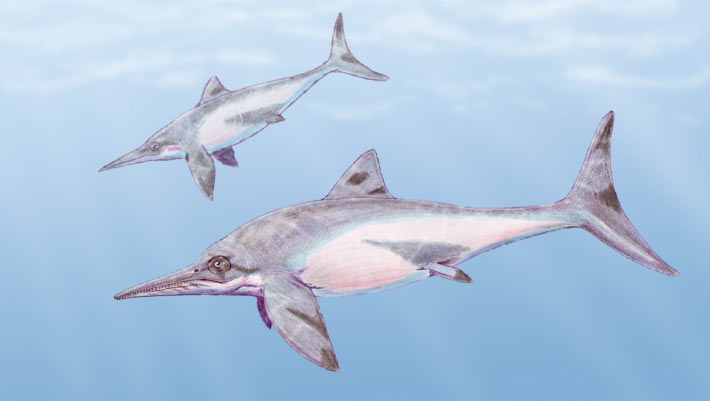
Ophthalmosaurid ichthyosaurs. Image credit: Dmitry Bogdanov / CC BY 3.0.
The remarkable ichthyosaur skeleton was retrieved in 2023 from a subterranean river passage located in El Cuajaní, an area situated within the Viñales Geopark and National Park in Cuba’s western region.
The portion of the specimen that has been exposed comprises the vertebral column, characterized by its U-shaped curvature, along with associated rib bones, individual vertebrae, and a single posterior limb.
“The fossil specimen is ensconced within the rock slab that constitutes the roof of the subterranean cavern, now identified as Cueva del Ictiosaurio, positioned approximately 60 meters from its entry point,” stated Dr. Manuel Iturralde-Vinent of the Academia de Ciencias de Cuba, in conjunction with his international colleagues from Cuba, Argentina, Poland, and the United States.
Radiometric analysis indicates the fossil dates back approximately 145 million years, placing it within the Tithonian stage of the Late Jurassic epoch.
Prior to this discovery, the ichthyosaur fossil record from Cuba was predominantly limited to older geological layers from the Oxfordian period.
“This particular fossil represents the most comprehensively preserved ichthyosaur specimen recovered from Cuba up to this point,” the research team of paleontologists noted.
“It notably expands the temporal range of ichthyosaur presence on the island; previously, only specimens from the Oxfordian age were documented.”
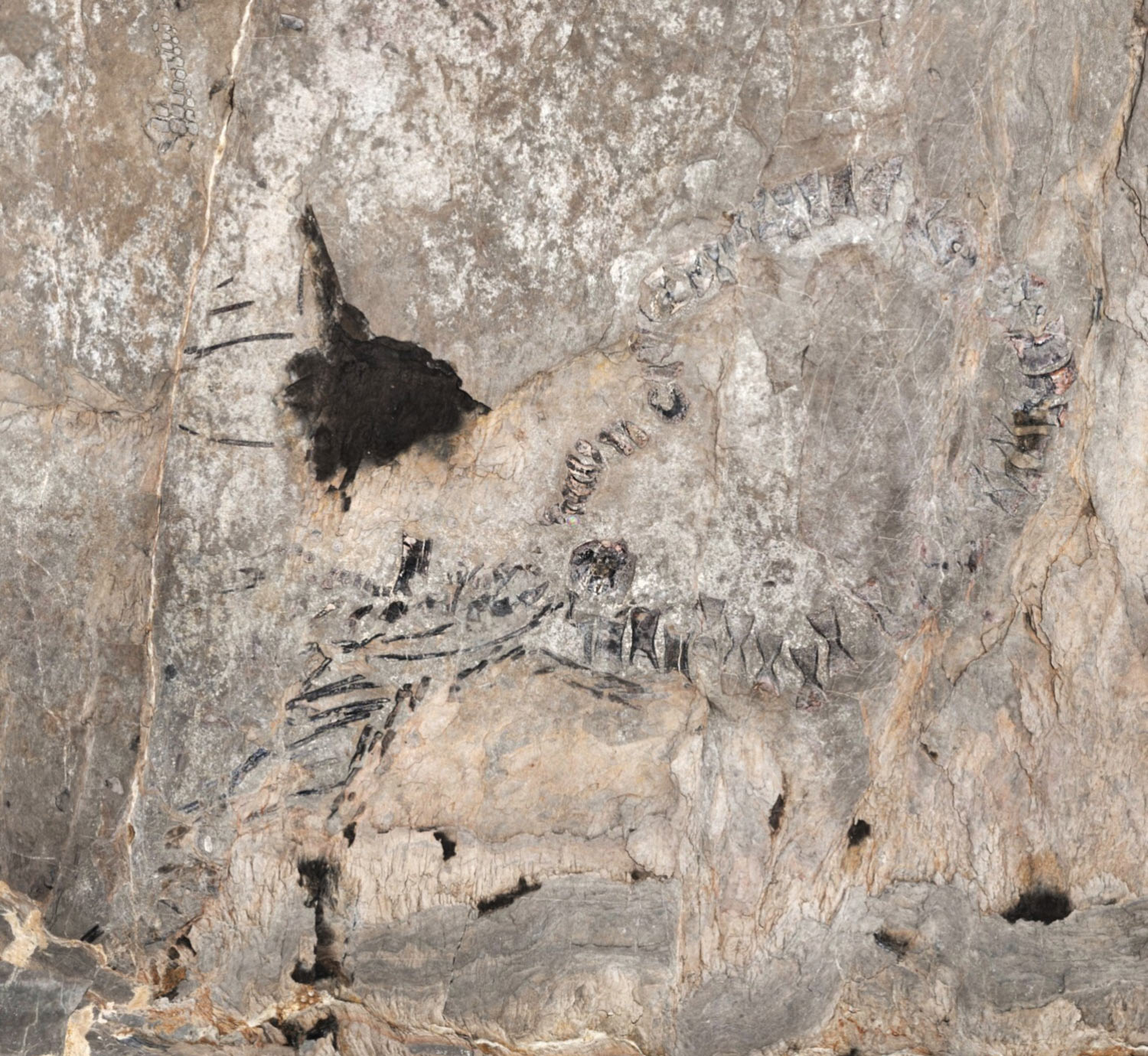
The partial skeleton of the El Cuajani ichthyosaur. Image credit: Iturralde-Vinent et al., doi: 10.1080/02724634.2025.2609717.
While the fossil, referred to informally by researchers as the El Cuajani ichthyosaur, has not yet been definitively classified to a specific species, its anatomical features suggest a close relationship to the ichthyosaur family known as Ophthalmosauridae.
“The structural characteristics of its hindlimb bear similarities to those of Tithonian platypterygiine ophthalmosaurids, exhibiting resemblances to species such as Caypullisaurus bonapartei and Aegirosaurus leptospondylus,” the scientists elaborated.
According to the scientific analysis, this ancient creature inhabited the expansive, open-sea environment of the early Caribbean seaway, a critical oceanic thoroughfare that facilitated connections across vast distances of the Jurassic world.
“The Caribbean seaway emerged as a significant marine conduit from the mid-Oxfordian period onward, bridging the Eastern and Western Tethys seas and playing an instrumental function in the dissemination of marine fauna between Europe, the Gulf of Mexico, and the Pacific Ocean since the Late Jurassic,” they explained.
“This route traced its origins back to the latest Triassic-Early Jurassic periods, manifesting as continental rift valleys. These should not be intrinsically considered part of the nascent Caribbean basin or the Gulf of Mexico, but rather as ancestral precursors situated in west-central Pangea.”
“The discovery of the El Cuajani ichthyosaur adds to the accumulating collection of Tithonian ichthyosaur findings recently unearthed in this region and holds the potential to enhance our comprehension of the group’s biogeographical evolution,” the researchers concluded.
Their research article was officially published on February 6 in the prestigious Journal of Vertebrate Paleontology.
—–
Manuel Iturralde-Vinent et al. A partial ichthyosaur (?Ophthalmosauridae) skeleton from the Tithonian (Upper Jurassic) of western Cuba. Journal of Vertebrate Paleontology, published online February 6, 2026; doi: 10.1080/02724634.2025.2609717