Cosmic cartographers utilizing the Hobby-Eberly Telescope Dark Energy Experiment (HETDEX) have made a remarkable discovery: the identification of vast hydrogen envelopes, referred to as Lyman-alpha nebulae, enveloping over 30,000 galaxies dating back 10 to 12 billion years. This revelation strongly indicates that the foundational material essential for galactic formation was significantly more plentiful in the early universe than previously surmised.
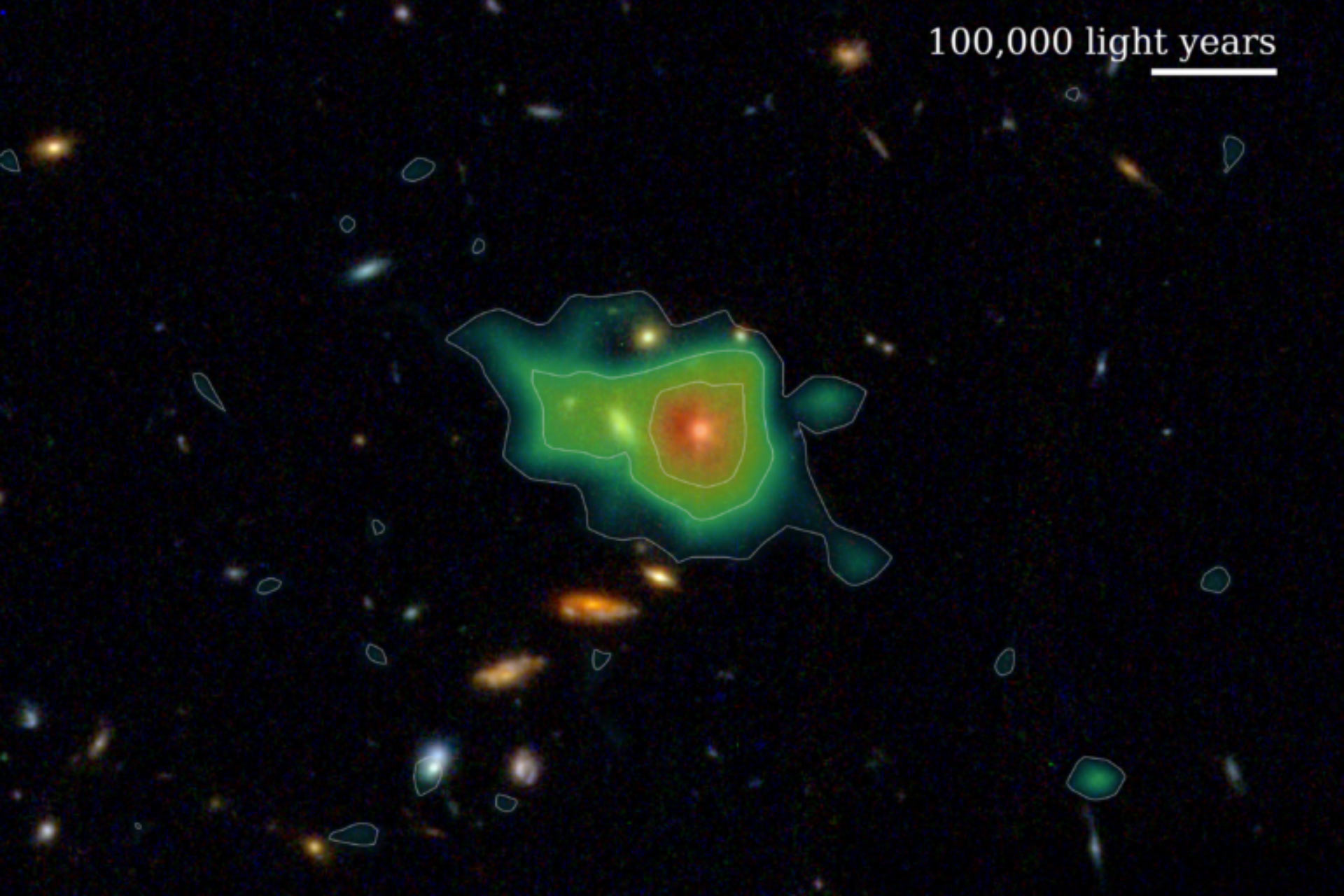
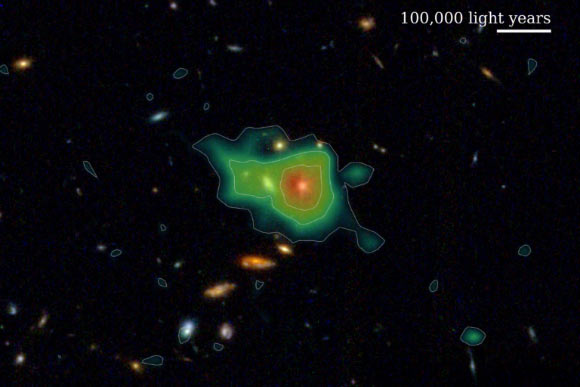
An immense shell of hydrogen gas, identified through HETDEX observations and overlaid on its position as visualized in deep imagery from the NASA/ESA/CSA James Webb Space Telescope, existed 11.3 billion years ago. This structure emits light derived from the collective illumination of numerous galaxies within it, with the most intensely luminous area depicted in red. Image attribution: Erin Mentuch Cooper, HETDEX / NASA / ESA / CSA / STScI.
The inherent challenge in detecting hydrogen gas stems from its lack of intrinsic luminosity.
However, proximity to an energetic source, such as a galaxy or cluster of galaxies populated with ultraviolet-emitting stars, can induce the hydrogen to fluoresce due to the emitted energy.
To achieve such detections, astronomical research demands significant allocations of time on highly precise, and frequently sought-after, instrumentation.
While prior astronomical surveys have identified a subset of these nebulae, their instrumentation had a limited capacity, capable of registering only the most luminous and extreme examples.
Furthermore, focused investigations of nascent galaxies typically employ such narrow fields of view that they inadvertently exclude all but the most diminutive nebulae.
Consequently, the intermediate population of formations has largely remained beyond our observational reach.
The data acquired by HETDEX is beginning to bridge this observational void. Employing the Hobby-Eberly Telescope situated at McDonald Observatory, this astrometric survey is meticulously mapping the spatial distribution of over a million galaxies in its endeavor to elucidate the nature of dark energy.
“We have amassed nearly half a petabyte of data encompassing not only these galaxies but also the intervening cosmic regions,” stated Dr. Karl Gebhardt, the principal investigator for HETDEX and the chair of the astronomy department at the University of Texas at Austin.
“Our observational scope encompasses a celestial area equivalent to more than 2,000 full lunar disks. The sheer scale and ambition of this project are unprecedented.”
“The Hobby-Eberly Telescope ranks among the largest instruments globally,” added Dr. Dustin Davis, an HETDEX scientist and postdoctoral researcher at the University of Texas at Austin.
“Moreover, the instrument HETDEX utilizes generates 100,000 spectral readings per observation. This yields an immense volume of data, promising a wealth of intriguing, captivating, and unusual discoveries for us to uncover.”
To facilitate the identification of hydrogen nebulae, the researchers selected the 70,000 brightest examples from the more than 1.6 million early galaxies cataloged by HETDEX to date.
With the computational power provided by supercomputers at the Texas Advanced Computing Center, they scrutinized these galaxies for evidence of surrounding hydrogen envelopes.
According to the research group, these nebulae span dimensions ranging from tens of thousands to hundreds of thousands of light-years across.
Some present as simple, ovoid clouds enveloping a solitary galaxy; others manifest as expansive, irregularly shaped masses containing multiple galactic entities.
“Those are the most fascinating ones,” remarked Erin Mentuch Cooper, HETDEX data manager and a researcher at the University of Texas at Austin.
“They bear a resemblance to colossal amoebas with filamentary extensions reaching into the void of space.”
A scholarly article detailing these findings was disseminated on March 11, 2026, in the esteemed publication, the Astrophysical Journal.
_____
Erin Mentuch Cooper et al. 2026. Lyα Nebulae in HETDEX: The Largest Statistical Census Bridging Lyα Halos and Blobs across Cosmic Noon. ApJ 1000, 38; doi: 10.3847/1538-4357/ae44f3