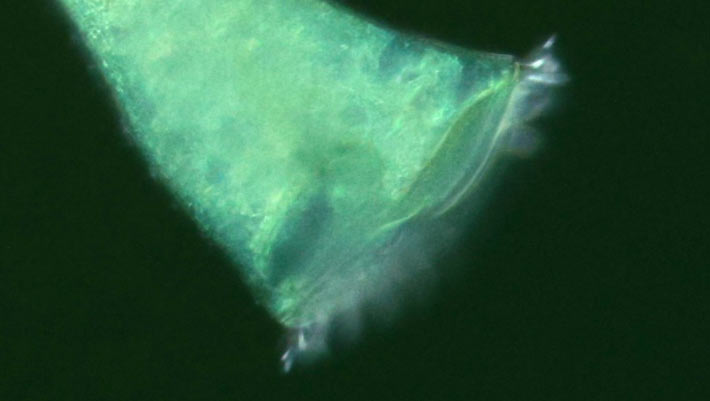
A discovery regarding the protist species known as Stentor coeruleus indicates that it employs the perception of physical contours to guide its movement, proposing that even the most rudimentary life forms can leverage geometrical principles for survival.
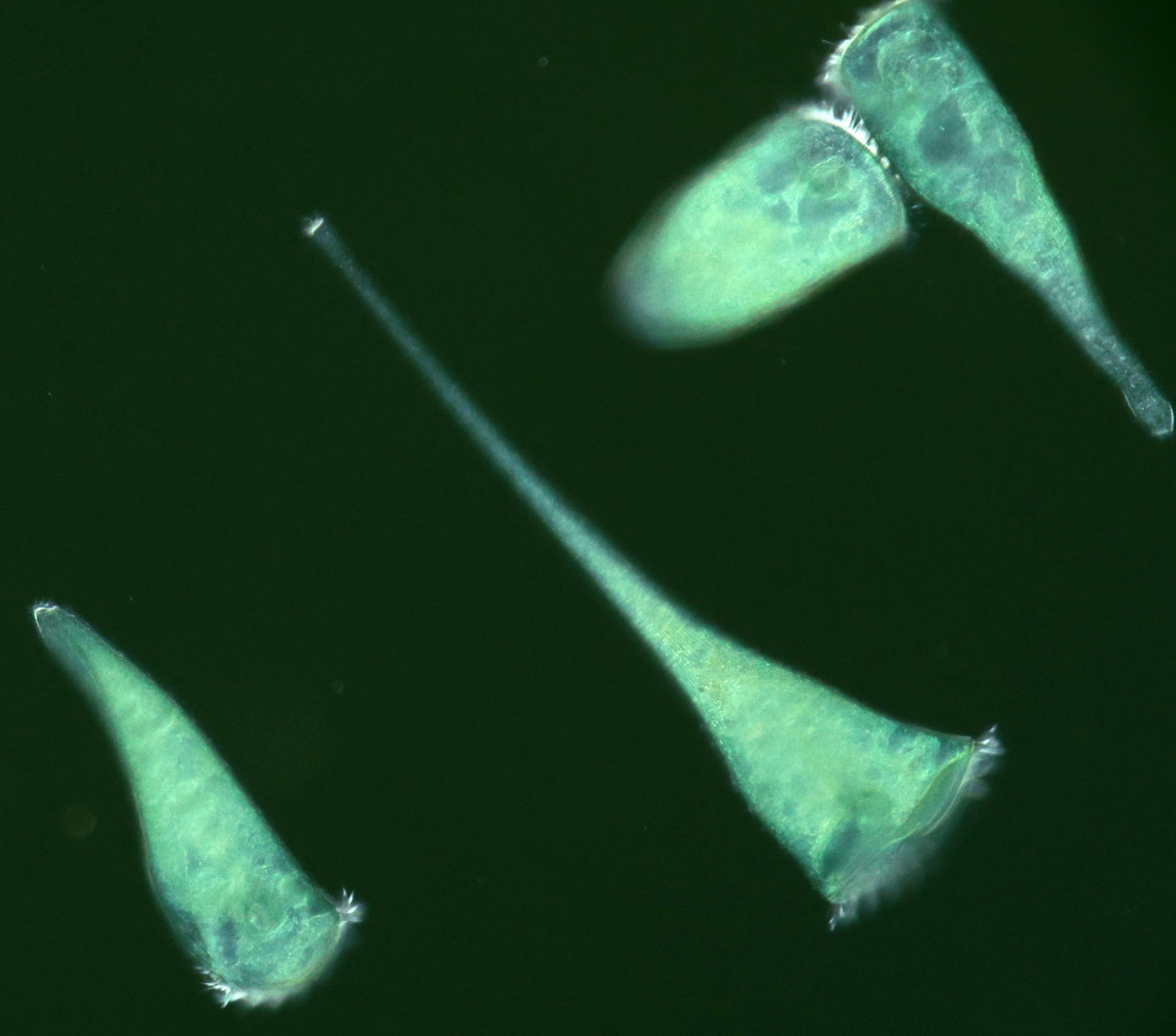
Stentor coeruleus. Image credit: Laboratory of Physical Ethology, Hokkaido University.
Weighing in at a mere 1 mm in length, Stentor coeruleus represents a single-celled organism belonging to the family Stentoridae.
“The complex behavioral repertoire of Stentor coeruleus encompasses transitions between free-swimming and substrate attachment,” stated Dr. Syun Echigoya from Hokkaido University, the lead author of the research.
“When in its swimming phase, Stentor coeruleus principally generates forward momentum via hair-like appendages named membranellar bands, which are situated around its anterior region.”
“This unicellular entity explores its environment, with its path influenced by both photic and chemical stimuli.”
“During propulsion, Stentor coeruleus gradually adopts an elongated, trumpet-like morphology and secures itself to a surface using a specialized anchoring organ located at its posterior extremity.”
“Even when attached, Stentor coeruleus generates external fluid dynamics through its membranellar band, thereby forming an oral structure for the capture of bacteria and other small ciliates that serve as sustenance.”
“Concurrently, adherence to a substrate may augment the organism’s vulnerability to predation,” the researchers noted.
“Consequently, the judicious selection of anchoring locations within varied ecological settings is likely a critical survival strategy for Stentor coeruleus.”
In pursuit of their investigation, Dr. Echigoya and his collaborators fabricated miniature containment units with meticulously calibrated dimensions, designed to simulate the structural elements frequently encountered by microorganisms in their natural aquatic habitats.
Certain chambers were characterized by smooth, planar surfaces, while others incorporated features such as edges, junctions, and confined spaces reminiscent of corners.
“We systematically modified geometrical attributes, including the angle and depth of corners, to establish differentiated options for anchorage,” Dr. Echigoya elaborated.
“Subsequently, we conducted a detailed quantitative analysis of the observed behaviors, drawing upon video recordings of the microorganisms and augmenting these with computational simulations.”
The patterns of movement observed were notably far from arbitrary.
Initially, the cells exhibited unconstrained locomotion, actively surveying their surroundings. However, upon approaching a solid surface, their behavioral patterns underwent a discernible alteration.
A subtle reconfiguration of their cellular structure into an asymmetrical form was observed, followed by the initiation of passive movement along the surfaces, facilitated by the coordinated action of their ciliary appendages.
Incrementally, they directed their trajectory towards more confined, corner-like geometries. Upon reaching these locations, they firmly affixed themselves to the substrate.
“The remarkable efficacy of this elementary approach was quite astonishing,” Dr. Echigoya conveyed.
“Stentor coeruleus does not possess the capacity for cognitive recognition of structures.”
“Through a simple alteration in its bodily configuration, it can engage physically with surfaces to identify and occupy suitable corner spaces for attachment.”
“These findings suggest that even minute physical characteristics within natural environments can exert a significant influence on the distribution and proliferation of microorganisms,” commented Dr. Yukinori Nishigami, the senior author of the study and a fellow researcher at Hokkaido University.
“At the microscopic scale, natural landscapes are replete with small recesses and sheltered areas.”
“The aptitude to detect and colonize these protected microhabitats might elucidate the mechanisms by which microorganisms persist, migrate, and aggregate into communities.”
The research findings have been formally published in the esteemed journal Proceedings of the National Academy of Sciences.
_____
Syun Echigoya et al. 2026. Geometrical preference of anchoring sites in the unicellular organism Stentor coeruleus. PNAS 123 (9): e2518816123; doi: 10.1073/pnas.2518816123