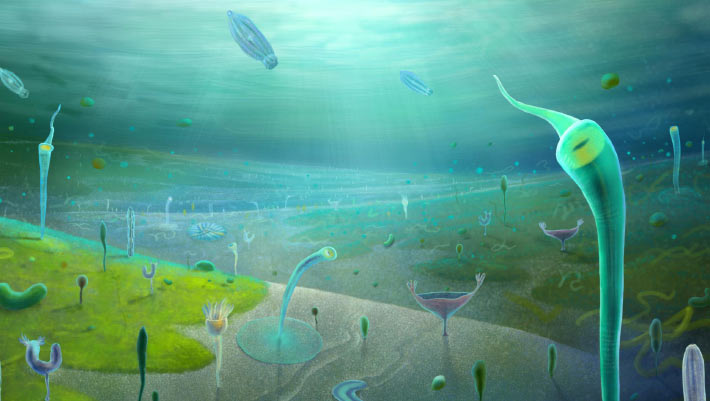
An extensive collection exceeding 700 Ediacaran fossils, originating from the concluding epoch of the Ediacaran period, strongly suggests that foundational animal lineages, encompassing primordial ancestors of vertebrates, underwent significant diversification millions of years prior to prevailing scientific estimations.
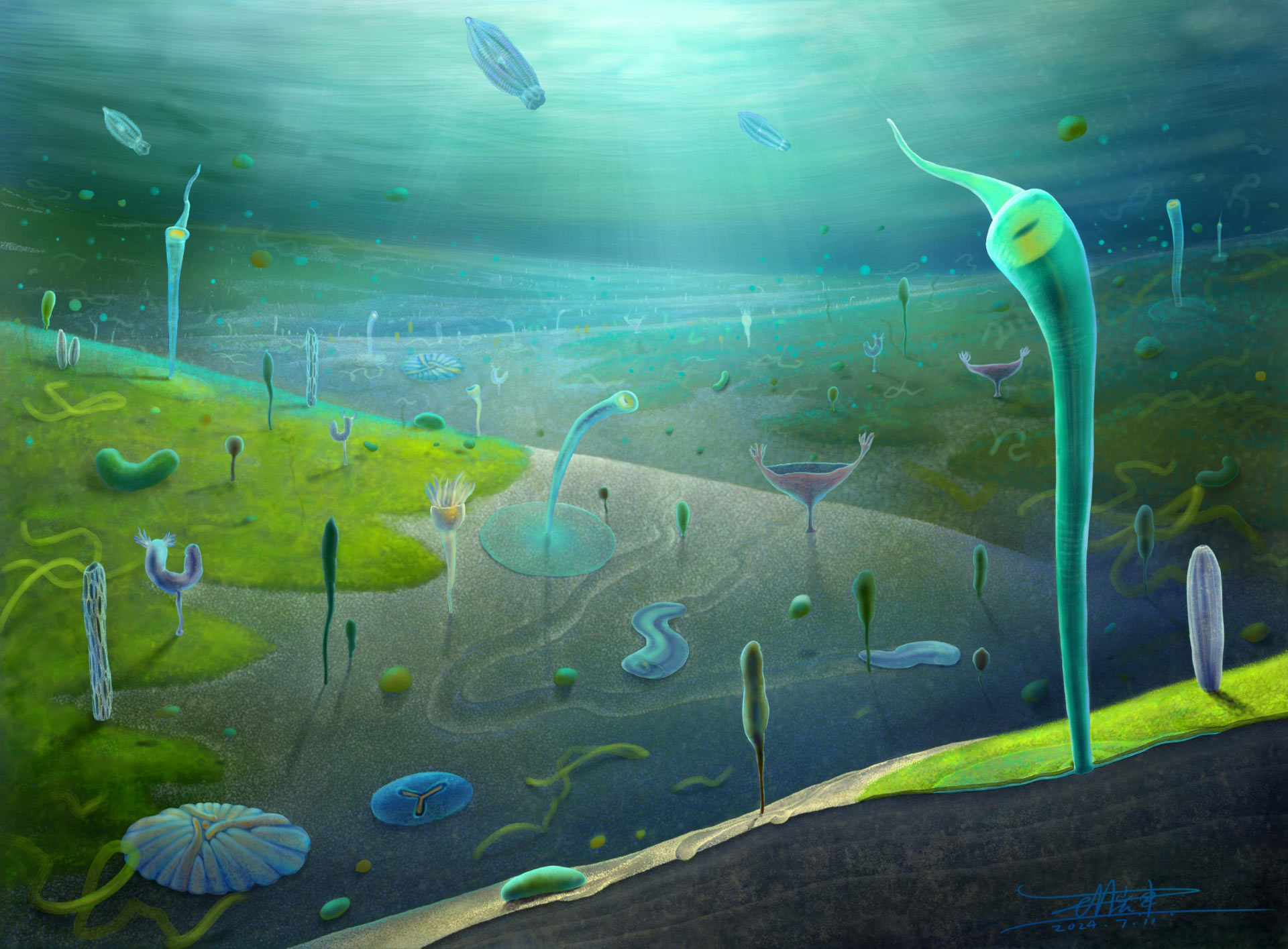
Reconstruction of the Jiangchuan Biota. Image credit: Xiaodong Wang.
The prodigious surge in animal complexity observed during the transition from the Ediacaran to the Cambrian geological periods represents one of the most pivotal evolutionary junctures in Earth’s protracted history.
However, extant fossil evidence has historically provided only an incomplete panorama of this profound transformation; Ediacaran biotas exhibit minimal structural or taxonomic affinity with their Cambrian successors, rendering the precise epoch of major animal group emergence enigmatically elusive.
“Our findings bridge a significant chasm in our understanding of the earliest stages of animal evolutionary radiation,” stated Dr. Gaorong Li, a distinguished researcher affiliated with Oxford University.
“For the first time, we have established the presence of numerous sophisticated animal forms, typically associated with the Cambrian, within the Ediacaran period, thereby indicating their evolution occurred substantially earlier than previously substantiated by paleontological data.”
In the course of their comprehensive investigation, Dr. Li and his collaborators meticulously analyzed over 700 fossil specimens unearthed from a recently identified paleontological site located in Yunnan Province, spanning southwestern China.
This remarkable fossil assemblage dates back an estimated 554 to 539 million years and is classified as part of the Jiangchuan Biota.
Distinguishing itself from the majority of Ediacaran fossil localities, which predominantly preserve organisms as superficial impressions on sandstone matrices, these newfound fossils are preserved as carbonaceous films. This mode of preservation bears a striking resemblance to that observed at renowned Cambrian fossil sites, such as the Burgess Shale in Canada.
“This discovery is profoundly significant as it illuminates a transitional ecological community: the peculiar Ediacaran realm gradually yielding to the burgeoning Cambrian, a subsequent era characterized by animals whose phylogenetic placement is considerably more straightforward within extant taxonomic groupings,” commented Dr. Luke Parry, also from Oxford University.
“Upon initial examination of these specimens, it was immediately apparent that we were encountering something entirely novel and unanticipated.”
The fossil assemblage includes the most ancient known progenitor lineages of deuterostomes, a broad classification encompassing modern vertebrates, including humans and various fish species.
Among the identified specimens are also found the ancestral forms of contemporary starfish and their closest evolutionary relatives, the acorn worms (belonging to the Ambulacraria phylum).
These organisms possessed a distinctive U-shaped morphology and were anchored to the primordial seafloor via a stalk-like appendage, featuring a pair of anterior tentacles utilized for capturing sustenance.
“The identification of these ambulacrarians within the Ediacaran period is a truly groundbreaking revelation,” remarked Dr. Frankie Dunn, a researcher at Oxford University.
“We have previously identified fossils representing distant relatives of starfish and sea cucumbers and are actively seeking further such specimens.”
“Furthermore, the discovery of ambulacrarian fossils within the Jiangchuan Biota strongly implies that chordates, animals possessing a vertebral column, must have also existed during this geological epoch.”
Additional ancestral groups represented within the fossil collection include vermiform bilaterian animals, some exhibiting sophisticated adaptations for feeding, alongside rare fossilized remains interpreted as early ctenophores (comb jellies).
A significant number of specimens display an amalgamation of anatomical characteristics that do not correspond to any recognized Ediacaran or Cambrian species.
“Our findings suggest that the apparent scarcity of these complex animal lineages at other Ediacaran sites may be attributable to disparities in fossilization processes rather than their actual biological absence,” posited Dr. Ross Anderson of Oxford University.
“Carbonaceous compressions, such as those observed at Jiangchuan, are infrequent in geological strata of this age, indicating that analogous communities may simply have failed to be preserved elsewhere.”
This pivotal discovery is detailed in a publication featured in the esteemed journal Science.
_____
Gaorong Li et al. 2026. The dawn of the Phanerozoic: A transitional fauna from the Late Ediacaran of Southwest China. Science 392 (6793): 63-68; doi: 10.1126/science.adu2291