A groundbreaking experiment conducted in Germany has yielded the inaugural evidence of a long-theorized pairing between a carbon-11 atomic nucleus and an eta prime (η’) meson, offering profound insights into the mechanisms by which nature’s most potent force generates mass.
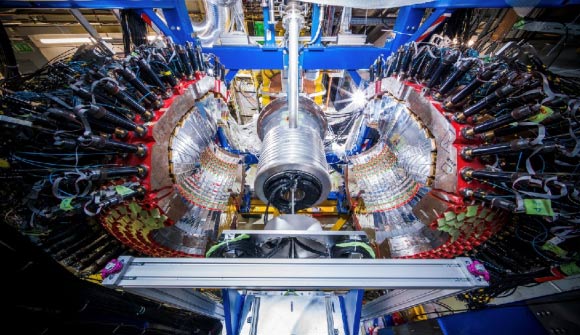
Sekiya et al. have identified evidence of an unusual atomic nucleus configuration at the GSI/FAIR research facility in Germany. Image courtesy of J. Hosan, GSI/FAIR.
“In the realm of physics, a categorization exists for four fundamental forces: gravitation, electromagnetism, the strong nuclear interaction, and the weak nuclear interaction,” stated Professor Kenta Itahashi of RIKEN and the University of Osaka, alongside his collaborators.
“Numerous agglomerations are sustained by these forces. For instance, celestial bodies like the Earth and Moon are gravitationally bound, and within atoms, the electromagnetic force serves to unite the positively charged nucleus with the negatively charged electrons.”
“The atomic nucleus itself is composed of protons and neutrons, which are held together by the strong interaction.”
“Beyond protons and neutrons, each constituting three quarks, other particles are subject to the strong interaction, including a class known as mesons.”
“Certain mesons possess a negative electrical charge,” the physicists elaborated.
“Consequently, in infrequent circumstances, they can supersede electrons within atoms, becoming bound to the atomic nucleus through the electromagnetic force, much like electrons.”
“However, the existence of electrically neutral mesons, such as the η’ meson, is also recognized.”
“Due to its absence of electric charge, its binding to the nucleus cannot occur electromagnetically, but rather exclusively through the strong interaction.”
“Such a state, where the strong force is the sole binding agent, is of particular scientific interest as it permits deductions concerning the characteristics of this fundamental force.”
Scientists had posited the potential existence of a meson-nucleus system, unified solely by the strong interaction, as early as 2005.
Nevertheless, empirical efforts to detect this anomalous state proved unavailing until recent developments.
Professor Itahashi and his research associates conducted their recent investigation utilizing the GSI fragment separator facility in Germany.
“A beam of protons impacts a carbon-12 nucleus at approximately 96% of the speed of light, dislodging a neutron. This neutron then combines with a proton to form a deuteron, which subsequently departs in a forward trajectory,” they elucidated.
“The residual carbon-11 nucleus is propelled into a highly energized state. This acquired excitation energy can manifest as an η’ meson, which, in rare instances, becomes bound to the carbon-11 nucleus, constituting a fleeting quantum state of aggregation.”
The implications of this experimental finding extend significantly beyond the mere confirmation of an exotic nuclear configuration.
Concurrently, it has been observed that the mass of the η’ meson undergoes a reduction when situated within the dense environment of an atomic nucleus.
This discovery significantly contributes to our comprehension of the origins of meson mass: when the masses of the constituent quarks within an η’ meson are aggregated, they account for merely about one percent of the total mass exhibited by a free η’ meson.
“Our research collective intends to undertake a refined follow-up experiment, leveraging a substantially larger volume of observational data, to achieve a more precise determination of the spectroscopic attributes of the bound η’-meson-nucleus system, with a particular focus on its energy levels, binding energy, and decay width,” the researchers stated.
Their published work can be found in the esteemed journal Physical Review Letters.
_____
R. Sekiya et al. 2026. Excitation Spectra of the 12C(𝑝,𝑑) Reaction near the 𝜂’-Meson Emission Threshold Measured in Coincidence with High-Momentum Protons. Phys. Rev. Lett 136, 142501; doi: 10.1103/6vsl-ng7x