On January 7, 2026, the Subaru Telescope yielded observations indicating a notably diminished ratio of carbon dioxide to water, a finding that suggests the intrinsic composition of the interstellar comet 3I/ATLAS underwent transformations as it approached the Sun.
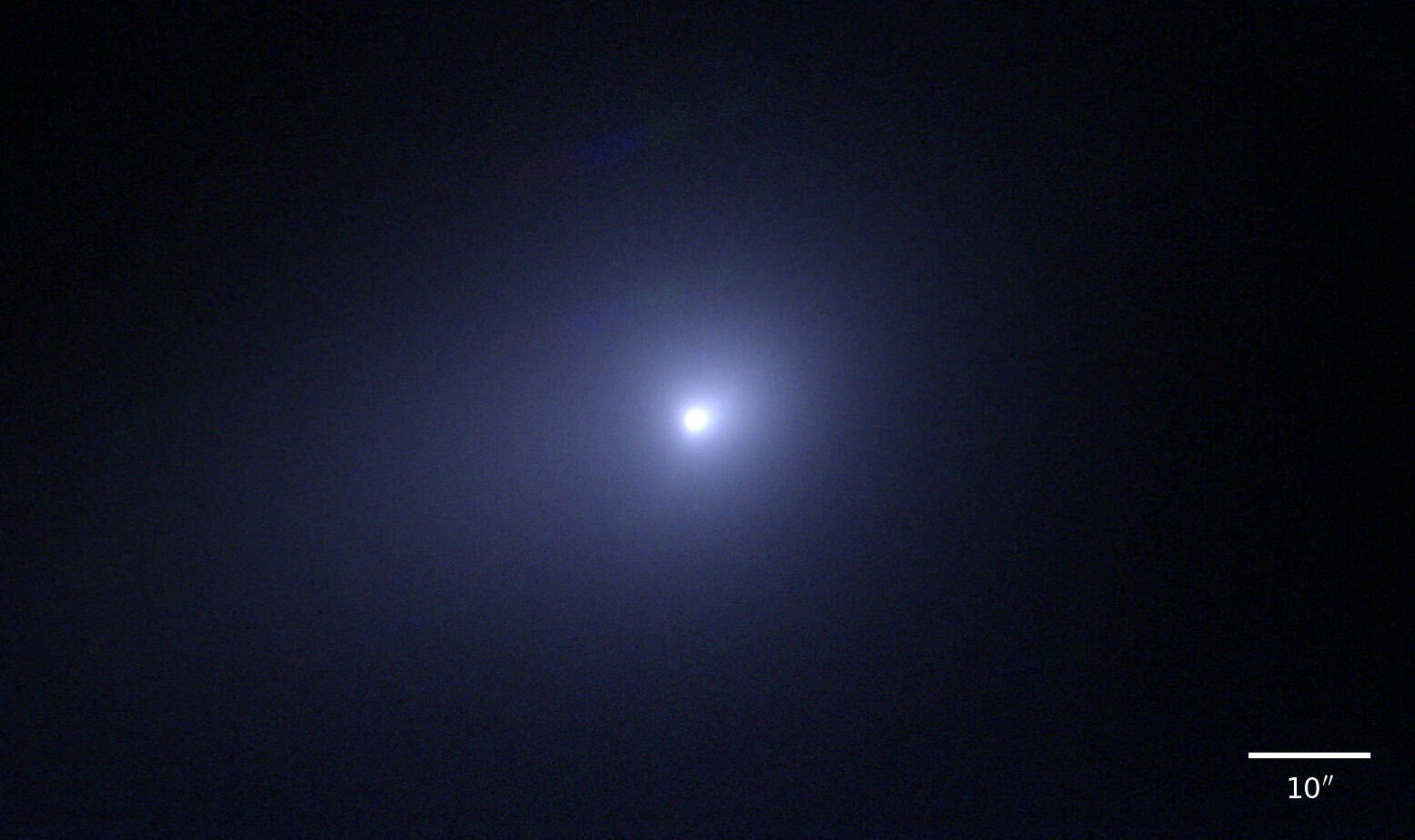
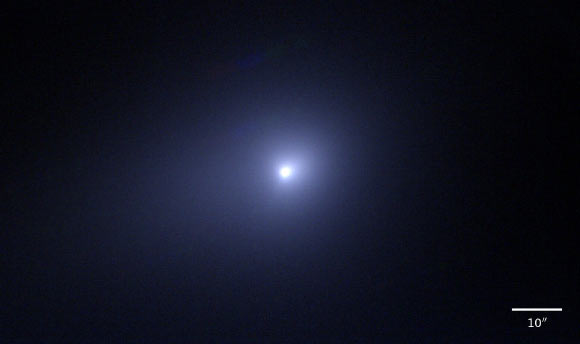
This image from the Subaru Telescope shows the interstellar comet 3I/ATLAS. Image credit: NAOJ.
The celestial body, 3I/ATLAS, was initially detected by the NASA-supported ATLAS survey instrument situated in Rio Hurtado, Chile, on July 1, 2025.
This cosmic interloper, also identified by the designations C/2025 N1 (ATLAS) and A11pl3Z, traversed into our solar system originating from the direction of the Sagittarius constellation.
The comet achieved its perihelion, the point of closest proximity to the Sun, on October 30, 2025.
“The interstellar comet 3I/ATLAS represents the third positively identified object of interstellar origin,” stated Yoshiharu Shinnaka, an astronomer affiliated with the Koyama Space Science Institute, alongside his colleagues from Japan.
“Its presence presents a singular chance to scrutinize the physical and chemical characteristics of icy planetesimals that coalesced within a protoplanetary disk located beyond our Solar System’s boundaries.”
“Since its initial detection on July 1, 2025, by the Asteroid Terrestrial-impact Last Alert System (ATLAS), subsequent observational efforts have swiftly confirmed the manifestation of cometary activity and have delineated the features of the dust coma, thereby providing estimations for the nucleus’s dimensions and the distribution of dust particles.”
Dr. Shinnaka and his collaborators conducted observations of 3I/ATLAS utilizing the Subaru Telescope on January 7, 2026, a period extending over two months past its perihelion passage.
Following this, they applied analytical methodologies and specialized knowledge, honed through the examination of comets within our own solar system, to the acquired data.
Through this detailed analysis, they were able to ascertain the proportion of carbon dioxide to water present in the coma, which is the gaseous envelope surrounding the comet’s core.
The composition of the coma’s gases is understood to directly mirror that of the nucleus itself, thus offering insights into the nucleus’s constituents.
The calculation of the carbon dioxide-to-water ratio derived from the Subaru Telescope’s measurements revealed a lower value compared to the ratios inferred from data gathered by the Webb and SPHEREx space telescopes.
This observed discrepancy aligns harmoniously with the hypothesis that the internal makeup of the nucleus differs from its outer layers, and that as 3I/ATLAS experienced elevated temperatures during its solar transit, gases were released from disparate zones of the nucleus.
“With the full-scale deployment of survey telescopes anticipated in the ensuing years, a considerable increase in the discovery of interstellar objects is projected,” Dr. Shinnaka remarked.
“By adapting the observational and analytical techniques we have cultivated through our research on solar system comets to the study of interstellar objects, we are now empowered to conduct direct comparisons between comets originating from both within and outside the Solar System, thereby investigating disparities in their composition and evolutionary trajectories.”
“Through dedicated investigations of such cosmic entities, our aspiration is to cultivate a more profound comprehension of the mechanisms by which planetesimals and planets have formed across a diverse array of stellar systems, including our own Solar System.”
The research conducted by the team is slated for publication in the Astronomical Journal, with a pre-print available via arXiv.
_____
Yoshiharu Shinnaka et al. 2026. A post-perihelion constraint on the CO2/H2O ratio of interstellar comet 3I/ATLAS from [O I] forbidden lines. AJ, in press; arXiv: 2603.25002