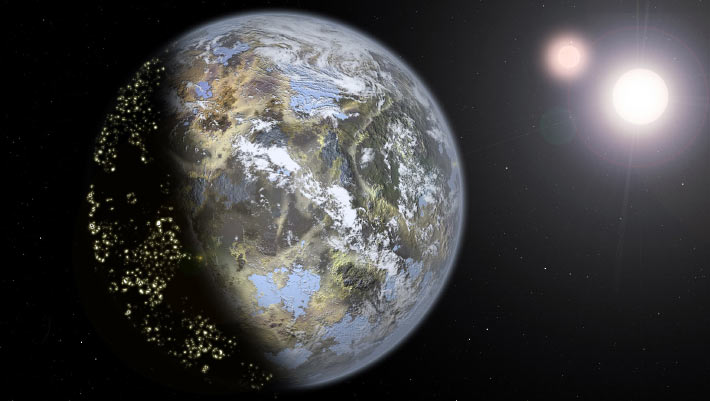
A novel ‘agnostic biosignature’ methodology scrutinizes exoplanetary systems for emergent patterns, positing that extraterrestrial existence might be discernible through its diffusion and subsequent alteration of entire planetary configurations.
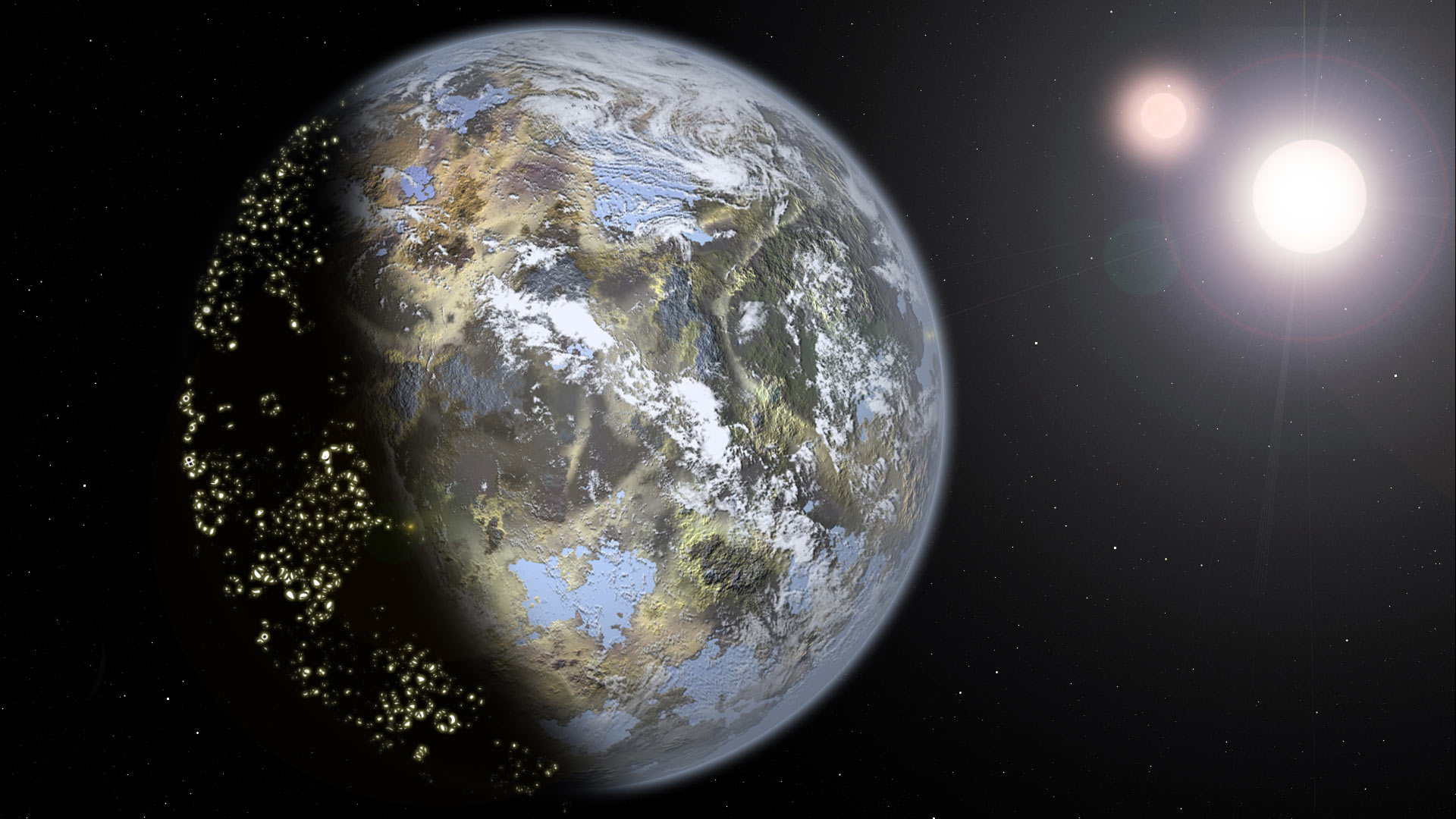
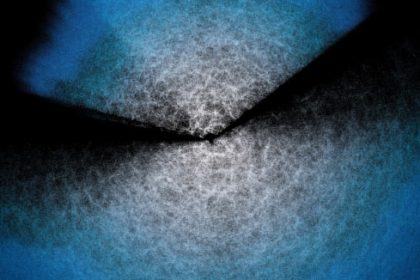
Harrison B. Smith & Lana Sinapayen employed an agent-based computational model to demonstrate that the inter-stellar propagation of life, coupled with its capacity to influence a planet’s observable attributes, could yield a reliable indicator of biological activity, characterized by statistical relationships between planetary features and their cosmic positions, presenting minimal likelihood of erroneous detection. Image credit: Sci.News.
The quest to ascertain the existence of life beyond Earth stands as one of contemporary science’s most profound challenges.
Aside from the laboratory recreation of life’s genesis on our own planet, the principal avenues for investigating alien life involve celestial bodies within and external to our Solar System.
Realistically, the number of locations suitable for the search for extraterrestrial organisms within our immediate cosmic neighborhood is quite limited.
Beyond the confines of our Solar System, the potential arenas for discovery are virtually boundless; however, a significant impediment exists: the difficulty in definitively attributing an exoplanet’s characteristics to the presence of alien life.
Rudimentary spectral biosignatures are prone to generating false positives; conversely, technosignatures mitigate this susceptibility but necessitate substantial presuppositions regarding the nature of potential life and its technological capabilities.
“We explored an entirely distinct concept: rather than focusing our search for life on individual planets, what if we could detect its presence through its aggregated impact across a multitude of celestial bodies?” articulated Dr. Harrison Smith of the Institute of Science Tokyo and Dr. Lana Sinapayen of the National Institute for Basic Biology.
Within their recent publication in the Astrophysical Journal, the researchers introduce an ‘agnostic biosignature’—a novel paradigm that eschews the requirement of precise knowledge concerning life’s composition or operational mechanisms.
Instead, this approach is predicated upon two overarching hypotheses: that life possesses the capability to disseminate between planets (perhaps via mechanisms like panspermia), and that it can instigate transformations in planetary environments over extended temporal scales.
Through the utilization of an agent-based simulation, the scientists meticulously modeled the potential spread of life across stellar systems and its capacity to modify planetary characteristics.
Their findings revealed that when life proliferates and exerts influence on planetary ecosystems, it engenders discernible statistical regularities that correlate planetary positions with their observable attributes.
Critically, these correlations manifest even in the absence of identifying a specific biosignature on any given planet.
In addition to confirming the potential presence of life, the researchers also devised a strategy for pinpointing celestial bodies most likely to harbor it.
By categorizing planets based on their observable attributes and their relative spatial arrangements, they succeeded in isolating clusters of planets exhibiting a high probability of having been affected by biological processes.
This investigative strategy prioritizes veracifiability over comprehensive coverage; it functions to minimize erroneous positive identifications, even if it means potentially overlooking some life-bearing planets.
Such a strategic focus proves particularly advantageous for directing subsequent observational efforts when telescope resources are constrained.
“By concentrating on the dynamics of life’s propagation and its environmental interactions, we can pursue its detection without the necessity of a definitive definition or a singular, conclusive signal,” stated Dr. Smith.
“Even if life elsewhere fundamentally diverges from terrestrial biology, its large-scale consequences, such as its spread and its role in planetary modification, may still leave detectable imprints. This is precisely what renders this methodology so compelling,” Dr. Sinapayen added.
_____
Harrison B. Smith & Lana Sinapayen. 2026. An Agnostic Biosignature Based on Modeling Panspermia and Terraforming. ApJ 1001, 102; doi: 10.3847/1538-4357/ae4ee3