
As a researcher investigating the potential of electrical brain stimulation to enhance human recall capabilities, I frequently encounter inquiries regarding the mechanics of memory and effective strategies for its utilization.
Fortunately, extensive research spanning several decades has yielded substantial insights into both of these fundamental questions.
Fundamentally, memory operates through a tripartite sequence, wherein distinct cerebral regions are instrumental in each phase. The initial phase, sensory memory, captures ephemeral sensory input, such as visual stimuli, auditory signals, and olfactory sensations, persisting only for milliseconds. This raw data is initially processed by the brain’s five primary sensory cortices, which are specialized for different modalities (e.g., the visual cortex for sight, the auditory cortex for sound).
Working memory, also referred to as short-term memory, is responsible for actively retaining and manipulating a confined volume of information over durations ranging from several seconds to a few minutes. This system functions as a cognitive workbench, enabling activities such as mental calculations, adherence to instructions, and comprehension of written material. Consequently, it predominantly engages the prefrontal cortex, the anterior region of the brain associated with attention, decision-making, and reasoning.
Finally, long-term memory facilitates the enduring storage of information, spanning from minutes to an entire lifetime. This encompasses both explicit recollections, which pertain to facts and personal experiences, and implicit memories, which involve learned skills, habitual actions, and emotional associations.
For the consolidation of long-term memories, the hippocampus and temporal lobes – structures situated deep within the brain, laterally adjacent to the temples – play a pivotal role in memories related to facts and life events. Conversely, the amygdala (located near the hippocampus), the cerebellum (positioned at the posterior of the brain), and the basal ganglia (embedded deep within the brain) are crucial for processing emotional and procedural memories.
While working memory often serves as a conscious conduit to long-term memory, it is subject to inherent limitations. In 1956, the American psychologist George Miller proposed that our working memory can typically accommodate approximately seven discrete units of information at any given moment. Although the precise quantity remains a subject of ongoing scholarly debate, the fundamental principle of a finite capacity for working memory persists, significantly influencing the efficacy of learning and recall.
However, individuals can actively enhance the functionality of their memory. The following section outlines five straightforward strategies to bolster both working and long-term memory.
1. Minimize Digital Distractions
The presence of smartphones demonstrably diminishes working memory capacity. Even maintaining a phone in proximity, irrespective of its orientation or silencing, can impair performance on memory and reasoning tasks. This effect arises because a portion of the brain remains engaged in monitoring the device. Resisting the impulse to engage with push notifications expends valuable cognitive resources, leading researchers to sometimes characterize smartphones as a cognitive drain. The most effective solution is straightforward: remove your phone from your immediate environment when concentration is required. Absence indeed liberates mental bandwidth.
2. Cultivate Mental Tranquility
Elevated levels of stress and anxiety consume considerable mental capacity. When preoccupied with worries or assailed by intrusive thoughts, a segment of working memory is perpetually occupied. Relaxation techniques and mindfulness practices have been shown to enhance both working memory performance and academic achievement, likely by mitigating stress. For those who find formal meditation daunting, employing breathwork, such as “cyclic sighing,” can be beneficial. This involves a deep inhalation through the nose, followed by a brief secondary inhalation, and then a slow exhalation through the mouth. Engaging in this practice for approximately five minutes can effectively soothe the nervous system, thereby fostering an optimal environment for learning.
3. Employ Strategic Grouping (Chunking)
Any individual can augment their working memory capacity through the strategic technique of chunking, which involves consolidating information into cohesive, meaningful units. This is a practice many already employ subconsciously to recall phone numbers or lists, by segmenting extended sequences into manageable fragments that the brain can then access as discrete clusters. These principles are equally applicable when delivering presentations, aiming to enhance audience retention of key concepts. Chunking would entail organizing ten case studies, for instance, into three to four overarching themes, each defined by a succinct heading and a singular core takeaway message. Adopt this structured approach on each slide: present one central idea, supported by a few pertinent details, before proceeding. By organizing information into coherent patterns, the cognitive load is reduced, and memorability is enhanced.
4. Engage in Active Recall
In the 19th century, the German psychologist Hermann Ebbinghaus elucidated the rapid rate at which information is forgotten post-acquisition. Within approximately thirty minutes, roughly half of learned material is lost, with further erosion occurring over the subsequent twenty-four hours. Ebbinghaus termed this phenomenon the forgetting curve. The light blue line depicted in the accompanying chart illustrates this principle.
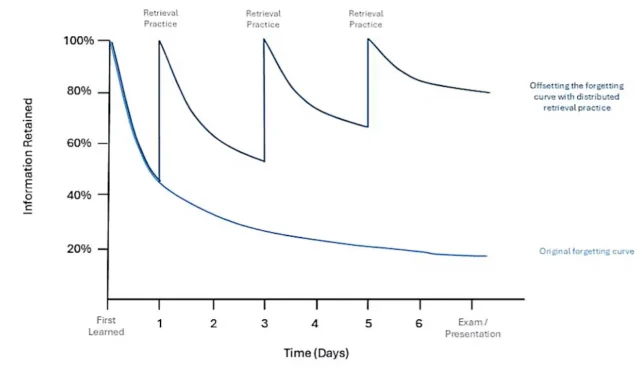
However, a highly effective method exists for enhancing learning and retention when attempting to absorb substantial amounts of information within a compressed timeframe: retrieval practice. When preparing for a presentation or studying for an examination, actively test your recall capacity rather than passively rereading notes. Utilize flashcards, tackle practice questions, or endeavor to articulate the material aloud without recourse to written aids. Memory formation is intrinsically linked to association. Each successful instance of information retrieval establishes a connection between the material and novel prompts, examples, and contextual cues. This process cultivates additional pathways for accessing information, thereby reinforcing each memory trace. Frequently, perceived “forgetting” is not an erasure of memory but rather an inability to access the appropriate retrieval cue.
5. Incorporate Strategic Pauses
Research substantiates that memory consolidation is more efficacious when study or practice sessions are interspersed with periods of rest (spaced learning), as opposed to being concentrated into single, prolonged blocks. When preparing for an examination, integrate substantial intervals of downtime into your revision regimen. The dark blue line on the accompanying chart demonstrates how the strategic spacing of practice sessions can improve long-term retention by modulating Ebbinghaus’s forgetting curve. One study suggests that the intervals between revision sessions should correspond to approximately 10-20% of the time remaining until the exam or presentation deadline. Consequently, if a deadline is five days hence and daily revision sessions are lengthy, it is advisable to incorporate breaks of half a day to a full day between these sessions. In essence, moderation is key; excessive effort may not yield commensurate benefits.
If there is one singular takeaway from this discourse on memory enhancement, it should be this: memory proficiency is not solely an indicator of intellect but is significantly influenced by strategic application. Marginal adjustments in one’s approach to learning or work can effect a profound impact on the acquisition and enduring retention of critical information.–