Leveraging an immense dataset comprising over a billion proton-colliding events meticulously gathered at CERN’s Large Hadron Collider (LHC), scientists have achieved a measurement of the W boson’s mass with unprecedented accuracy. This determined value aligns precisely with the Standard Model’s theoretical projections, reinforcing researchers’ conviction that no unforeseen forces are influencing the experimental outcome.
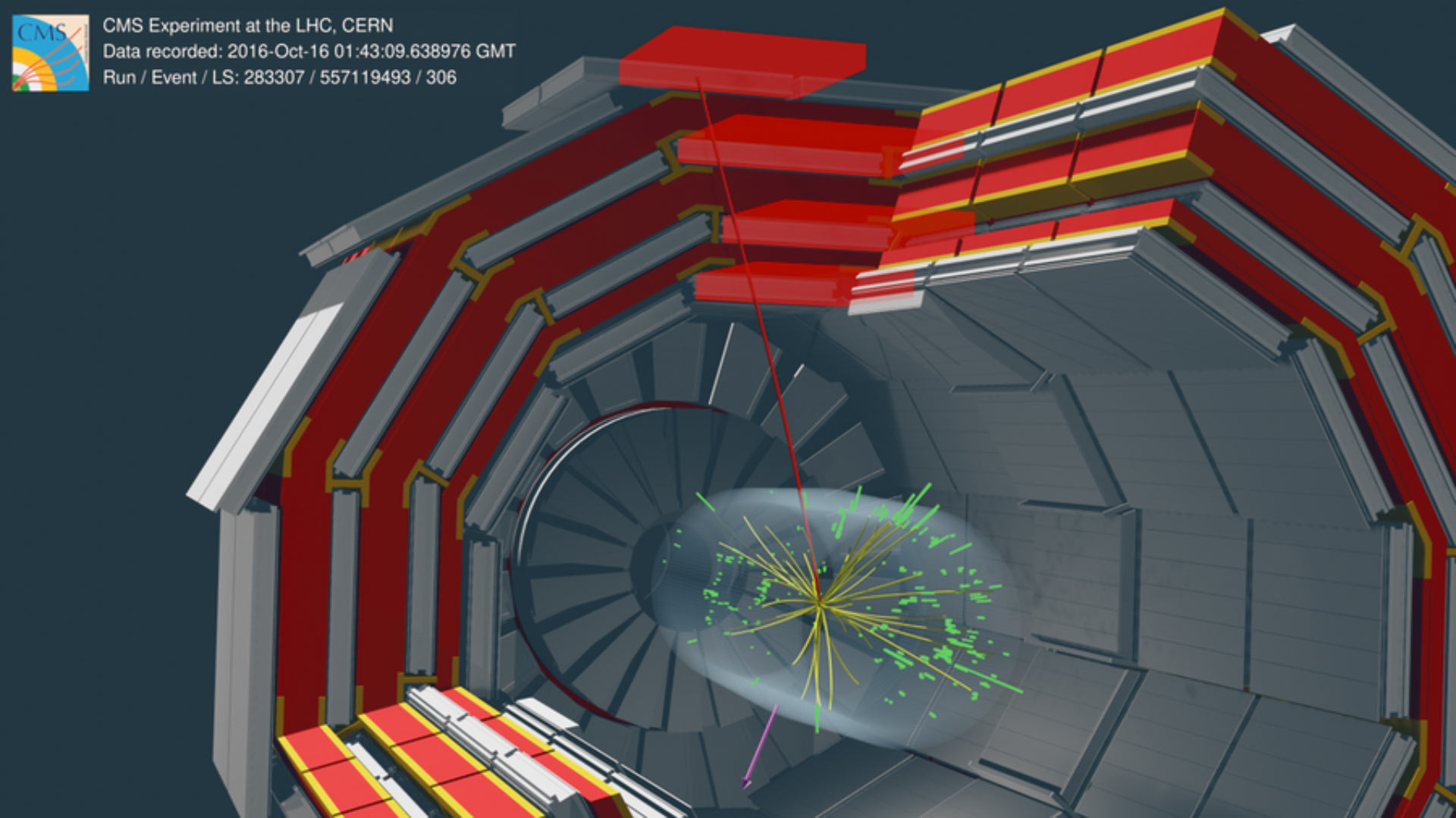
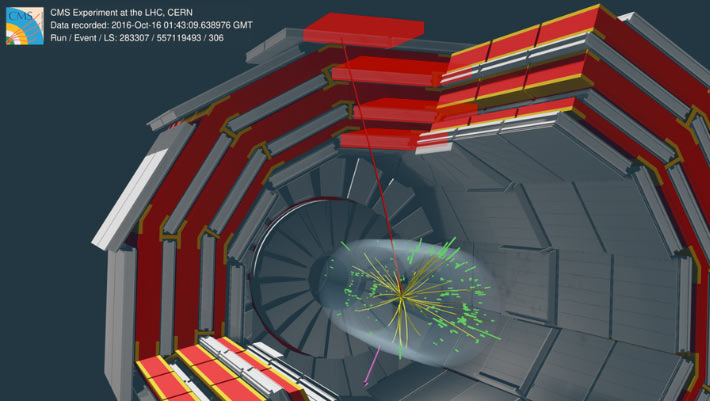
A representative collision event observed by the CMS experiment, illustrating a W boson’s decay into a muon (depicted by a red trajectory) and an undetectable neutrino (represented by a pink arrow). Credit: CMS / CERN.
The W boson, first identified in 1983, stands as one of the two fundamental particles responsible for mediating the weak nuclear force, an essential component of nature’s four fundamental interactions.
This weak force is instrumental in facilitating particle identity transformations, such as the conversion of protons to neutrons and vice versa. Such transformations are the driving mechanism behind radioactive decay and the nuclear fusion processes that energize celestial bodies like the Sun.
Directly observing a W boson is exceedingly challenging due to its rapid disintegration into two distinct particle types, one of which, a neutrino, is so ephemeral that it evades all detection methods.
Consequently, physicists must rely on precisely measuring the other resultant particle, identified as a muon, and employing sophisticated modeling to infer the total mass of its parent particle, the W boson.
For the current investigation, researchers utilized the Compact Muon Solenoid (CMS) experiment, a highly advanced particle detector situated at the LHC. This instrument excels at accurately tracking muons and other particles generated in the wake of proton-proton collisions.
From an aggregate of billions of proton-proton collisions, the research team successfully isolated approximately 100 million events that featured a W boson decaying into both a muon and a neutrino.
Each of these identified events underwent rigorous, in-depth analysis to refine and pinpoint the W boson’s mass with exceptional exactitude.
The finalized determination established the W boson’s mass at 80360.2 ± 9.9 megaelectron volts (MeV).
This newly established mass value is wholly consistent with the theoretical tenets of the Standard Model, which currently represents the preeminent framework for elucidating the fundamental constituents of matter and their interactions.
The precision achieved in this latest measurement is comparable to that of a prior determination conducted in 2022 by the Collider Detector at Fermilab (CDF).
That earlier measurement had presented a deviation from expectations, registering a significantly higher mass than predicted by the Standard Model. This discrepancy had introduced the intriguing possibility of undiscovered physical phenomena, such as novel particles or forces.
Given that the recent CMS measurement demonstrates a comparable level of precision to the CDF result and, crucially, aligns with the Standard Model as well as numerous other experimental findings, it strongly suggests that the current understanding of the W boson’s properties is robust and well-grounded.
“Frankly, this outcome brings immense relief,” commented Dr. Kenneth Long, a physicist affiliated with MIT.
“This updated measurement serves as robust validation of our trust in the Standard Model.”
The comprehensive details of the team’s scientific endeavor were formally presented this month in the distinguished scientific journal, Nature.
_____
CMS Collaboration. 2026. High-precision measurement of the W boson mass with the CMS experiment. Nature 652, 321-327; doi: 10.1038/s41586-026-10168-5