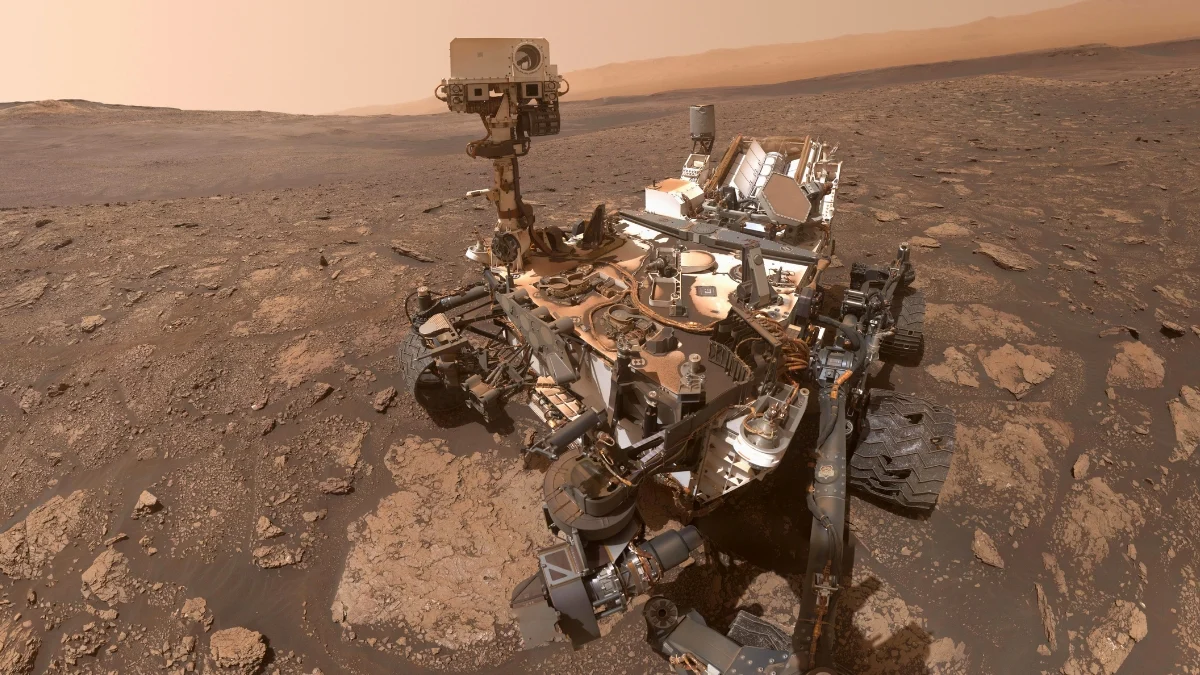
In a significant development, a NASA rover has identified additional fundamental components for life on Mars, following the execution of a pioneering chemistry experiment conducted on another celestial body. Scientists disclosed this information on Tuesday.
The research team, operating under NASA’s auspices, underscored that the discovered organic molecules do not constitute conclusive proof of prior existence of life. They posited that these compounds could have originated on the red planet itself or arrived via meteorite impacts.
Nevertheless, they asserted that this finding substantiates the preservation of these critical indicators of Martian geological history on the planet’s surface for over three billion years.
At that period in time, it is theorized that the Martian landscape was characterized by extensive bodies of water, including vast lakes and rivers, which represent a crucial element for the emergence of life as we understand it.
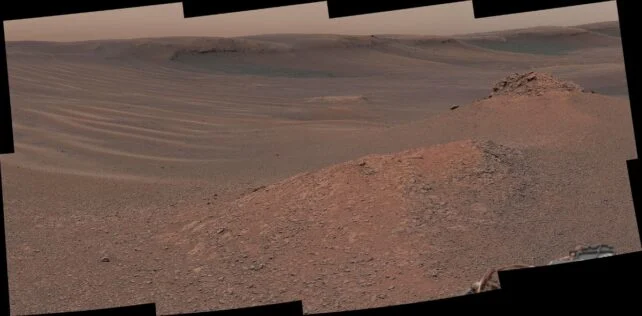
NASA’s Curiosity rover achieved its landing within a region known as Gale crater, a former lakebed, in 2012. Since its arrival, the rover has been actively engaged in the search for evidence suggesting the potential for past life on Mars.
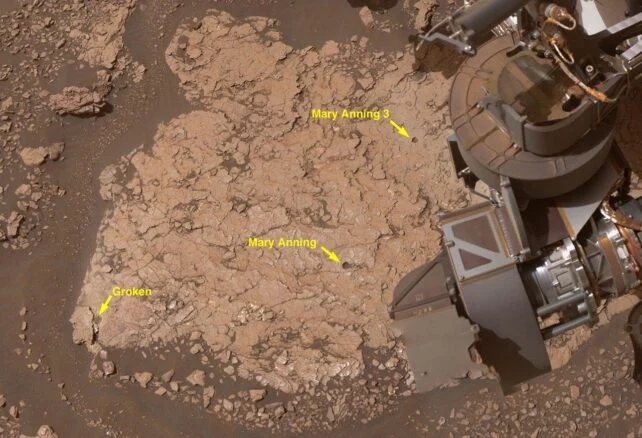
“This particular experimental procedure has never before been implemented on another world,” stated Amy Williams, an astrobiologist contributing to the Curiosity mission, in remarks to AFP.
Williams, the principal author of a recently published study detailing these findings, indicated that the team operated under considerable pressure, knowing they had only “two opportunities to achieve accurate results.”
The experiment, which was carried out in 2020, yielded the identification of over 20 distinct organic molecules, including several that had not previously been definitively detected on Mars.
Among these discoveries was a compound identified as benzothiophene, a substance that has also been found in meteorites and asteroids.
“The identical materials that were deposited on Mars through meteoritic impacts are the same materials that fell upon Earth, and they likely served as the foundational components for the genesis of life on our planet,” Williams remarked.
She further elaborated that another identified molecule, containing nitrogen, functions as “a precursor to the eventual formation of DNA.”
“We are observing the fundamental constituents of life – prebiotic chemistry on Mars – preserved within these ancient rocks over billions of years.”
Future endeavors
However, these discoveries do not serve as definitive proof that life, even in the form of microscopic organisms, once thrived on Mars.
Williams suggested that one avenue for substantiating such an “extraordinary assertion” would involve repatriating Martian rock samples to Earth for more thorough scientific scrutiny.
NASA’s Perseverance rover has already ammassed a collection of rocks earmarked for such an undertaking, referred to as the Mars Sample Return initiative.
Nevertheless, this mission has effectively been suspended subsequent to a vote conducted by the U.S. Congress in January.
The findings from Curiosity, demonstrating the efficacy of experiments employing the TMAH chemical compound on extraterrestrial surfaces, could still inform subsequent space exploration efforts, according to the recent publication in Nature Communications.
The European Space Agency’s Rosalind Franklin rover, distinguished by its significantly more profound drilling capability compared to Curiosity, is slated to transport this chemical agent to Mars.
Following a protracted period of delays, NASA announced last week that the ESA’s rover is now projected for launch to the red planet in late 2028.
This specialized chemical compound will also be integrated into the Dragon rotorcraft payload, which is scheduled for deployment in 2028 on a mission to investigate Saturn’s moon, Titan.