The planet is experiencing a warming trend, and a recent investigation indicates that by the 2090s, nearly a third of the global population may confront a dual threat of heatwaves and arid conditions occurring with fivefold greater frequency.
Scientists from Germany and China focused their study on co-occurring extreme hot and dry events – periods characterized by simultaneous severe drought and intense heatwaves in the same geographical area.
Based on the research team’s predictive modeling and our present trajectory of greenhouse gas emissions, it is projected that 28 percent of the world’s inhabitants, translating to approximately 2.6 billion individuals, will encounter these compounded extremes at least five times more often by the conclusion of this century compared to the mid-century mark.
The confluence of heat and drought exacerbates the repercussions far beyond the impact of either phenomenon in isolation. This includes not only an increase in heat-related fatalities but also amplified risks of wildfires, diminished agricultural yields, and heightened societal and economic volatility.
“Heat and drought mutually intensify each other,” observes Di Cai, a climate scientist affiliated with the Ocean University of China. “When hot and dry conditions converge, they precipitate water scarcity and unpredictable food pricing. For those laboring outdoors, the conditions become perilous.”
The investigative team synthesized data from 152 climate simulations derived from eight distinct climate models. These were utilized within the framework of the Intergovernmental Panel on Climate Change’s (IPCC) Sixth Assessment Report to forecast both population expansion and climate shifts.
Under the current governmental policies, the data suggests a projected temperature increase of 2.7 °C by the year 2100, which is anticipated to drive this elevated occurrence of combined hot and dry extremes. These events were defined by historical records as periods featuring temperatures within the top 10 percent for a given region, coupled with drought conditions classified as moderate or more severe.
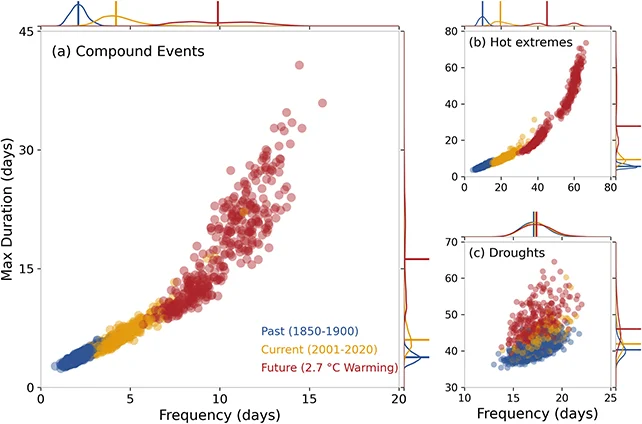
The scientists’ modeling indicates that globally, we can anticipate encountering 2.4 times more simultaneous hot and dry occurrences by the century’s close than we experience presently, with these events potentially persisting for nearly three times longer at their peak duration.
However, the impact of these increases will be unevenly distributed across different regions of the world. Nations situated in tropical zones and lower-income countries, those with the smallest contribution to global warming, are predicted to bear the brunt of these changes.
“There is profound inequity concerning lower-income nations,” states Cai. “Securing funding for air conditioning is challenging. Healthcare provisioning is difficult. When water resources deplete, there is no safety net. This transcends mere climate science; it fundamentally affects day-to-day existence.”
The model simulations unequivocally identified human-induced emissions of greenhouse gases as the principal driver behind the ongoing escalation in global temperatures, which is already intensifying extreme weather phenomena.
“The decisions we make today will have a direct bearing on the daily lives of billions in the future,” emphasizes Cai.
The research highlights an alternative pathway, underscoring the substantial impact that policies focused on emission reduction can achieve.
The analysis revealed that renewed adherence to the 2015 Paris Agreement and the establishment of additional legally binding long-term commitments could lead to a reduction in the number of individuals affected by these compound events by one-third.
Should these pledges be fully enacted, the proportion of the global population exposed to fivefold more frequent hot and dry extremes would decrease from 28 percent to 18 percent, meaning nearly 900 million fewer people would be impacted.
While further in-depth analyses may offer more detailed risk assessments, the researchers assert that their findings “demonstrate the pressing necessity for equitable and immediate climate action that safeguards the most vulnerable populations.”
“When nearly 30 percent of the world’s population is facing such consequences, it represents a critical situation,” comments Monica Ionita, a climatologist at the Alfred Wegener Institute in Germany. “This should compel us to contemplate our future actions with significantly greater depth and consideration.”