
The array of potential advantages associated with GLP-1 medications is continuously expanding, with a recent analysis, primarily based on preclinical research, suggesting a role for these widely utilized diabetes and weight-management drugs in mitigating the molecular precursors of dementia.
This comprehensive examination was conducted by investigators at Anglia Ruskin University in the United Kingdom, scrutinizing 30 previously published studies that involved cell cultures and laboratory animals.
Specifically, the researchers evaluated the impact of four distinct GLP-1 drugs on the detrimental accumulation of amyloid-beta and tau proteins within the brain, which are characteristic markers of Alzheimer’s disease.
Out of the preclinical investigations reviewed, a significant majority—22 in number—indicated a decrease in amyloid-beta plaques, while 19 studies reported a reduction in tau tangles. These aberrant protein aggregates are believed to inflict damage upon and lead to the demise of neurons in Alzheimer’s patients, although alternative causal factors are also being identified.
It is important to acknowledge that substantial further research is required before it can be definitively stated that GLP-1 agents, such as Ozempic and Wegovy, may contribute to a diminished risk of dementia, particularly given that the review only encompassed two small-scale human clinical trials.
Nevertheless, a growing body of evidence derived from cellular and animal models of the condition suggests an undeniable correlation.
“This novel review presents one of the most thorough assessments to date of how GLP‑1 medications interact with the fundamental pathological processes of Alzheimer’s,” observes physiologist Simon Cork.
“Our investigation highlights several biological pathways through which GLP‑1 drugs might exert an influence on Alzheimer’s, including the suppression of inflammation, enhancement of insulin signaling within the brain, and modulation of enzymes implicated in the generation of amyloid‑beta.”
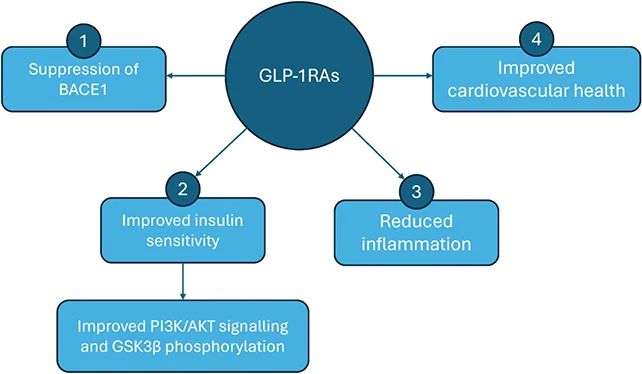
GLP-1 drugs derive their nomenclature from the glucagon-like peptide-1 (GLP-1) hormone, whose actions they effectively mimic. In a technical sense, they function as GLP-1 receptor agonists, engaging the same cellular receptors as the native GLP-1 hormone to elicit comparable physiological responses, such as decelerated gastric emptying, stimulated insulin secretion, and attenuated appetite.
While commonly recognized by proprietary names like Wegovy, Ozempic, and Mounjaro, the critical components are their active pharmaceutical ingredients. The four substances investigated in this review were semaglutide, liraglutide, exenatide, and dulaglutide.
Liraglutide emerged as the most frequently represented active ingredient within the scope of the review and demonstrated the most consistent efficacy in restoring both amyloid-beta and tau levels to within acceptable parameters.
Exenatide exhibited the least pronounced effect across the entirety of the analyzed data; however, it still correlated with reduced amyloid-beta and tau in a subset of the studies.
Two diminutive clinical trials were also incorporated into the examination, yielding inconsistent findings.
Cerebral neuron metabolism was maintained in one trial, and another study documented a reduction in amyloid-beta within extracellular vesicles. Nevertheless, neither trial provided evidence that GLP-1 drugs effectively curbed amyloid-beta deposition in the brain or assisted in averting cognitive decline.
“Although definitive evidence from human trials demonstrating an impact on cognitive deterioration is still absent, the current findings suggest that these medications may possess a prophylactic effect rather than a therapeutic one for individuals with pre-existing cognitive impairment,” explains Cork.
Prior investigations have indicated that individuals undergoing treatment with GLP-1 medications may, in certain circumstances, exhibit a lower incidence of dementia development.
Conversely, other studies focusing on individuals with early-stage Alzheimer’s disease or mild cognitive impairment have produced contradictory outcomes. For instance, a publication from the preceding year found no discernible association between semaglutide administration and a deceleration of cognitive impairment progression.
It is also a well-established fact that both obesity and diabetes—the two primary conditions for which GLP-1 drugs are developed—are independently implicated in the pathogenesis of dementia. Delineating the multifarious mechanisms at play and their subsequent repercussions on dementia risk will necessitate ongoing investigation.
The precise mechanisms by which GLP-1 therapeutics might confer protection against toxic protein accumulation and dementia require further in-depth exploration. The researchers propose that potential contributing factors may include attenuated inflammation, reduced protein synthesis, and ameliorated insulin signaling.
“Given that over three-quarters of preclinical studies have reported reductions in amyloid‑beta or tau, coupled with emerging preliminary findings from human studies, GLP‑1 drugs remain highly promising candidates for future Alzheimer’s prevention trials,” states Cork.
“Subsequent large-scale, early-phase clinical trials are now imperative to ascertain whether these encouraging indicators translate into measurable benefits for patients.”