An anomalous celestial object, detected by NASA’s Chandra X-ray Observatory, might represent a crucial transitional phase, bridging the gap between enigmatic ‘black hole stars’ and fully observable supermassive black holes, thereby illuminating new pathways to understanding the genesis of the earliest colossal black holes.
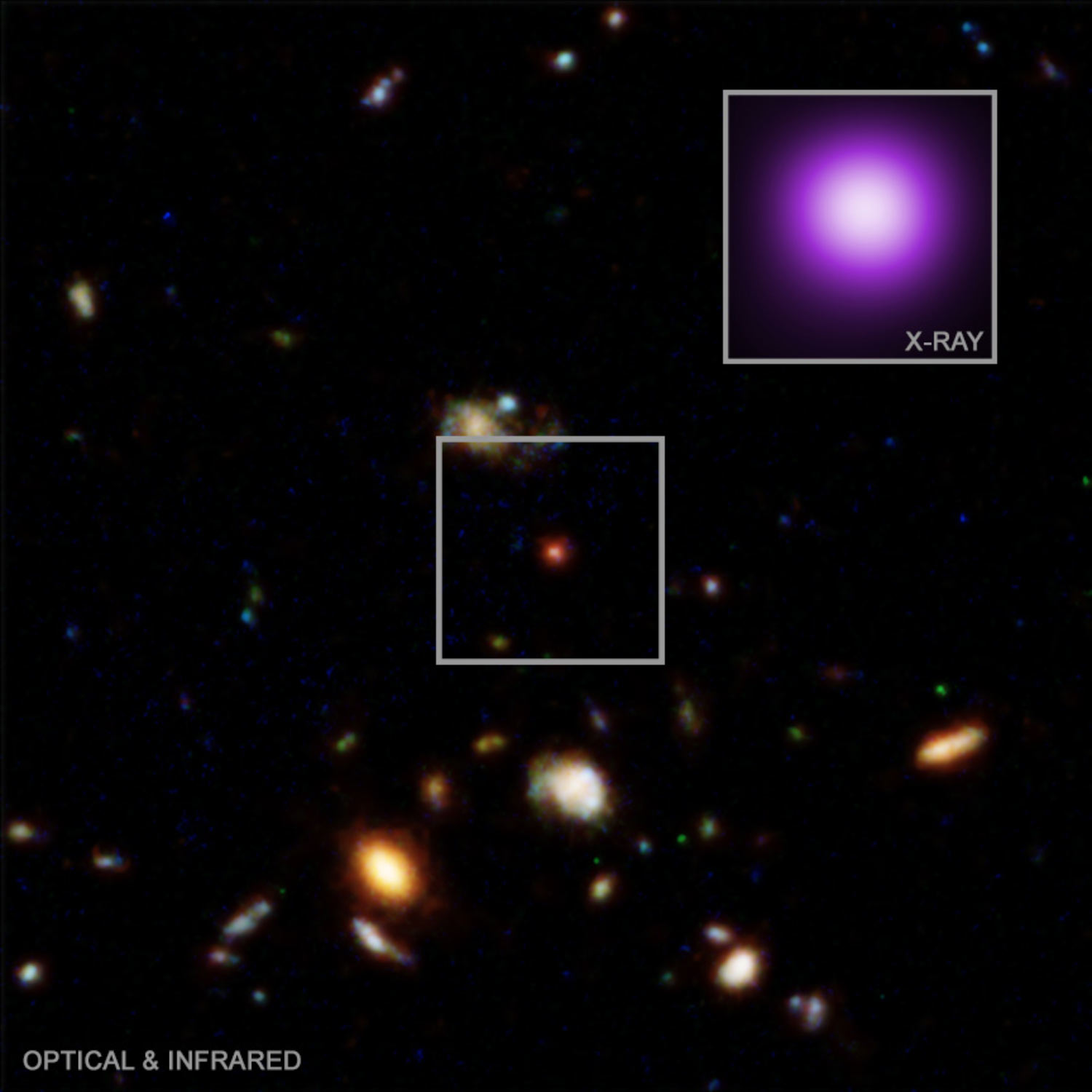
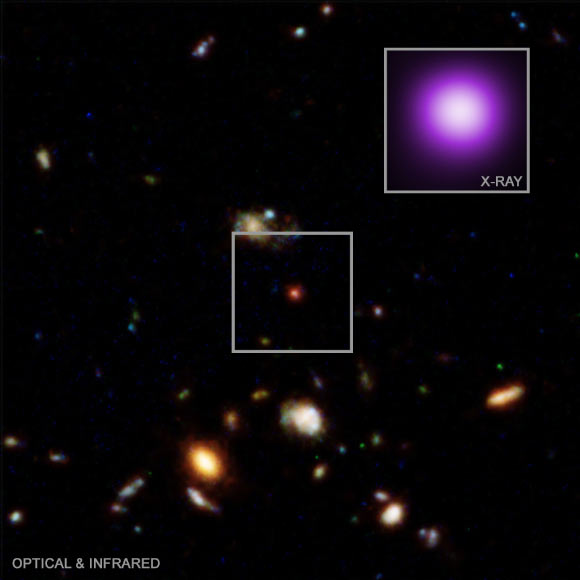
The optical and infrared image from Hubble show the region around the X-ray dot, while the Chandra X-ray image shows the close up. Image credit: NASA / CXC / Max Plank Inst / Hviding et al. / ESA / STScI / HST / CXC / SAO / N. Wolk.
In the nascent stages of the James Webb Space Telescope’s scientific operational period, reports surfaced regarding a novel category of perplexing cosmic entities.
Astronomers identified a multitude of diminutive, reddish celestial bodies situated approximately 12 billion light-years distant from our planet, or even further, which subsequently became categorized as ‘little red dots’ (LRDs).
A significant consensus among many researchers posits that LRDs are actually supermassive black holes enveloped within dense gaseous nebulae, effectively obscuring the tell-tale signatures across various light spectrums, including X-rays, which are typically instrumental in their identification.
This characteristic would distinguish them from conventionally growing supermassive black holes, which are not encased in such dense gaseous shrouds, thus permitting the unimpeded egress of brilliant ultraviolet radiation and X-rays emitted by matter spiraling into the black holes.
Given these attributes and their potential resemblances to stellar atmospheres, the scientific community has dubbed this hypothesis the ‘black hole star’ scenario for LRDs.
The recently pinpointed ‘X-ray dot,’ located at an approximate distance of 11.8 billion light-years from Earth, may serve as a pivotal conduit connecting the ‘black hole star’ concept with conventionally observed, actively accreting supermassive black holes.
Formally designated 3DHST-AEGIS-12014, this object exhibits the predominant characteristics of an LRD, including its diminutive size, reddish hue, and substantial cosmic separation; however, it conspicuously emits X-ray radiation, a trait absent in other identified LRDs.
“For several years, astrophysicists have been endeavoring to ascertain the true nature of these little red dots,” stated Dr. Raphael Hviding, an astrophysicist affiliated with the Max Planck Institute for Astronomy.
“This singular X-ray emitting object might be, to employ a common idiom, the key that allows us to connect all the disparate pieces of evidence.”
The researchers’ discovery of this unique entity was facilitated by a comparative analysis of new data from the Webb telescope and prior, more extensive observations conducted by Chandra.
“If little red dots represent supermassive black holes undergoing rapid accretion, the pertinent question arises: why do they not exhibit X-ray emissions comparable to other such celestial behemoths?” inquired Dr. Anna de Graaff, an astrophysicist associated with the Harvard & Smithsonian’s Center for Astrophysics.
“The identification of a little red dot that deviates from the established pattern offers us invaluable new insights into the energetic processes that might be driving them.”
The investigative team proposes that the X-ray dot signifies a transitional evolutionary stage, moving from an LRD classification to that of a typical, actively growing supermassive black hole.
As the central black hole accretes surrounding gas, intermittent voids or openings begin to form within the gaseous envelope.
This perforation permits X-rays originating from matter plunging into the black hole to escape, subsequently being registered by the Chandra observatory.
Ultimately, once all available gas is consumed, the state of a ‘black hole star’ ceases to manifest.
Further analysis of the Chandra data pertaining to the X-ray dot also indicates fluctuations in its X-ray luminosity, lending credence to the hypothesis that the black hole is partially obscured.
As the surrounding gas cloud undergoes rotation, variations in density – pockets of more or less concentrated gas – can traverse the path of the black hole, inducing perceptible alterations in X-ray brightness.
“Should we validate the X-ray dot as a little red dot undergoing a transition, it would not only represent a groundbreaking discovery of its kind but might also afford us our first direct glimpse into the innermost regions of an LRD,” remarked Dr. Hanpu Liu, an astrophysicist at Princeton University.
“Furthermore, this would provide the most compelling evidence to date that the evolutionary trajectory of supermassive black holes lies at the core of a portion, if not the entirety, of the little red dot population.”
An alternative theoretical framework proposed for the X-ray dot suggests it might be a more conventional type of growing supermassive black hole, but one concealed by an uncommon variety of interstellar dust previously unencountered by astronomers.
Future observational campaigns are scheduled, which are anticipated to yield definitive clarifications of its true nature.
“The X-ray dot had remained within our Chandra survey archives for over a decade, yet its remarkable significance remained unrecognized until the advent of the Webb telescope’s observations of that celestial field,” explained Dr. Andy Goulding, also from Princeton University.
“This instance serves as a potent illustration of synergistic collaboration between two exceptional astronomical observatories.”
The findings stemming from this investigation are formally documented in a publication within the esteemed Astrophysical Journal Letters.
_____
Raphael E. Hviding et al. 2026. The X-Ray Dot: Exotic Dust or a Late-stage Little Red Dot? ApJL 1000, L18; doi: 10.3847/2041-8213/ae4c88