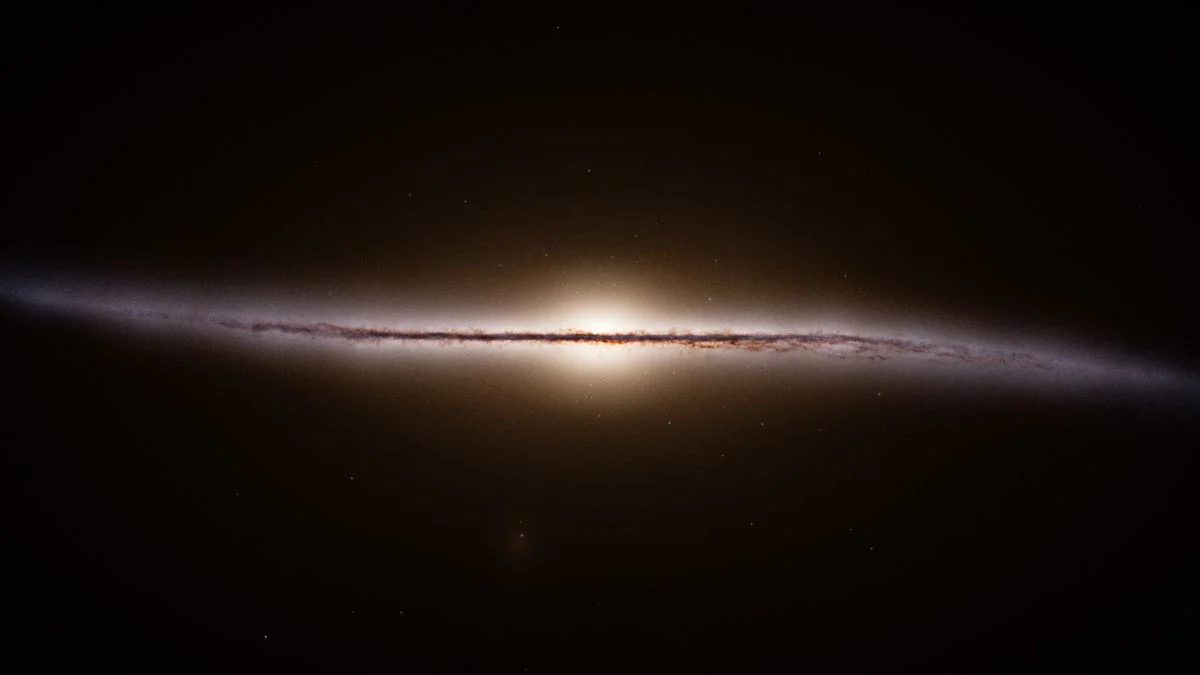
Precisely locating the perimeter of the Milky Way presents a more intricate challenge than initially perceived.
Our inherent position within the galaxy poses an immediate difficulty in discerning its boundary. Furthermore, the very definition of this “edge” is complex, as the galaxy progressively diminishes in density with increasing distance from its core.
A recent academic publication, authored by a team of investigators initially affiliated with the University of Malta, proposes a definitive answer.
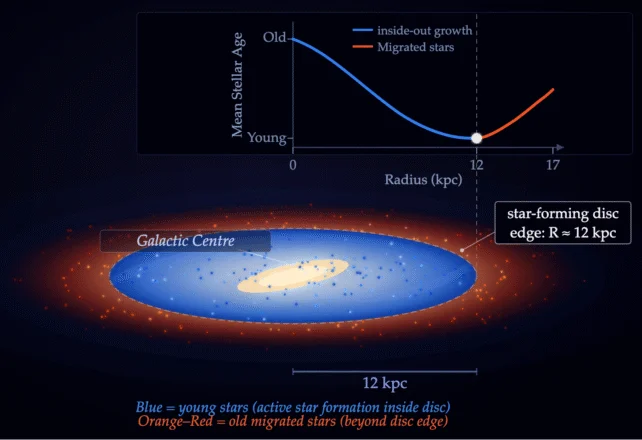
This boundary can be demarcated by the region where star formation occurs. In their research, disseminated within the journal Astronomy & Astrophysics, they unequivocally establish this “edge” to lie between 11.28 and 12.15 kiloparsecs from the galactic center, equivalent to approximately 40,000 light-years.
Even achieving this delineation proved to be a formidable undertaking.
The researchers meticulously examined the stellar ages of over 100,000 stars classified as giants, drawing upon data from numerous observational surveys, including APOGEE-DR17, LAMOST-DR3, and Gaia.
Their analysis uncovered a compelling narrative regarding the evolutionary trajectory of stellar positions within the galaxy in relation to their age.
This observed correlation conforms to a U-shaped curve. In this representation, the vertical axis denotes stellar age, while the horizontal axis indicates the distance from the galaxy’s nucleus.
In straightforward terms, this signifies that stars situated nearer to the galactic core are the most ancient. Their age progressively decreases as one moves outward up to a specific point, beyond which they begin to increase in age again.
This pivotal “specific point,” as identified by the study’s authors, signifies the terminal boundary of the galaxy’s star-forming activity, and consequently, its perceived “edge.”
The rationale behind this U-shaped age distribution is multifaceted.
In proximity to the supermassive black hole at the galactic center, a greater abundance of gas and dust facilitated earlier stellar genesis, resulting in the presence of older stars.
At greater distances from the core, the distribution of gas and dust becomes more diffuse. Consequently, the gravitational forces that ultimately lead to the formation of stars operate at a reduced pace. This results in stars becoming progressively younger as one approaches the defined “edge.”
However, the phenomenon observed beyond this boundary—the continued presence and indeed renewed aging of stars—warrants explanation.
The prevailing hypothesis posits that the outer regions, situated beyond the galaxy’s established “edge,” are inhabited by stars that originated within the active star-forming zone but were subsequently displaced outwards due to various cosmic events.
The research highlights two primary mechanisms responsible for this stellar migration: the influence of gravitational perturbations exerted by the galaxy’s spiral arms, and the disruptive effect of the central galactic bar, which can effectively eject stars from the primary star-forming environs.
Therefore, while the inner sectors of the Milky Way are characterized by stellar populations of considerable age, the outer regions also host ancient stars, having migrated there over eons.
The existence of a distinct cessation of star formation approximately 40,000 light-years from the center is attributed to three key factors identified in the study.
Firstly, the Outer Lindblad Resonance associated with the galaxy’s central bar can impede the flow of gas, confining it to the inner galactic regions.
Secondly, a phenomenon known as a “galactic warp” in the galactic plane at this particular distance causes further dispersion of available gas over a more expansive area.
A third potential explanation suggests that the interstellar gas itself may become too attenuated to undergo the necessary cooling and accretion processes required for star formation.
These revelations carry significant implications for our understanding of the Milky Way’s structure and evolution.
This research definitively categorizes the Milky Way as a Type-II (down-bending) disc galaxy, a classification shared by approximately 60% of comparable galaxies observed within the local universe.
More profoundly, however, this work enhances our comprehension of the broader narrative of the Milky Way’s development.
We can now clearly delineate the conclusion of the Milky Way’s period of prolific star formation and the commencement of its more expansive and quiescent outer regions.
This newfound clarity fosters a deeper sense of connection to our galactic neighborhood, regardless of the age of its constituent celestial bodies.
This article was originally disseminated by Universe Today. Access the original publication.