Geologists possess an extensive understanding of ancient coastal environments and shallow marine ecosystems—encompassing their paleoecology, resident fauna, weather seasonality, and even the precise temporal resolution of preservation—all thanks to the intricate structures formed when sand particles are consolidated by microbial activity, creating formations identified as microbial mats.
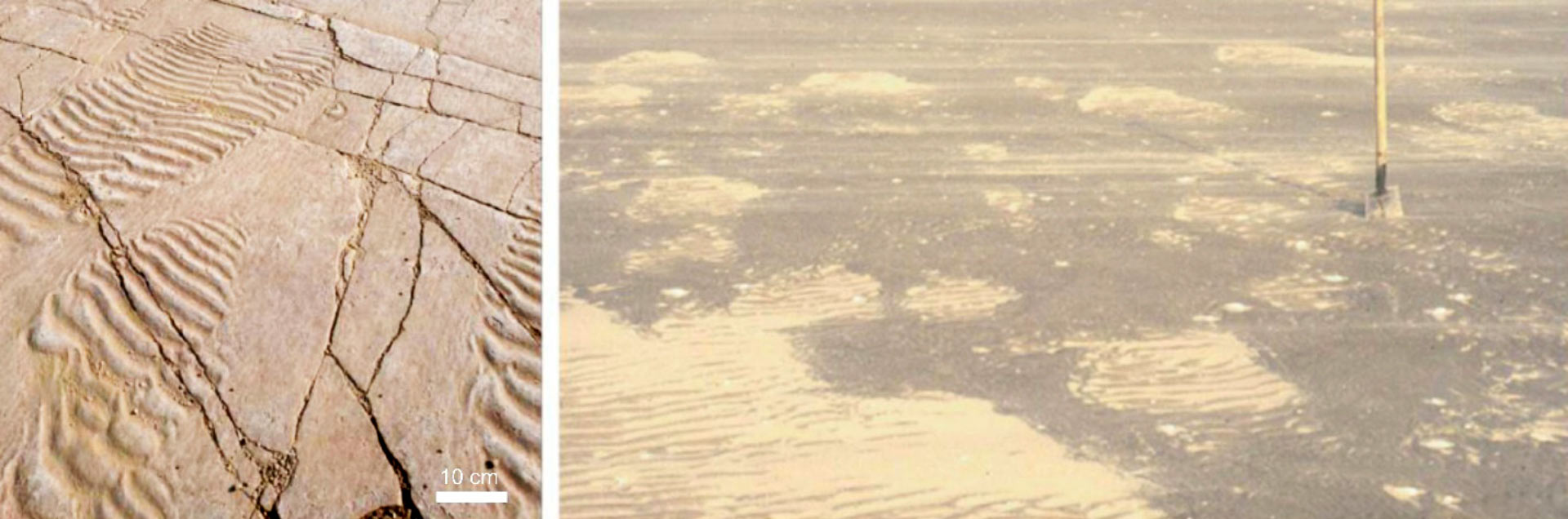
A planar microbial mat exhibiting scour marks resembling ripple patterns on a tidal flat from the Cambrian period (left) compared to its modern counterpart (right). The image is credited to Nora Noffke.
What are frequently disregarded as mere ‘pond scum’ are, in reality, these gelatinous aggregations of microorganisms and sand that serve as the pivotal agents in preserving the sedimentary evidence of bygone eras.
Within the historically significant Cambrian Blackberry Hill locality in Wisconsin, USA, these microbial mats were instrumental in transforming the ancient tidal flats, preserved as quartz sandstone, into exceptional sites for fossil trace production.
By cohesive binding of loose sand grains, these mats established a stable substrate capable of capturing the subtle impressions left by soft-bodied organisms such as jellyfish (scyphozoans), the distinctive feeding patterns of ancient mollusks ‘plowing’ through the sediment, the faint tracks of extinct arthropods, and other indications of faunal locomotion.
Absent this biogenic cementing agent, the dynamic forces of shifting tides and tempestuous storms characteristic of the Cambrian inland sea would have inexorably obliterated these trackways and trails, much like the ephemeral nature of sandcastles subjected to oceanic waves.
The paleontological findings unearthed at Blackberry Hill have yielded profoundly important insights into the behavioral ecology of organisms inhabiting tidal flats approximately half a billion years ago.
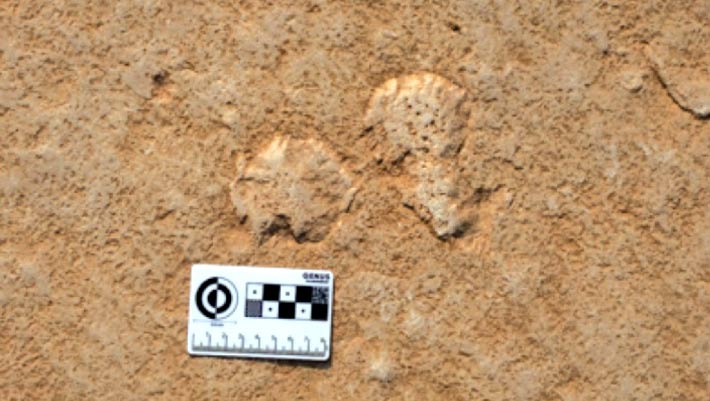
These exceptionally preserved mats provided documentation of a trackway that ultimately facilitated the identification of the creature responsible—an early euthycarcinoid named Mosineia—responsible for some of the earliest terrestrial locomotion traces (Protichnites), a long-standing paleontological enigma for over 150 years.
Furthermore, they enabled researchers to deduce that arthropods, possessing greater agility than their more robust mollusk counterparts, were capable of traversing higher intertidal zones in pursuit of supplementary nourishment, potentially engaging in scavenging activities.
Large, gastropod-like mollusks, some comparable in size to an adult human’s foot and occasionally reaching lengths of up to a meter, grazed upon these microbial mats, generating distinct trails classified as Climactichnites, which indicates that this ‘scum’ constituted a primary attractant, drawing marine life into the intertidal realm (defined as the transitional zone between high and low tide along a coast).
By rapidly colonizing and encasing these traces, the microbial mats frequently served to shield them from obliteration by protective insulation against disruptive tidal currents and storm surges. This preservation mechanism has furnished a detailed archival record of faunal activities, and even the ‘death traces’ (mortichnia) of organisms that struggled to subsist amidst a rapidly fluctuating environmental context.
The presence of microbial mats within the geological strata also conveyed valuable information about prevailing environmental conditions and occurrences, such as seasonal fluctuations and sporadic tempestuous events. Evidence of ancient storms is manifested by centimeter-scale fragments of microbial mats that were dislodged and inverted. While thick mats are too robust to register detailed traces, only their thinner, more pliable counterparts are capable of effectively recording such imprints.
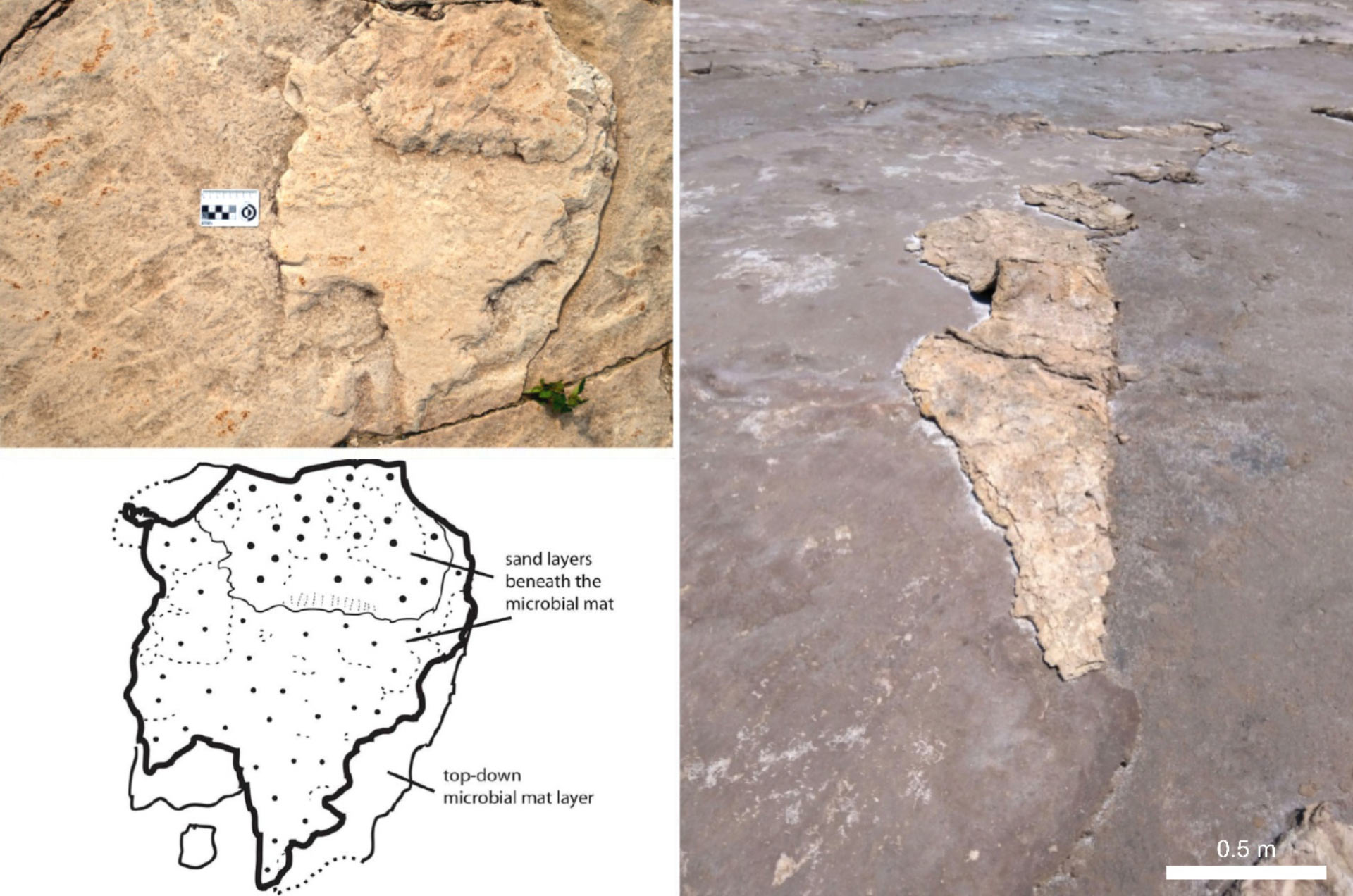
A substantial, inverted section of a microbial mat discovered on a Cambrian (left) and contemporary (right) beach. Observe the presence of Climactichnites trails adjacent to the measurement scale in the left image. Photographed by Nora Noffke.
Moreover, fragments of these mats, known as mat chips, detached and became preserved, particularly towards the conclusion of the growth cycle, when the microbial colonies began to undergo disintegration.
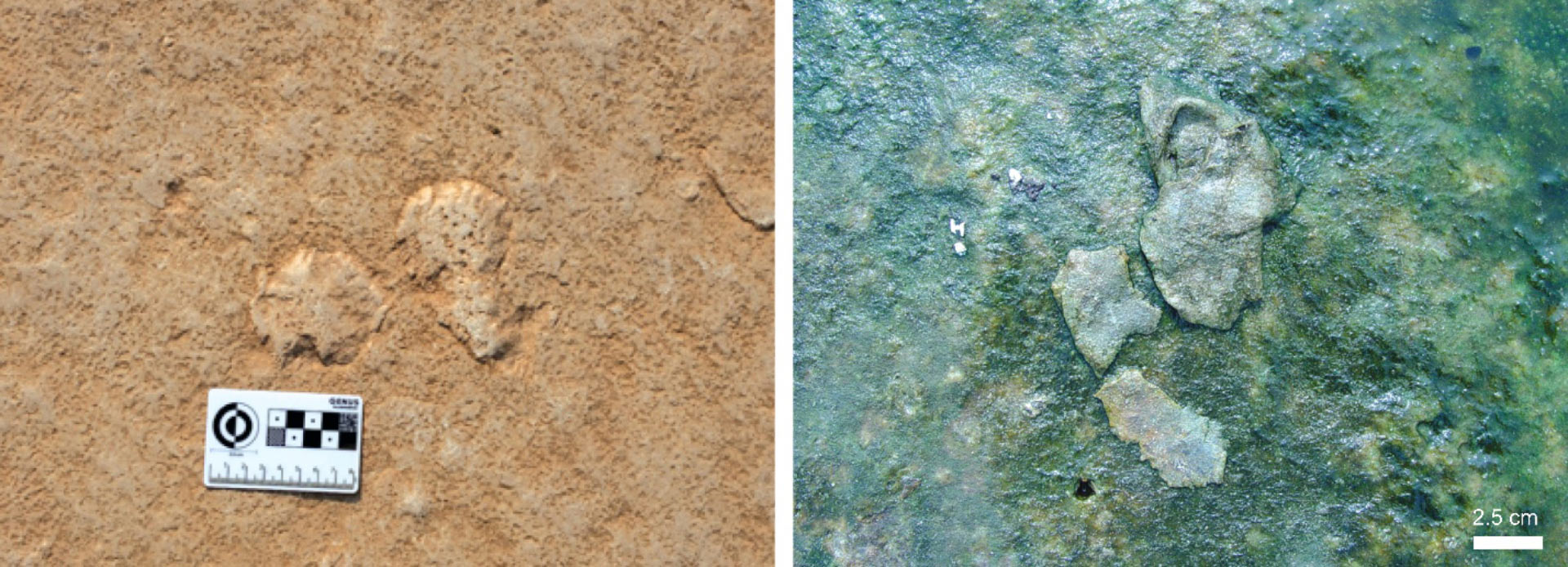
Dispersed microbial mat fragments observed on a tidal flat surface dating from the Cambrian period (left) and on a modern-day tidal flat (right). The image is attributed to Nora Noffke.
“Presently, extensive systems of microbial mats are flourishing in the tidal flats and lagoons that fringe Earth’s continental margins,” stated Nora Noffke, a Professor at Old Dominion University and the principal investigator for a research publication featured in the journal Palaios.
“These contemporary mats exhibit the same developmental stages, degrees of fragmentation, and desiccation as those documented at Blackberry Hill.”
“Without their preservative influence, our comprehension of past life and Earth’s historical occurrences would remain largely obscured by the erosive effects of ancient currents, wave action, and the passage of time.”
_____
N. Noffke & K.C. Gass. 2026. Microbial mat facies in Cambrian tidal flats and implications for the trace fossil record (Elk Mound Group, Wisconsin, USA). Palaios, p. 74-90; doi: 10.2110/palo.2025.042