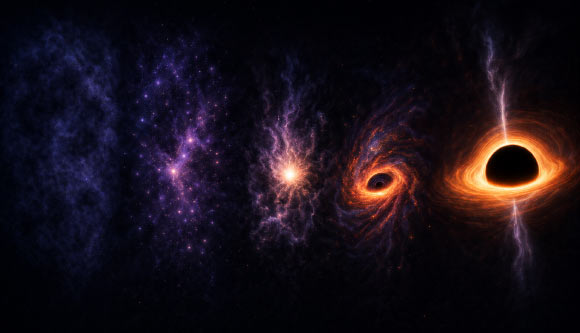
Recent investigations conducted by cosmic researchers affiliated with the University of California, Riverside, Sam Houston State University, and the University of Oklahoma propose that the disintegration of dark matter may have been the catalyst for the accelerated contraction of primordial gas formations, thereby facilitating the genesis of supermassive black holes at a significantly earlier epoch than previously theorized.
“Our research indicates that the process of decaying dark matter could fundamentally reconfigure the developmental trajectory of the universe’s initial stars and galaxies, resulting in pervasive cosmological repercussions,” stated Yash Aggarwal, a graduate student at the University of California, Riverside.
“Given that the James Webb Space Telescope is currently unveiling an abundance of supermassive black holes within the primordial cosmos, this proposed mechanism might serve to reconcile the discrepancies between existing theoretical frameworks and observational data.”
Aggarwal and his research associates have evidenced that if dark matter—the enigmatic constituent comprising 85% of the universe’s matter and instrumental in galactic formation—undergoes decay, it can effectively release a minute quantity of its energy into surrounding gas, thereby accelerating the rate of direct collapse.
The energy contribution required from each decaying dark matter particle is remarkably small, equivalent to approximately one billion trillionth of the energy contained within a standard AA battery.
“The nascent galaxies were fundamentally agglomerations of unadulterated hydrogen gas, characterized by a chemical sensitivity that is extraordinarily susceptible to energy infusions at the atomic scale,” commented Dr. Flip Tanedo from the University of California, Riverside.
“These are precisely the properties sought after in a dark matter detector; consequently, the supermassive black holes observed today could potentially represent the signatures of such ‘detectors’.”
Within the scope of their investigation, the astronomers undertook the modeling of the thermochemical dynamics of gas masses subjected to the influence of decaying axions.
Their findings indicated that a specific range of dark matter masses, falling between 24 and 27 electronvolts, could establish the requisite conditions for seeding direct collapse black holes.
“This collaborative endeavor originated from a confluence of fortunate circumstances that brought together the pertinent specialists at an opportune moment, including a series of symposia designed to foster dialogue among particle physicists, cosmologists, and astrophysicists regarding the significant unresolved queries in their respective disciplines,” Dr. Tanedo remarked.
“We have substantiated that the presence of a suitable dark matter environment can substantially elevate the probability of the phenomenon known as direct collapse black holes occurring.”
“In a similar vein, the endorsement of interdisciplinary collaboration was instrumental in facilitating the fortunate alignment of factors that led to this research.”
The research paper detailing these findings was formally published on April 14, 2026, in the esteemed Journal of Cosmology and Astroparticle Physics.
_____
Yash Aggarwal et al. 2026. Direct collapse black hole candidates from decaying dark matter. JCAP 04: 034; doi: 10.1088/1475-7516/2026/04/034