A novel genus and species of hyperodapedontine rhynchosaur, an extinct group of herbivorous reptiles possessing beaks, has been identified by Brazilian paleontologists. This groundbreaking discovery is based on a partial skull and lower jaw fragments retrieved from rock formations dating back to the Triassic period. Designated Isodapedon varzealis, this species seemingly represents an isolated evolutionary offshoot within a lineage previously believed to exhibit limited diversity.
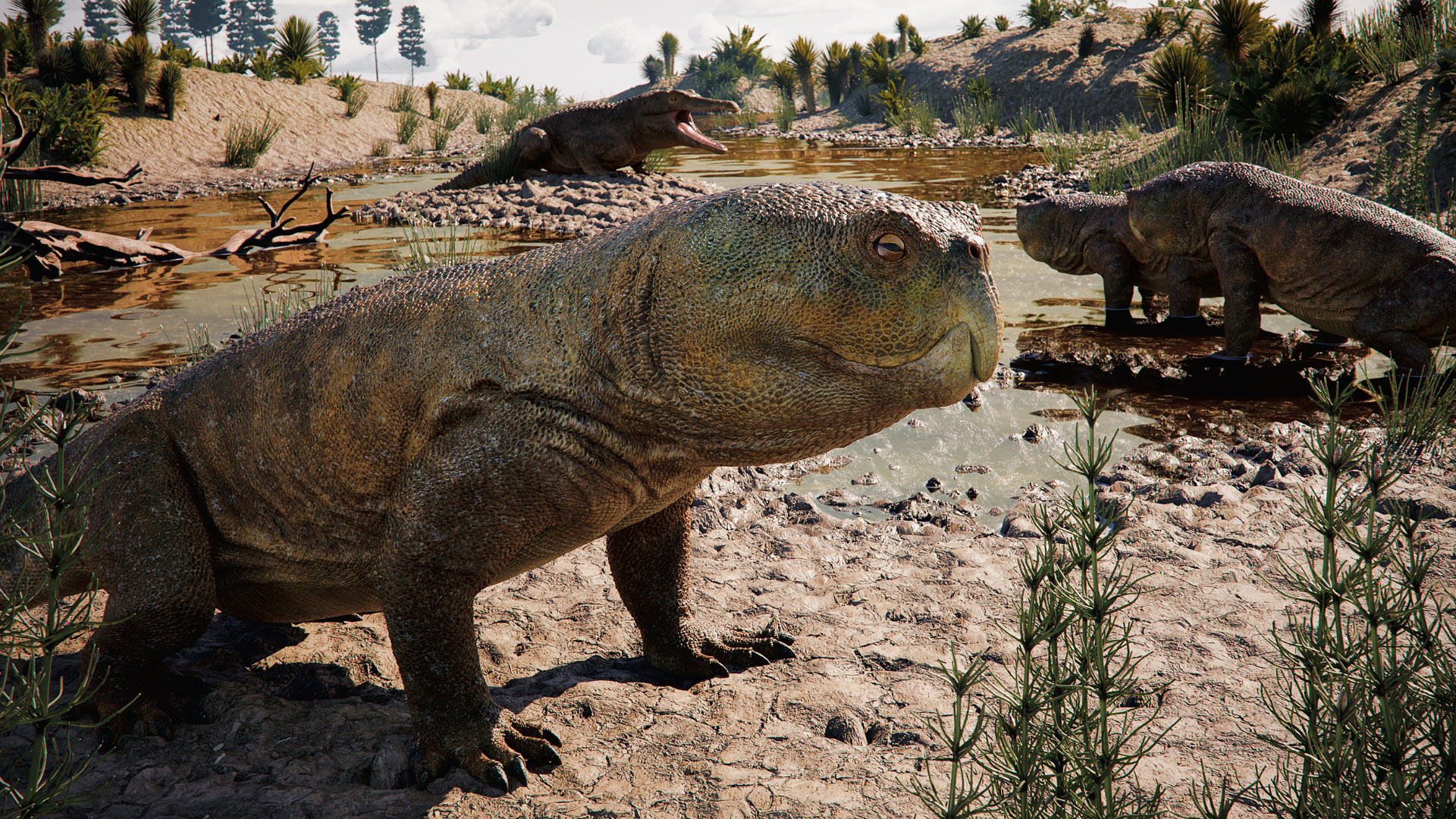
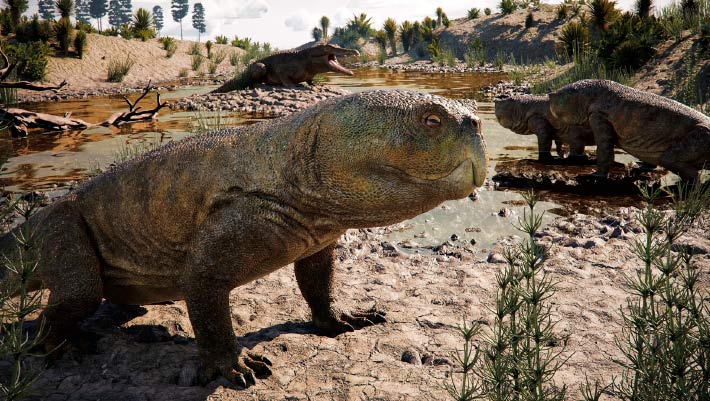
An artistic representation of a Late Triassic landscape of southern Brazil depicting individuals of Isodapedon varzealis in the foreground and a proterochampsid in the background. Image credit: Caio Fantini.
Rhynchosaurs were among the most prevalent herbivores of their era, having dispersed across a significant portion of the supercontinent Pangea and, in certain localities, constituting the overwhelming majority of fossilized vertebrate remains.
Their highly specialized masticatory structures, characterized by a horny beak and parallel rows of grinding teeth, facilitated the consumption of hardy flora, enabling them to thrive in terrestrial environments.
“Rhynchosauria, an early diverging clade within Archosauromorpha, is represented by several species distributed mainly during the Middle and Late Triassic, though their origin dates back to the Early Triassic,” stated paleontologist Jeung Hee Schiefelbein from the Universidade Federal de Santa Maria, alongside his research collaborators.
“Rhynchosaurs spanned nearly the entirety of Pangea, and their fossil record extends across several present-day regions, including Brazil, Argentina, Canada, the United States, Zimbabwe, Tanzania, South Africa, Madagascar, India, England, and Scotland.”
“By the Late Triassic, rhynchosaurs achieved a nearly global distribution, playing a significant role as primary consumers in terrestrial ecosystems.”
“Owing to their abundance, especially in Late Triassic units, rhynchosaurs are also vital biostratigraphic markers, with rhynchosaurs making up to 90% of the vertebrate fossils in some outcrops.”
The type specimen, or holotype, of Isodapedon varzealis was discovered at the Várzea do Agudo paleontological site in the Brazilian state of Rio Grande do Sul.
This fossil deposit is estimated to be approximately 230 million years old, placing it within the Carnian stage of the Triassic period.
A distinctive characteristic of the upper jaw of Isodapedon varzealis is the presence of bilaterally symmetrical tooth-bearing surfaces, a feature uncommon among its relatives. Furthermore, an exceptional arrangement of the lower jaw suggests a unique feeding mechanism compared to other identified rhynchosaurs.
A comprehensive phylogenetic analysis has positioned this species outside the previously identified South American members of its subgroup, known as hyperodapedontines.
These discoveries cast doubt on the conventional taxonomy of these reptiles and advocate for a more restrictive definition of the well-established genus Hyperodapedon, confining it to its original type species.
The research findings also indicate a more extensive and intricate evolutionary diversification of rhynchosaurs than was previously understood.
Closely related forms appear to have undergone significant dispersal throughout southwestern Gondwana—the southern component of Pangea—while retaining relatively consistent morphological characteristics.
“Isodapedon varzealis’ unique combination of craniomandibular characters, including symmetrical maxillary tooth-bearing areas and autapomorphic dentary features, distinguishes it from contemporaneous species such as Macrocephalosaurus mariensis and Hyperodapedon sp.,” the research team reported.
“These differences probably reflect divergent ecological strategies within a diverse herbivorous guild, which could indicate niche partitioning during a time of dynamic environmental and floral changes associated with the Carnian Pluvial Episode.”
“Moreover, its affinities with early diverging hyperodapedontines from Argentina and possibly Zimbabwe point to a broad, morphologically conservative radiation across southwestern Gondwana, highlighting ecological stability before the emergence of more derived and geographically restricted lineages.”
A scientific publication detailing this discovery was released on April 15 in the journal Royal Society Open Science.
_____
Jeung Hee Schiefelbein et al. 2026. A new hyperodapedontine rhynchosaur from a cynodont-dominated site (Upper Triassic) of southern Brazil. R Soc Open Sci 13 (4): 260176; doi: 10.1098/rsos.260176